| Welcome, Guest |
You have to register before you can post on our site.
|
| Online Users |
There are currently 9 online users.
» 0 Member(s) | 5 Guest(s)
Applebot, Baidu, Bing, Google
|
| Latest Threads |
Poussin's Shepherds
Forum: Alchemical symbolism and imagery
Last Post: Paul Ferguson
10-15-2026, 08:52 AM
» Replies: 0
» Views: 45
|
William of Conches: Dialo...
Forum: Reviews and book notices
Last Post: Paul Ferguson
10-15-2026, 08:41 AM
» Replies: 0
» Views: 46
|
John Dee's Aphorisms On A...
Forum: Reviews and book notices
Last Post: Paul Ferguson
10-15-2026, 08:26 AM
» Replies: 0
» Views: 51
|
The Arabic Influences on ...
Forum: Reviews and book notices
Last Post: Paul Ferguson
10-15-2026, 08:23 AM
» Replies: 0
» Views: 51
|
New translation of Dee's ...
Forum: Reviews and book notices
Last Post: Paul Ferguson
10-15-2026, 08:18 AM
» Replies: 0
» Views: 48
|
Video: Hidden Symbols of ...
Forum: Alchemical symbolism and imagery
Last Post: Paul Ferguson
10-14-2026, 10:25 AM
» Replies: 0
» Views: 68
|
Dan Jing Ju Yao
Forum: Alchemy texts
Last Post: Paul Ferguson
10-14-2026, 10:18 AM
» Replies: 0
» Views: 56
|
Newton's Alchemical Writi...
Forum: Articles on alchemy
Last Post: Paul Ferguson
10-14-2026, 10:15 AM
» Replies: 0
» Views: 55
|
Exhibition NY, SF: Leonor...
Forum: Alchemical symbolism and imagery
Last Post: Paul Ferguson
10-14-2026, 09:17 AM
» Replies: 0
» Views: 73
|
Videos: The Hermetic Dial...
Forum: Articles on alchemy
Last Post: Paul Ferguson
10-14-2026, 09:03 AM
» Replies: 0
» Views: 57
|
|
|
| Artist: Gali Izmailova |
|
Posted by: Paul Ferguson - 04-07-2026, 11:02 AM - Forum: Alchemical symbolism and imagery
- No Replies
|
 |
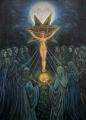
"Gali Izmailova is a contemporary artist working at the intersection of symbolism, psychological realism, and social satire.
Her practice explores themes of moral degradation, collective illusion, violence, repression, and self-deception. Through allegory, grotesque imagery, and theatrical staging, she creates visual narratives about the modern human condition — its fears, dependencies, and voluntary blindness.
Her works are built upon contrasts: celebration and decay, beauty and distortion, stage and backstage, simulation and reality."
https://galyanomaly.tilda.ws/worlds
|

|
|
| In Russian: The Transhumanist Paradigm in the Alchemical Tradit |
|
Posted by: Paul Ferguson - 04-07-2026, 10:58 AM - Forum: Articles on alchemy
- No Replies
|
|
Gnatik E.N. RUDN Journal of Philosophy. 2026;30(1):268–282
Abtract (via DeepL):
This paper examines alchemical doctrine through the lens of ideas that correspond to the theoretical constructs of transhumanism. It is demonstrated that alchemy, this complex and contradictory cultural phenomenon which existed in various civilisations over long periods of their historical and cultural development, currently occupies a unique niche within the heritage of philosophy, chemistry and the natural sciences as a whole. The activities of a small circle of initiates, striving to master ‘perfect knowledge’, were focused on a holistic study of the entire diversity of the surrounding world: from phenomena on a cosmic and biological scale to the investigation of the composition of inorganic matter, the understanding of the causes of diseases, the search for methods of their treatment, and so on. An immersion in alchemical sources provides evidence that the human aspiration to modify the surrounding world and oneself, one’s biological nature as a controllable process, has very deep historical roots. For centuries, the main guiding principle and the alchemists’ cherished goal was to bring about fundamental qualitative changes within a certain body or object (whether inanimate or animate), its ‘rebirth’ and transition to a new, more perfect level. In the author’s view, the ideological and conceptual legacy of previous eras, with its focus on comprehending the laws of the universe, unravelling the mystery of the origin of life, and addressing issues of human perfection, longevity, immortality, and so on, has not yet been exhausted. The alchemical tradition, which is an integral part of the spiritual and material history of humanity, represents an important, not yet fully understood and not entirely overcome legacy of the past, a worldview doctrine that to this day retains its heuristic potential. The study emphasises that, in the current complex and conflict-ridden historical situation, humanity, having begun to utilise the fruits of convergent technologies on a very broad and active scale, is rather recklessly succumbing to the dominance of technocratic thinking, without fully realising the socio-cultural consequences. Transhumanism, as the conceptual successor to alchemy and drawing its inspiration from contemporary creative and constructive activity, is the most radical project of postmodernism, aimed at mastering ‘perfect knowledge’ and concentrating all-encompassing power over nature and humanity in the hands of those who succeed in mastering this knowledge.
https://journals.rudn.ru/philosophy/arti...9375/26662
|
|
|
|
|