| Welcome, Guest |
You have to register before you can post on our site.
|
| Online Users |
There are currently 8 online users.
» 0 Member(s) | 5 Guest(s)
Applebot, Baidu, Bing
|
| Latest Threads |
Poussin's Shepherds
Forum: Alchemical symbolism and imagery
Last Post: Paul Ferguson
Yesterday, 08:52 AM
» Replies: 0
» Views: 17
|
William of Conches: Dialo...
Forum: Reviews and book notices
Last Post: Paul Ferguson
Yesterday, 08:41 AM
» Replies: 0
» Views: 14
|
John Dee's Aphorisms On A...
Forum: Reviews and book notices
Last Post: Paul Ferguson
Yesterday, 08:26 AM
» Replies: 0
» Views: 15
|
The Arabic Influences on ...
Forum: Reviews and book notices
Last Post: Paul Ferguson
Yesterday, 08:23 AM
» Replies: 0
» Views: 14
|
New translation of Dee's ...
Forum: Reviews and book notices
Last Post: Paul Ferguson
Yesterday, 08:18 AM
» Replies: 0
» Views: 15
|
Video: Hidden Symbols of ...
Forum: Alchemical symbolism and imagery
Last Post: Paul Ferguson
10-14-2026, 10:25 AM
» Replies: 0
» Views: 36
|
Dan Jing Ju Yao
Forum: Alchemy texts
Last Post: Paul Ferguson
10-14-2026, 10:18 AM
» Replies: 0
» Views: 24
|
Newton's Alchemical Writi...
Forum: Articles on alchemy
Last Post: Paul Ferguson
10-14-2026, 10:15 AM
» Replies: 0
» Views: 26
|
Exhibition NY, SF: Leonor...
Forum: Alchemical symbolism and imagery
Last Post: Paul Ferguson
10-14-2026, 09:17 AM
» Replies: 0
» Views: 38
|
Videos: The Hermetic Dial...
Forum: Articles on alchemy
Last Post: Paul Ferguson
10-14-2026, 09:03 AM
» Replies: 0
» Views: 23
|
|
|
| Poussin's Shepherds |
|
Posted by: Paul Ferguson - Yesterday, 08:52 AM - Forum: Alchemical symbolism and imagery
- No Replies
|
 |
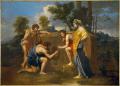
Nicolas Poussin’s famous masterpiece, Et in Arcadia Ego (https://www.google.com/search?kgmid=%2Fm...rcadia+Ego) (also known as The Arcadian Shepherds), has frequently been viewed through an esoteric or alchemical lens by alternative historians and occult theorists. [1] (https://www.aengusart.co.uk/blog/the-arc...as-poussin), [2] (https://www.aengusart.co.uk/blog/tag/poussin)
While mainstream art history interprets the painting as a classic memento mori—a reflection on the inevitability of death even in paradise—allegorical and esoteric readings connect it deeply to alchemy and hermeticism through several distinct elements: [1] (https://www.facebook.com/davidligare/pos...999758550/), [2] (https://www.khanacademy.org/humanities/r...in-arcadia)
1. The Pendant Painting: The Alchemical Shift
Poussin did not paint the original 1627 version of the Shepherds in isolation. It was commissioned alongside a pendant (sister) painting: Midas Washing at the Source of the Pactolus. [1] (https://thecurseofoakisland.com/theories...of-secrets)
• The Connection: The Midas myth centers on the literal transmutation of base elements into gold—the foundational pursuit of alchemy.
• The Symbolism: Both paintings feature an identical bearded River God. Esoteric scholars argue that pairing the "transmutation of gold" (Midas) with the "transmutation of the soul/mortality" (The Shepherds) was a intentional nod to the dual nature of the Great Work (Magnum Opus). [1] (https://thecurseofoakisland.com/theories...of-secrets)
2. The Color Palette as Alchemical Stages
In the famous 1637–1638 Louvre version, the three foremost figures are prominently dressed in the three primary colors: Red, Yellow, and Blue (or white/yellow variants depending on the light). In traditional alchemy, the progression of the Great Work is represented by color transitions: [1] (https://www.facebook.com/davidligare/pos...999758550/)
• Nigredo (Blackness/Melancholy): Represented by the shadow and the tomb.
• Albedo (Whiteness/Purification): The pale, statue-like woman standing on the right.
• Citrinitas (Yellowness/Dawn) and Rubedo (Redness/Completion): Found in the tunics of the kneeling shepherds. [1] (https://www.khanacademy.org/humanities/r...in-arcadia), [2] (https://mshanks.com/et-in-arcadia-ego/), [3] (https://www.aengusart.co.uk/blog/the-arc...as-poussin), [4] (https://www.facebook.com/davidligare/pos...999758550/)
3. The Shadow and "Prima Materia"
The shepherd kneeling on the left is depicted tracing his own shadow onto the stone tomb. [1] (https://www.instagram.com/reel/Da5tJ4YlDqC/)
• While art historians link this to Pliny the Elder's myth on the origin of painting, alchemical interpretations view the shadow as the Prima Materia (prime matter) or the unrefined soul. Tracing the shadow onto the stone symbolizes the projection of the spirit onto material reality, attempting to solidify or understand the temporal nature of the flesh. [1] (https://www.aengusart.co.uk/blog/the-arc...as-poussin), [2] (https://www.instagram.com/reel/Da5tJ4YlDqC/)
4. Rosicrucian and Hermetic Geometries
Alternative histories—most notably popularized in holy grail mythologies and esotericism—suggest that the placement of the shepherds' hands, staffs, and eye-lines forms sacred geometry (like pentagrams or the Golden Ratio) pointing to hidden geographic coordinates or hermetic truths. Though X-ray analyses of the canvas show no geometric underdrawings, the painting remains a pillar in Rosicrucian lore as a visual riddle concealing the secret to spiritual immortality. [1] (https://www.aengusart.co.uk/blog/tag/poussin), [2] (https://www.aengusart.co.uk/blog/the-arc...as-poussin)
|

|
|
| William of Conches: Dialogue on Natural Philosophy |
|
Posted by: Paul Ferguson - Yesterday, 08:41 AM - Forum: Reviews and book notices
- No Replies
|
|
"“This long-awaited English translation of William of Conche’s Dragmaticon Philosophiae now makes available what is arguably the most original and systematic synthesis of western thought concerning the structure of the physical universe, as it was understood in the twelfth century."
William of Conches (https://www.google.com/search?kgmid=%2Fm...of+Conches) is highly relevant to historians of alchemy, but not because he practiced transmutation or wrote laboratory recipes. Instead, he is a crucial figure in the history of matter theory and the transmission of scientific text that paved the way for late-medieval Western alchemy. [1] (https://www.ebsco.com/research-starters/...s/alchemy/), [2] (https://baike.baidu.com/en/item/Alchemy/1520933)
Historians of science and alchemy study his work for three main reasons:
1. A Unique "Atomistic" Four-Element Theory
While mainstream medieval alchemy heavily relied on the strict Aristotelian view of elements (where earth, air, fire, and water are continuous and constantly shifting), William proposed a unique atomistic cosmology. [1] (https://www.britannica.com/biography/William-of-Conches), [2] (https://www.oundleschool.org.uk/the-ound...chemistry/)
• Following the medical translations of Constantine the African, William defined an element as the "simplest and minimum part of any body" (particulae).
• He argued that the "pure elements" are invisible, indivisible units governed by intrinsic properties (hot, cold, wet, dry).
• For an alchemist, understanding how matter can be broken down to its fundamental, unobservable "minima" and reconstituted is a core theoretical requirement for transmutation. William's Philosophia mundi provided a respected, non-heretical framework for thinking about particulate matter. [1] (https://en.wikipedia.org/wiki/William_of_Conches), [2] (https://www.alchemywebsite.com/rbacon.html), [3] (https://baike.baidu.com/en/item/Alchemy/1520933), [4] (https://www.britannica.com/biography/William-of-Conches)
2. Early Integration of Arabic Science
European alchemy took off in the mid-to-late 12th century when Arabic texts were translated into Latin. William was one of the very first Christian scholars to eagerly adopt Arab and Islamic medical and physical lore. By incorporating these texts into his commentaries on Plato's Timaeus, he helped bridge the gap between classical Greek cosmology and the advanced physical sciences coming from the Islamic world. [1] (https://www.newadvent.org/cathen/15632b.htm), [2] (https://www.ebsco.com/research-starters/...s/alchemy/), [3] (https://www.catholic.com/encyclopedia/wi...of-conches), [4] (https://www.britannica.com/biography/William-of-Conches)
3. The Naturalization of "Miracles"
William famously argued that scholars shouldn't just say "God willed it" when observing a strange physical phenomenon; instead, they must look for the natural mechanisms God put in place. This strong defense of natural philosophy over supernatural intervention gave a strong intellectual justification to early experimentalists—including alchemists—who wanted to manipulate nature in a laboratory setting. [1] (https://www.ebsco.com/research-starters/...s/alchemy/)
Summary of Differences:
To put his work in context, a direct comparison shows where William fits compared to later, traditional medieval alchemists:
Attribute: William of Conches (Early 12th c.) versus Later Scholastic Alchemists (13th–14th c.)
Focus: Macrocosmic natural philosophy and matter theory versus Laboratory experimentation and metal transmutation.
Core Concept: Particulate atoms forming the four elements versus the Sulfur-Mercury theory of metals.
Goal: Explaining the cosmos through reason and natural laws versus Achieving the Philosopher's Stone or medical elixirs.
See:
https://tinyurl.com/37n6yujn
|
|
|
|
| John Dee's Aphorisms On Astrology And Magic: |
|
Posted by: Paul Ferguson - Yesterday, 08:26 AM - Forum: Reviews and book notices
- No Replies
|
|
Aphorisms On Astrology And Magic: John Dee’s Propædeumata Aphoristica Translation and Commentary by John Michael Greer
Azoth Press 2025
Delux Edition:
#8 of 52 hand-numbered copies
* leather bound in leather box
"John Dee needs no introduction to the modern occultist. The court astrologer and wizard of Queen Elizabeth I, the owner of the best library in Elizabethan England, the author of historic works on mathematics and navigation, and one of many secret agents employed by Elizabeth’s government in its struggle for survival against foreign and domestic enemies, he was also the co-creator of the Enochian system of magic, one of the most widely practiced methods of ceremonial work in modern occultism, and the author of the enigmatic Monas Hieroglyphica, one of the most cryptic works in the history of alchemy. It may startle readers, then, to learn that his first significant book on occult topics remains nearly unknown in today’s occult community. Nonetheless this is the case. The Propaedeumata Aphoristica (“Aphoristic Introduction”), first published in 1558 and brought out in a new revised edition in 1568, is that work. Dee wrote it as a convenient guide to the fundamental principles of astrology and astrological magic. It begins and ends with Dee’s magical and alchemical emblem, the Hieroglyphic Monad. In a series of 120 aphorisms, ranging in length from a sentence to more than a page, he sets out the worldview of the Renaissance astrologer and magus with a conciseness that has rarely been equaled."
https://www.facebook.com/groups/occultbo...0VXe9HhmK6
|
|
|
|
| New translation of Dee's Monas Hieroglyphica |
|
Posted by: Paul Ferguson - Yesterday, 08:18 AM - Forum: Reviews and book notices
- No Replies
|
|
"The Hieroglyphic Monad: New Translation by Michael Zellmann-Rohrer of the University of Oxford New York: Von Zos, 2018
De Luxe Edition: #2 of 30 hand-numbered copies
*Matching Box
*1. Photo
*2. Facsimiles
"This special edition includes reproductions of several pages from books that formed part of Dee's original library with his personal annotations, and reproduced on a fine quality of archival paper as large-scale Giclée prints. Also, there are additional materials from both the British Library and the Wellcome Collections."
https://www.facebook.com/groups/occultbo...JDJaFxPzyO
|
|
|
|
| Dan Jing Ju Yao |
|
Posted by: Paul Ferguson - 10-14-2026, 10:18 AM - Forum: Alchemy texts
- No Replies
|
|
"Across millennia of Daoist internal cultivation, masters of inner alchemy (内丹, Neidan) recorded their deepest insights in poetic verse to preserve sacred lineage transmissions. The poem Dan Jing Ju Yao (《丹经举要》, Essentials of Alchemical Scriptures) encapsulates the foundational lineage of Chinese esoteric philosophy, outlining the sacred trajectory from the primordial divination diagrams of antiquity to the golden elixir methods of the Song dynasty."
https://longhumountain.com/blogs/taoist-...ing-ju-yao
|
|
|
|
| Exhibition NY, SF: Leonora Carrington and Cecilia Vicuña |
|
Posted by: Paul Ferguson - 10-14-2026, 09:17 AM - Forum: Alchemical symbolism and imagery
- No Replies
|
|
Lehmann Maupin and Gallery Wendi Norris to Collaborate on Two-Part Exhibition Pairing Leonora Carrington and Cecilia Vicuña
The intersection of Chilean artist and poet Cecilia Vicuña (https://www.google.com/search?kgmid=%2Fm...icu%C3%B1a) and the concept of alchemy relates heavily to her use of raw material transformation, ecological critique, and ancestral indigenous rituals. [1] (https://biennialfoundation.org/2022/05/5...-biennale/), [2] (https://www.printedmatter.org/programs/events/994)
The connection manifests across several major contexts:
1. "Material Alchemy" and Migrations
Vicuña's work is frequently framed through the lens of material alchemy. This perspective focuses on how she takes discarded, fragile, or seemingly insignificant objects—a practice she famously terms lo precario (the precarious)—and transmutes them into sacred, politically charged art. [1] (http://www.ceciliavicuna.com/curriculum-vitae), [2] (https://digital.artplay.com/blogs/artist...lia-vicuna), [3] (https://artmuseum.princeton.edu/art/stor...al-alchemy), [4] (https://www.printedmatter.org/programs/events/994)
• The Quipu: By spinning and knotting unspun wool, debris, or thread, she performs a physical alchemy that transforms raw materials into an ancestral Andean language of resistance and memory. [1] (https://www.instagram.com/p/DeKIlE-jDyH/), [2] (https://www.artsy.net/article/artsy-edit...-their-due), [3] (https://www.printedmatter.org/programs/events/994)
• Debris & Text: Her site-specific installations, drawings, and found-object assemblages ("basuritas") conceptually elevate garbage into an urgent commentary on global climate change and spiritual ecology. [1] (https://www.mocanomi.org/posts/cecilia-v...-to-happen), [2] (https://www.printedmatter.org/programs/events/994)
2. The 59th Venice Biennale: The Milk of Dreams
Vicuña's art was a focal point of the 59th Venice Biennale (2022), which heavily emphasized themes of alchemical transformation, hybridity, and somatic materiality. [1] (https://biennialfoundation.org/2022/05/5...-biennale/)
• Her featured installation, NAUfraga, engaged with the concept of trans-historical dialogue.
• The exhibition placed her alongside historical surrealists and contemporary visionaries to explore how bodies and materials blend together, mimicking old-world alchemical processes to envision a post-humanist interconnectedness with nature. [1] (https://biennialfoundation.org/2022/05/5...-biennale/)
3. Leonora Carrington Dialogue
A significant exhibition by Lehmann Maupin and Gallery Wendi Norris paired Cecilia Vicuña directly with the legendary surrealist artist Leonora Carrington. Carrington's entire oeuvre is famously steeped in occultism, witchcraft, and literal alchemy. By placing Vicuña's practice in a dual exhibition with Carrington, curatorial focus highlighted how both women use their art to subvert patriarchal structures by channeling esoteric, earth-centered, and transformative ritual magic. [1] (https://www.facebook.com/artnewsmag/post...818355311/), [2] (https://biennialfoundation.org/2022/05/5...-biennale/)
https://tinyurl.com/y3zzpcf4
|
|
|
|
| Videos: The Hermetic Dialogues I: The Hermetic Tradition |
|
Posted by: Paul Ferguson - 10-14-2026, 09:03 AM - Forum: Articles on alchemy
- No Replies
|
|
A conversation with Professor Wouter Hanegraaff, Dr. Aaron Cheak, and Fra. Ike Baker.
Moderated by Dr. Shannon Grimes.
In what sense can we speak of a Hermetic “tradition”? Is Hermetism a dead lineage at the mercy of scholarly and occultist reconstruction? Or is there a secret lifeblood that continues to animate it through traditions of translation and rebirth? As a source of inspiration, life certainly appears to have been breathed into it time and time again. To adapt T. S. Eliot, do innovations that are “true” to the tradition become part of the tradition over time, giving it renewed life? What might this mean for us today? Join us for a conversation with Wouter Hanegraaf, Aaron Cheak, and Ike Baker as we explore various perspectives on the nature of the Hermetic tradition.
Part of the Hermetic Dialogues series hosted by the Hermopolis Academy.
https://www.youtube.com/watch?v=QTey6FrTHOU
|
|
|
|
|