Distillation of Vinegar
Steve Kalec
Skalec@videotron.ca
|
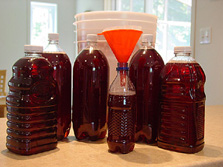
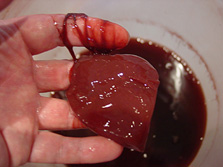
WINE VINEGAR After having aged our wine at least a year, it was allowed to pass through a secondary fermentation in which we successfully received our vinegar mother. In two months our wine was converted into a delicious vinegar. Having racked the vinegar off from its sediments, it was found to be very good and very clean tasting. Its body was pure and clean as can be seen through its clarity. It was found to have become an excellent vinegar, with a wonderful inviting bouquet. |
|
MOTHER OF VINEGAR To see the mother of vinegar forming is very interesting. Simply place the wine in an open container just a little over half full. This will allow for the the process of the of a secondary fermentation. Add water in ratio of of 1 parts water to 3 parts wine. Placing into the wine a piece of bread will facilitate the development of the mother. Cover container with cloth. |
|
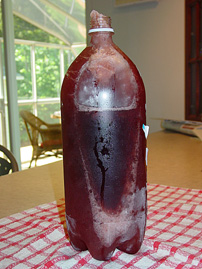
FROZEN VINEGAR The vinegar was placed into plastic two liter pop bottles. A space was allowed for the expanding ice, and the bottles were placed for 24 hours into the freezer. We can see here that the mostly watery part of the vinegar is frozen, while the acetic part is not. We must keep in mind that water has a higher freezing point than acetic acid. This allows for us the distillation of the acetic acid from our vinegar through a freezing method. The ancient alchemists used to do this work in the coldest parts of winter. |
|
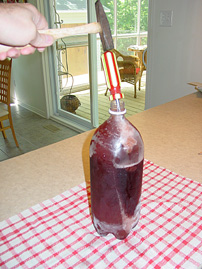
PUNCTURING THE ICE A passage must be made for the more acetic unfrozen part so it can flow through the frozen water as an ice blockage. A simple screwdriver struck though the center of the ice build up will cause a hole deep enough to allow the more concentrated vinegar to flow through. |
|
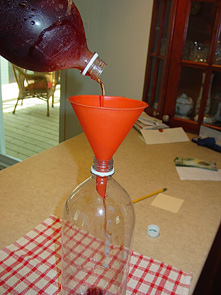
POURING OUT CONCENTRATE The unfrozen more concentrated and more acetic liquid part is poured over into a new container. |
|
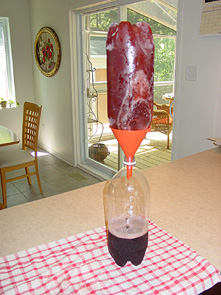
DISTILATION SET UP After all the liquid concentrated unfrozen part has been poured over, invert the entire icy watery vinegar over on top of the new container using a funnel to hold in place the top container. It is advised to place this set up in a corner of two adjoining walls of a room so that it holds in place as weights shift when ice melts. Allow the distillation to proceed for three to four hours as the more concentrated acetic acid will accumulate through the continuous drippings in drops. |
|
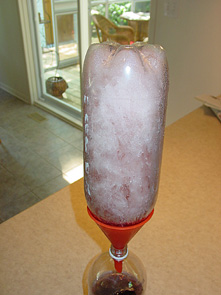
CLEARED ICE Judging by sight, it is easily seen when the most part of the acetic acid has gone over into the new container leaving the phlegm (water) behind seen as an ice sludge stuck in the original container. |
|
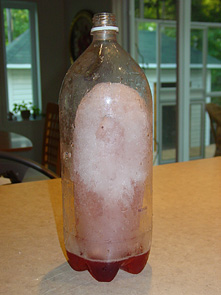
PHLEGM The large piece of ice left over is clear evidence that a separation of the phlegm (water), has been achieved and the first distillation was had. |
|
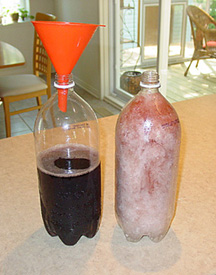
THE SEPARATION What is seen here is depicting the result of the first distillation of six liters of vinegar. There now still remains four liters to be distill. So we can easily judge that out of ten liters there will result two liters of a more pure acetic acid. The resulting two liters then will pass through a second freeze distillation. We can even work through a third if we wanted to, which would already yield an acetic acid strong enough for working the "Way of the Acetate". |
 Study Courses