
|
The painting McLean was working on in December 2011. 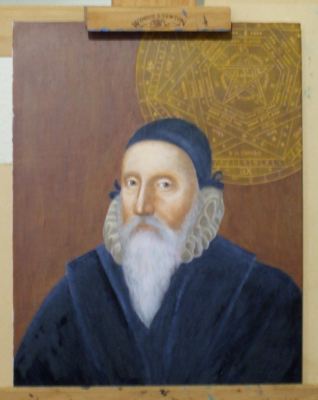 A few years ago I made a portait of John Dee copying the image from the painting in the Ashmolean in Oxford. I managed to sell this, and a few months ago another person asked me to make a similar portrait. Rather than a straight portrait, I decided to put the Aemeth diagram in the background behind Dee. This person agreed to commission me to do this. I have now made some progress and this is how the piece stands at present. I may put another glaze over the background to make it less prominant. Hopefully it should only take another ten hours to complete. The painting McLean was working on in December 2011. 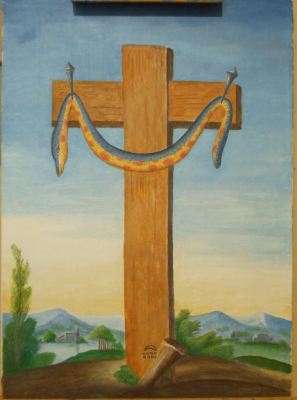 This is a copy of an illustration of the well known crucified snake from a 18th century manuscript of the Flamel hieroglyphics - the Molinier manuscript in the Bibliotheque Nationale. I am planning to create copies of all the images from this manuscript. The painting McLean was working on in December 2011.  This is a copy of an illustration of the monkey trumpeteer from a Manuscript of the Aurora consurgens in Prague. It still needs some work on the details. The painting McLean was working on in March 2010. 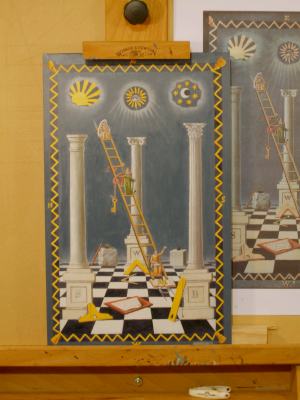 This early 19th century painting of a masonic tracing board by Josiah Bowring is quite well known. I have been comissioned to make a copy of this. Although the painting looks finished in this photograph, it actually needs a lot more work on the details. An alchemical painting McLean was working on in March 2010. 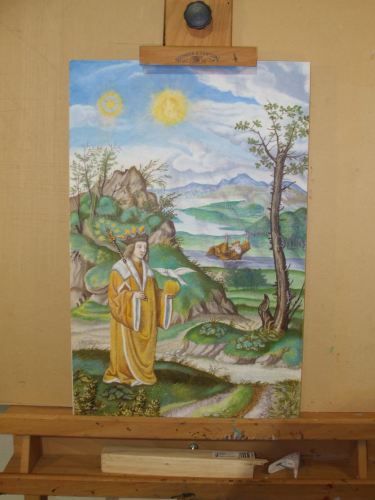 The death of the old king and rise of the young king from the Splendor solis, here copying the best known version in the British Library, without the decorative border. The painting McLean was working on in Dec 2009/Jan 2010.
Jacopo de'BarbariA Portrait of Luca Pacioli 1495. 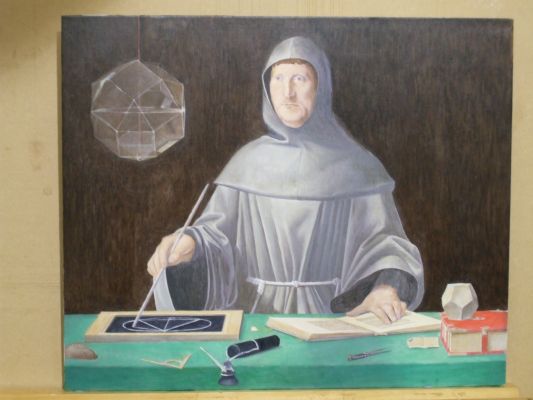 The painting McLean was working on in July/August 2009.
Joos van Craesbeeck Temptation of St Anthony. 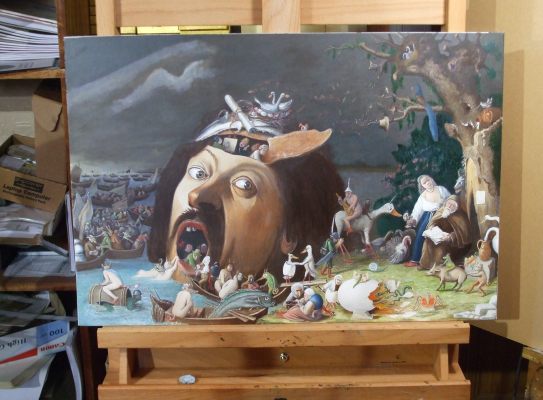 The painting McLean was working on in June 2009.
Pieter Huys Temptation of St Anthony. 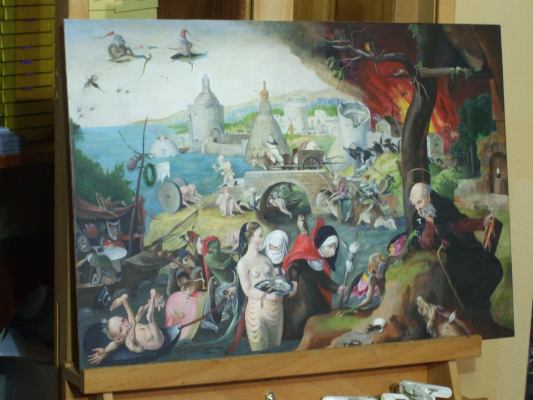 The painting McLean was working on in April/May 2009.
Niederrheinischer Meister Love Spell. 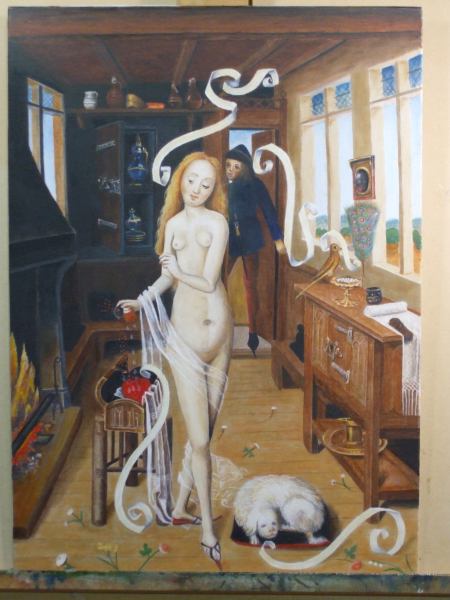 The painting McLean was working on in April/May 2009.
Albrecht Aldorfer The Rest on the Flight into Egypt. 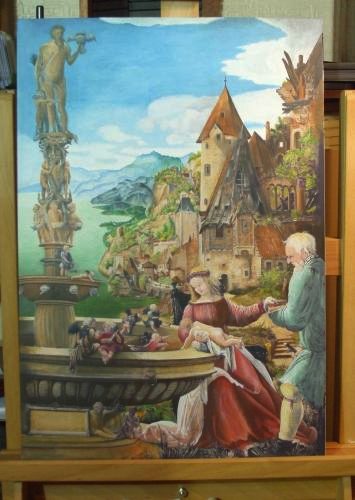 The painting McLean is working on in March 2008.
Image from the Splendor solis manuscript
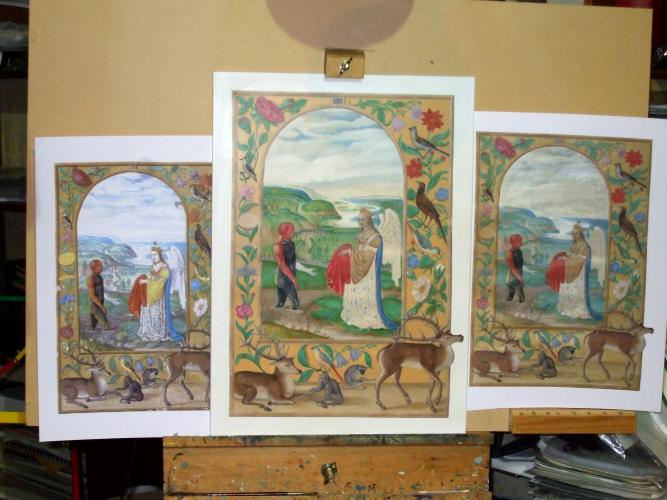 I really love this image of the man with the glass sphere head emerging out of the swamp. I decided to make a copy not from the most familiar London, British Library manuscript of 1582, but from the earlier original of 1545 now in Nürnberg. On my easel I have printouts of the London on the left and the Nürnberg on the right. Because this was an detailed illumination on vellum it would not be possible to paint this in oils at the same size, so I have enlarged it to about twice the original size. Even on this larger scale reproducing the details is proving rather exacting. The painting McLean was working on in early March 2008.
Mary Magdelene by Rogier van der Weyden 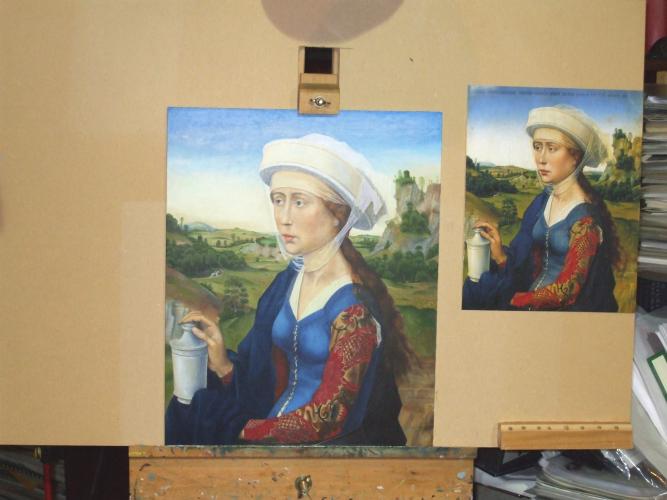 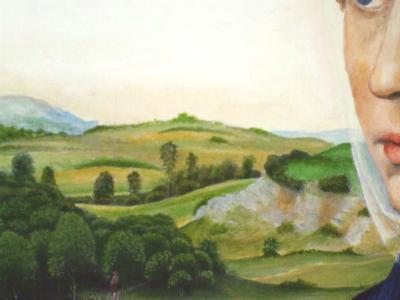 The painting McLean was working on in February 2008.
I wanted to set myself a little challenge and make a facsimile copy of the Mona Lisa, just to see what was possible. Early on I decided to work from a 17th century copy rather than primarily from the familiar original. The original painting appears to have been damaged in some areas by some over vigorous cleaning in the past and detail and colour has been lost, especially from the background. When I looked at photographs of this copy, I could see the intact columns which framed the window in front of which the figure was sitting. These seem to have been cut off the original, leaving only shadows of the pillar bases. Also the figure is seated in a chair, something not now immediately obvious in the original painting, but if one looks deeply into it one can see the arm of this chair, though it is almost lost in the dark background. I decided that, rather than make an exact copy of the familiar Mona Lisa, I would attempt to do a little restoration or reconstruction to bring out some of the lost features. I have thus lightened her garment to bring out the folds and also lightened her translucent veil. This is a puzzling feature in the original painting, as it appears on the side of her face almost like the shadow of painted out hair, however, on deeper examination one can see that it continues around behind her head and emerges on the other side of her face. It is quite lost within the darkening of the paint and the varnish. I decided to lighten this and make it visible again. One can thus see that her hair is not let down in the modern style but is contained within this veil, as would be more seemly for 15th century aristocratic women. As I show in the photo above, I am about half way through completing the work. I have to apply a few more layers to the face in order to smooth the forms more and seemlessly blend the tones. Having now heightened the details in her garment and the wooden panelling under the window, I must now apply layers of earth tones over this to darken it down a bit and make the shadowed areas more realistic. In the original the paint has badly cracked (particularly where white pigment was used) into those fine filaments known as craquelure. In my painting the image is of course totally smooth.
Mona Lisa 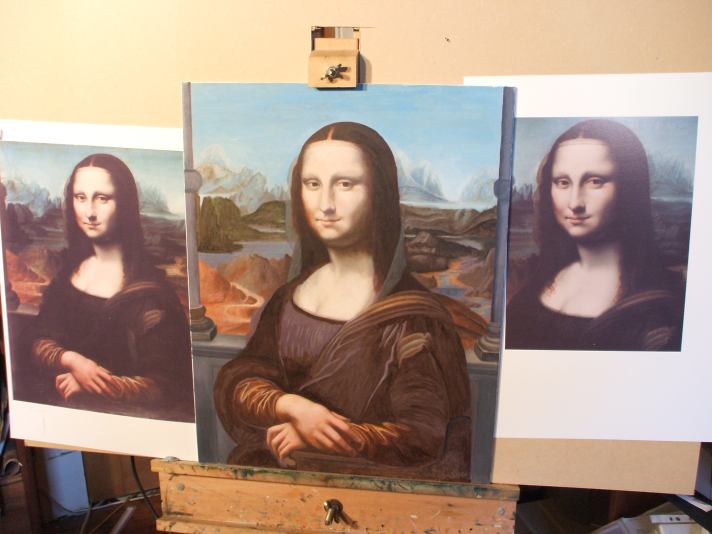 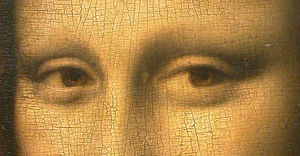 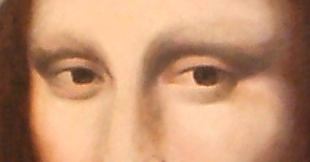 |