





2 hours ago
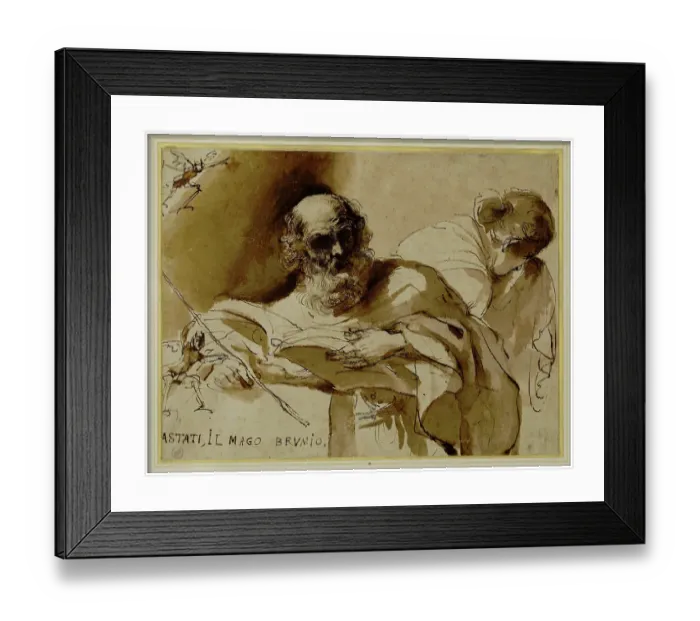
Astati, il mago Brumio (often translated as Astati, the Mage Brumio or Armed with Spears, Brumio the Wizard) is a famous Baroque pen, brown Indian ink, and watercolor drawing on paper created by the Italian master Guercino (Giovanni Francesco Barbieri) between 1618 and 1620. [1] (https://rocznik.mnw.art.pl/ojs/index.php...06/211/333), [2] (https://www.finestresullarte.info/de/aus...-leihgaben)
The piece is part of the collection at the Biblioteca Reale in Turin. [1] (https://www.finestresullarte.info/en/exh...onal-loans)
Artistic and Alchemical Context
While the prompt connects the drawing to alchemy, the artwork itself reflects the early 17th-century fascination with the interplay between folk magic, witchcraft, and early scientific inquiry. [1] (https://www.finestresullarte.info/en/exh...onal-loans)
• The Imagery: The drawing features a mysterious inscription: "Astati, il Mago Brumio" (interpretable as "Armed with spears, Brumio the wizard"). It depicts a bearded, elderly wizard browsing through a heavy tome. Behind him, a crying woman appears to seek a remedy for some physical or amorous ailment. The composition features Guercino's characteristic Baroque irony, including mischievous, winged devils—one poking the wizard's hand with a spear. [1] (https://rocznik.mnw.art.pl/ojs/index.php...06/211/333)
• The "Science vs. Magic" Intersection: Art historians often group this drawing alongside Guercino’s scientifically minded works (such as his Atlas holding the globe). During the Renaissance and Baroque eras, occult practices like alchemy, magic, and astronomy were deeply intertwined—viewed as different threads of the same tapestry used to unlock the secrets of nature. [1] (https://engelsbergideas.com/reviews/guer...ss-of-art/), [2] (https://www.finestresullarte.info/en/exh...onal-loans)
• Studio Visual Puzzles: Scholars suggest Guercino created these highly imaginative, witch-and-wizard drawings as humorous rebuses or visual riddles to entertain his assistants and family during downtime in his studio (Accademia del Nudo). [1] (https://rocznik.mnw.art.pl/ojs/index.php...06/211/333)
The piece is part of the collection at the Biblioteca Reale in Turin. [1] (https://www.finestresullarte.info/en/exh...onal-loans)
Artistic and Alchemical Context
While the prompt connects the drawing to alchemy, the artwork itself reflects the early 17th-century fascination with the interplay between folk magic, witchcraft, and early scientific inquiry. [1] (https://www.finestresullarte.info/en/exh...onal-loans)
• The Imagery: The drawing features a mysterious inscription: "Astati, il Mago Brumio" (interpretable as "Armed with spears, Brumio the wizard"). It depicts a bearded, elderly wizard browsing through a heavy tome. Behind him, a crying woman appears to seek a remedy for some physical or amorous ailment. The composition features Guercino's characteristic Baroque irony, including mischievous, winged devils—one poking the wizard's hand with a spear. [1] (https://rocznik.mnw.art.pl/ojs/index.php...06/211/333)
• The "Science vs. Magic" Intersection: Art historians often group this drawing alongside Guercino’s scientifically minded works (such as his Atlas holding the globe). During the Renaissance and Baroque eras, occult practices like alchemy, magic, and astronomy were deeply intertwined—viewed as different threads of the same tapestry used to unlock the secrets of nature. [1] (https://engelsbergideas.com/reviews/guer...ss-of-art/), [2] (https://www.finestresullarte.info/en/exh...onal-loans)
• Studio Visual Puzzles: Scholars suggest Guercino created these highly imaginative, witch-and-wizard drawings as humorous rebuses or visual riddles to entertain his assistants and family during downtime in his studio (Accademia del Nudo). [1] (https://rocznik.mnw.art.pl/ojs/index.php...06/211/333)