- Artwork Tarots
items available - Artwork Tarots
out of print- No 1 Alchemical Emblem tarot
- No 2 Marie-Claude Purro
- No 3 Alchemical Wedding Tarot
- No 5 Tarot of the Sidhe
- No 9 Aleph Tarot
- No 13 Fortuna's Wheel Tarot
- No 15 Phantomwise Tarot
- No 16 Lebanese Tarot
- No 17 Arto Tarot
- No 18 Diary of a Broken Soul
- No 24 Fialko Tarot
- No 26 W. T. Horton Tarot
- No 27 Greater Mysteries Tarot
- No 28 Golden Serpent Tarot
- Artwork Tarots
temporarily unavailable - How the Artwork
tarots are made - Study Course
the Artwork of modern Tarot - Tarot Database
project - Tarot collectors
Forum on tarot collecting - Other sites
- Tarot Weblog
- Tarot decks for sale
 Facebook page
|
Adam's Tarot Weblog Entries from 6th July 2010. Go to Archive 1 - entries from 21st November 2006 to 30th April 2007. Go to Archive 2 - entries from 1st May 2007 to 1st November 2007. Go to Archive 3 - entries from 2nd November 2007 to 30th November 2008. Go to Archive 4 - entries from 12th December 2008 to 29th June 2010. To contact Adam, email adam@alchemywebsite.com Click here to join the Art Tarots emailing list. Click here to see the Tarots Collectors Forum. Click here to see the unpublished tarot designs page. |
|

|
15 December 2015
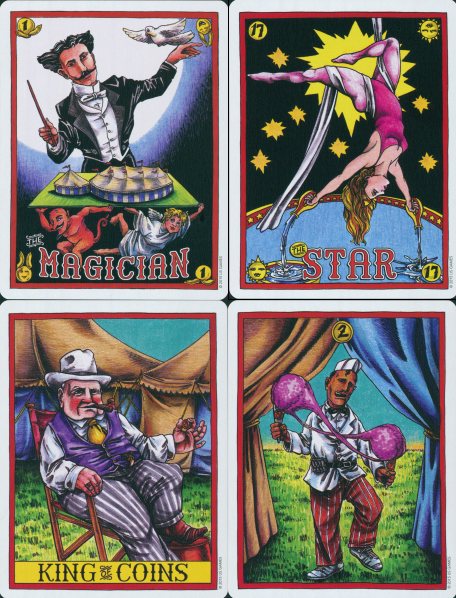
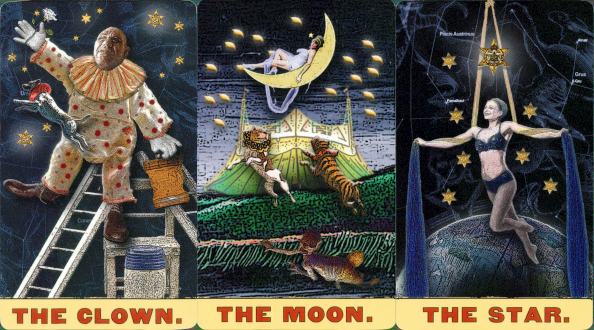
The Legrande Circus and Sideshow Tarot was recently issued by US Games. The set of large, intensely coloured cards is supplied in a substantial cardboard box, which surely is the best way to package tarot. The imagery evokes the atmosphere of circus acts and the sideshows that surround a circus. It is a Rider Waite clone, following the Pamela Colman Smith images quite closely, though, of course, translating these into the world of the circus. The artist, Joe Lee, is not just someone enthused by circus imagery, but he studied clowning at the Barnum and Bailey Clown College, worked as a professional circus clown with Ringling Brothers Circus, and later wrote a number of books on the subject. After leaving the circus life he taught art classes in New York and came to establish himself as an illustrator. So who could be better to create a circus themed tarot.
5 December 2015
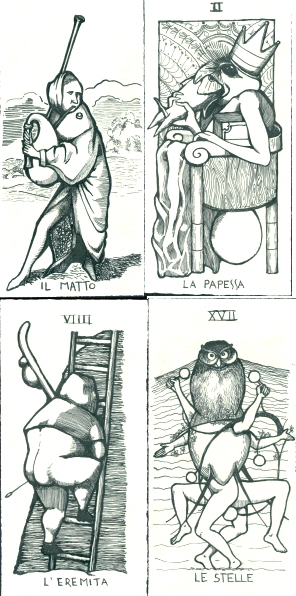
A month ago I showed three tarots I had bought from the Italian publisher who produced the Bambolanera Tarot. About a year ago I also purchased the artwork for their Hieronymus Bosch inspired designs. These are the original drawings, rather than an actual published deck. I do not usually have the funds available to buy original artwork, but I found I could not resist this one. The artwork is credited to Layla and is in the form of pen line drawings. Each card depicts a scenario from a Hieronymus Bosch painting. I wish I could find the actual name of the artist or artists who creates the powerful and evocative imagery for their tarots.
1 December 2015
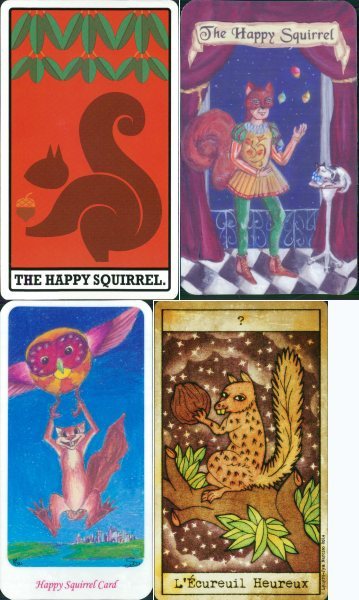
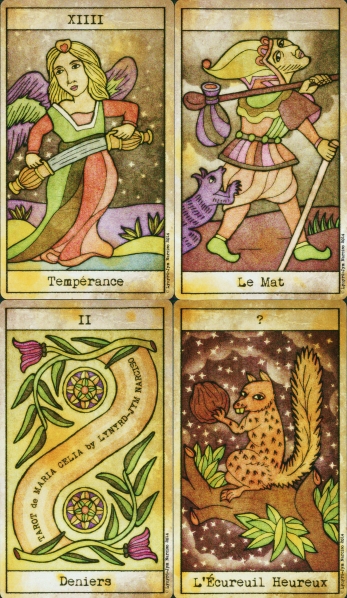
In the mid 1990s an episode of the US cartoon series The Simpsons had a scene with a tarot reader. The character Lisa visits a tarot reader and during this she draws card XXIII 'The Happy Squirrel'. A few tarot artists, probably fans of The Simpsons, came to include a Happy Squirrel card in their decks.
I noticed that Ly Narciso included this in his recent deck we looked at on the 18th November, and this led me to wonder just how many tarot include this. I can count nine, but there may well be more.
Tarot de Maria Celia
Touchstone Tarot
Tierney's Delight
Midnight Masquerade
Tarot Collectors Forum deck 2009
Picture Postcard
Mibramig
International Icon
Animism
Robin Ator's International Icon of 2003 appears to be the earliest, followed a year or so later by Robyn Tisch Hollister's Midnight Masquerade. I would welcome notices of any I have missed from this provisional list.
27 November 2015
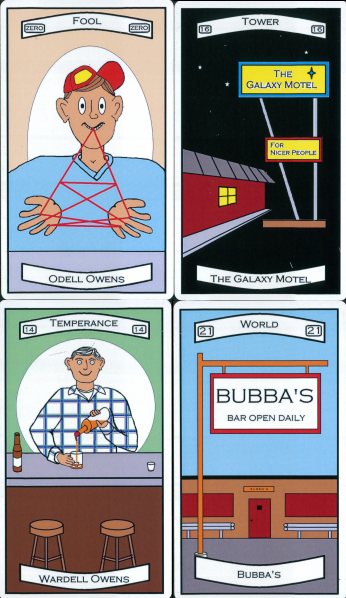
Sordid Lives is an American television series created, written, and directed by Del Shores and broadcast in 2008-9. It was essentially a prequel to the 2000 film Sordid Lives, also by Shores, self-described as a "Black comedy about white trash". A publicity notice states "The show is set in small town Texas and centers on the Ingram family. The story of Bible-thumping Baptists, beer-swilling bar trash and everyone in between in a small Texas town, contrasted with the appearance-driven world of Hollywood and the hysterical comedy and tender poignancy that come from learning to be yourself and love the family you have instead of the family you want".
I have never seen this show, nor would I want to, but it seems to have made sufficient impact to have inspired this tribute deck. Set of 22 Majors plus 4 additional cards.
26 November 2015
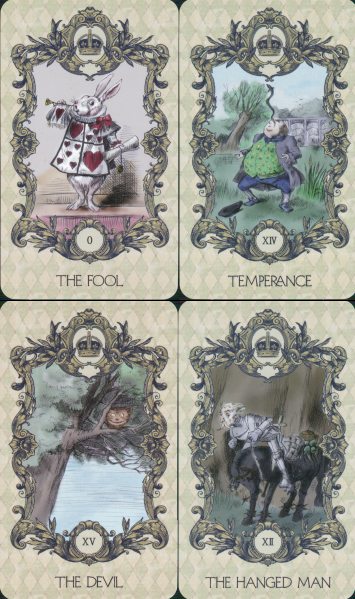
On the third of November I drew attention to a number of decks inspired by the Alice in Wonderland theme. On Monday while adding Korean material to my database I found that I had another fine tarot on this theme. The Tarot Card Alice book and deck issued in Korea in December 2011 uses the original illustrations of Tenniel to Alice in Wonderland and Through the Looking Glass. These have been subtly and sensitively redrawn and coloured without overwhelming the underlying drawings. At first glance one would think the colouring was through watercolour, but on close inspection this appears to have been done digitally in watercolour style.
25 November 2015
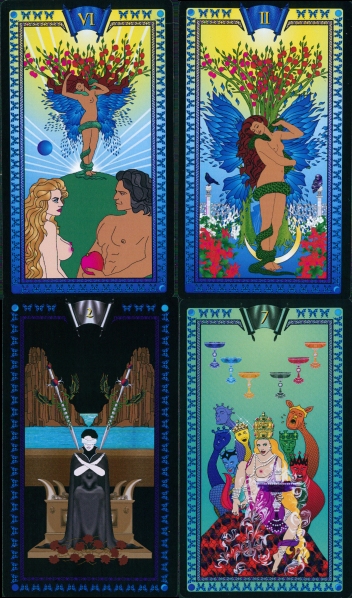
The Lilith Bible Tarot, created by Lorelei Douglas, seems to be an attempt to recontextualise Christianity within a wider pagan and female centred mythology, drawing on Jewish and Egyptian elements. I cannot immediately grasp many of the reworkings within the imagery, I suppose I must wait for an explanatory book. The previously obscure Lilith myth become popularised in the late 20th century as it resonated with the then emerging feminist critique of religion. This tarot seems to work within this emergent myth. Lilith appears on the Lovers card, with Adam and Eve in the foreground. Here she is identified with the serpent on the tree, and we see her in the same role as the High Priestess. One would have to be relatively well read in Christian and Jewish mythology to grasp the meaning of many of the Major arcana within this system, though the Minors to a great extent follow the Pamela Colman Smith prototype. The artwork is a composite of line drawings with collaged elements, probably built up in layers using software like Photoshop.
23 November 2015
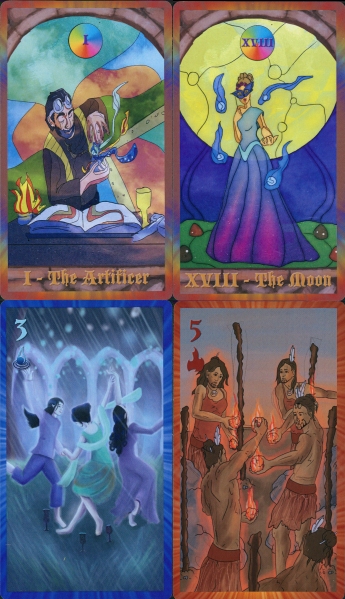
The people who designed the LifeDeck of Kelcross certainly take themselves very seriously. They have created their own mythological structure around a supposed realm of Kelcross. The deck was apparently created by six people. The Earth, Water and Air suits use the same diffuse, out of focus, style, obviously created digitally, while the Fire suit and the Majors (which in Kelcross speak is the Majum) have quite strong outlines which may have been first drawn by pen then scanned and coloured digitally. The creators of this imagined world have set up a Facebook Kelcross Academy to explain the elements of their underlying esoteric mythology. The Majors follow the established archetypes though some cards are renamed. The imagery of the pips of the Minors to a great extent reference Pamela Colman Smith's emblem sequences, but with considerable variations. I seem to recall this was initially launched as a Kickstarter project, but I am not sure if it proved successful. At any rate it is now available from the print-on-demand card game publisher www.TheGamecrafter.com
22 November 2015
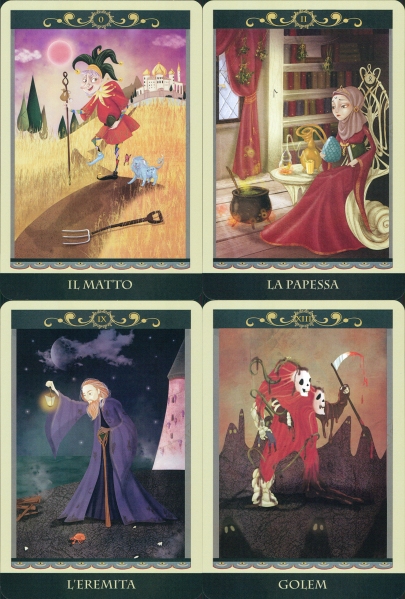
The Gioco degli Arcani Maggiori is a Majors only tarot issued in April 2015 in Italy. The concept and book is by Valeria Menozzi and the illustrations were made by A. Coppola. These were created digitally but in the style of watercolour paintings without constraining pen outlines. The imagery is quite cute. We see the Priestess with her cauldron and her little alchemical still beside her on the table. The Hermit seems very conventional, but then we notice at his feet a little hermit crab. I cannot remember ever seeing that in a tarot, though perhaps my memory fails me here, but this is a neat touch. Another unique feature is the Death card, here renamed as the Golem. We recall that the Golem is an idea in late medieval Jewish magic where an almost living being was created by a magician from clay, the most famous one being that made by Rabbi Loew of Prague, possibly a legend fabricated in the 19th century.
21 November 2015
The Dream Monsters Tarot by William Zierfus is a riot of eyes, amorphous bodies and bright colours. William Zierfus is a US writer and artist, who has written and illustrated a number of children's books and is probably influenced by the Dr. Seuss stories and illustrations. His "monsters" are far from scary. They are like blobs of protoplasmic lime, cherry and lemon jelly. They remind me of the early surrealistic paintings of Johfra (some decades before his more emblematic Zodiac Series). I am not sure if William Zierfus had seen these rather neglected paintings of Johfra Bosschart from the 1950s and early 60's, but if not he seems to have touched on much the same concept for his imagery.

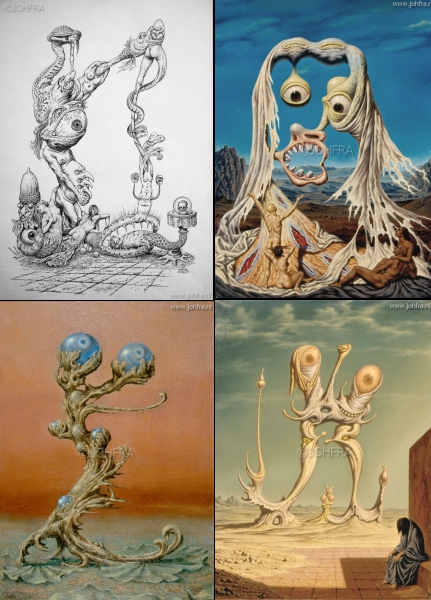
Three of Johfra's paintings and a drawing are shown on the right for comparison.
20 November 2015
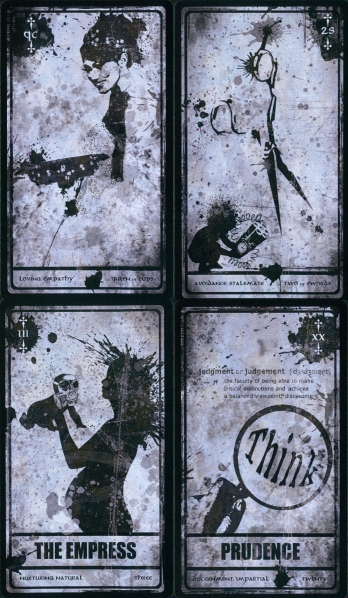
There are a number of 'dark decks', tarot designs that dwell on the negative, dark side of humanity, often with images of grim horror and decay. We can recall such as the Tarot der Schatten, the Savage Tarot, the Marilyn Manson Tarot, the Devil's Tarot, the Alchemical Wedding Tarot and a number more. Well the Darkana has now joined this growing band of tarots that seem designed to excoriate and corrode the soul. Of course, this is a pose and high style in some communities, and not really to be taken that seriously. Like some others, the Darkana adopts a palette almost devoid of colour, with a background texture of inkblots and scratches. Imposed on this are digitally modified photographs in grey tones. Often the imagery on the card is perverse, the opposite of the stated meaning of the card. Thus the smiling Queen of Cups with "Loving empathy" fires off an Uzi machine pistol gangster style, the Two of Swords has a conventional image of a pair of scissors, but at the bottom left is a young child handling a bomb consisting of some sticks of gelignite set with a timer. The pregnant Empress holds up a child wearing a gas mask. Some images are more positive, but one loses sight of this positivity in a grim dark sea. This tarot is entirely successful in what it sets out to achieve. It will, doubtless, appeal to a certain audience and, of course, this negative imagery is part of modern tarot art. It can be seen as the antithesis, and perhaps a response to, the delightful and engaging imagery of some tarots. Darkana is not without humour and irony, but it will hardly make one laugh out loud, or even bring a smile to the lips. I feel the need to collect such material in order to fully document aspects of our modern culture, to make my collection representative of all facets of tarot art, but I expect only a small group of collectors will rush to buy this set of dark arcana. You can buy copies from www.thegamecrafter.com
19 November 2015
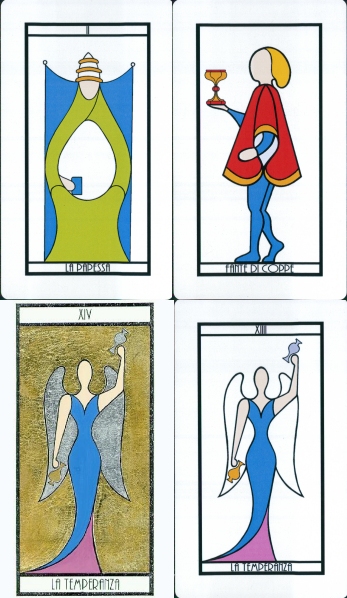
In 1994 Marco Benedetti created a set of tarot images. The major arcana were set on a background of gold leaf with silver leaf also applied to some of the images. These were not printed at the time, but earlier this year he took advantage of the US based print on demand card producer The Gamecrafter to issue these as the Marco Benedetti Tarot. He reduces each figure to a series of simple beautifully drawn curves colouring them sparely with block colour with no modelling. The figures have no facial features. This abstraction seems to heighten their archetypal nature. His designs reflect the Art Deco style. This is a full 78 card deck with non-emblematic pip cards. I include one of his original major arcana paintings so we can see the design with the gold leaf background. Sadly The Gamecrafter does not print in gold ink otherwise I feel sure Marco Benedetti would have used this. This is a rather cool, detached yet archetypal set of images. You can buy copies from www.thegamecrafter.com
18 November 2015
Lynyrd-Jym Narciso is well known to tarot collectors as one of the more prolific creators of tarots. He is based in the Philippines and I think his earliest published tarots date to 2004 or 2005, but since then we have all been delighted by his continuing output. One of the features of his art is that he does not adopt a fixed style, and each tarot he designs is quite different from its predecessors. This deck, Tarot de Maria Celia, is a Tarot de Marseilles in a modern art style with the figures drawn in flowing curves and are child rather than adult proportioned giving them larger heads and somewhat shorter limbs than is usual. This gives them a distinctive quality which is quite memorable. Narciso is at home in many media and has fine drawing skills, and most of his recent work is done digitally, however, his skills in traditional media enable him to produce high quality digital imagery. His texturing in this deck is very fine, and they are made to look as if they had been created on translucent tracing paper using oil based paints and one is viewing them in transmitted light, which is is rather neat device. We have seen in his other tarots how he loves to explore different aspects of luminosity. I look forward to seeing what he does next. He publishes decks under the name Paraluman, which I went and looked up in Google translate under Filipino, and found it meant "The Muse". Lynyrd-Jym Narciso certainly has a good relationship with his muse.
I have only just bought this tarot which is available through The Gamecrafter, though I have known about it for some time. I was consolidating some purchases in order to reduce the costs of postage and customs charges from the USA. So expect to see here a few decks issued through The Gamecrafter over the next few weeks.
You can buy a copy from www.thegamecrafter.com
17 November 2015
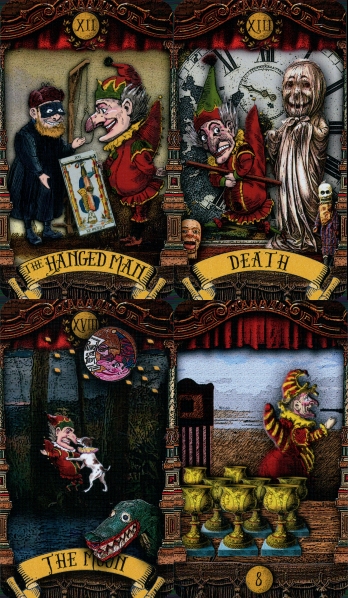
I seem to remember that Mr Punch has made an appearance in some tarot decks, but here he asserts himself with a tarot deck entirely devoted to himself. This is the Tragically Comic or Comically Tragic Tarot of Mister Punch issued by Duck Soup Productions. The artwork is by Douglas Thornsjo, and we have seen his work before in the 2013 Tarot of the Zirkus Magi, where he adopts a deeply saturated palette of colours and mimics late 19th and early 20th century vaudeville posters and giving these a deliciously humorous twist.
16 November 2015
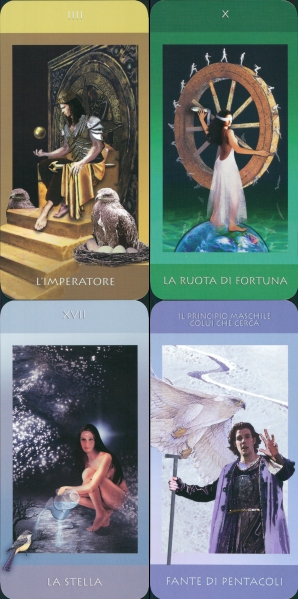
The Tarocchi del Calderone Magico ( the tarot of the magical cauldron) comes with a large paperback book. It is readily available through Amazon.it With that title one would expect it to be heavily oriented towards a pagan theme, but it does not appear overtly magical or pagan, at least to my mind. The artwork is digital, mostly using photographs which have been modified, then pushed through a graphic filter to remove the detail, probably one of the blur or texture filters in Photoshop. One can see the different layers used in building the images. It is well printed and produced, and also inexpensive.
14 November 2015
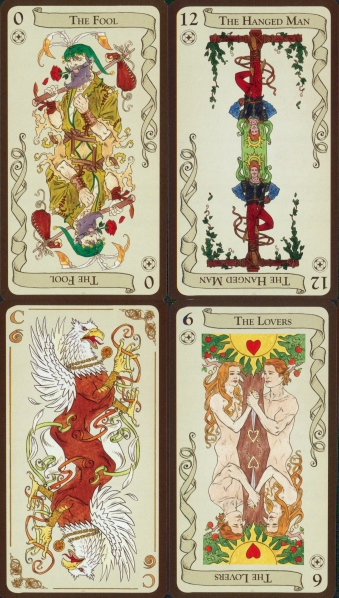
The Tarot of Loka is a Jeu de Tarot deck with the familiar reversible images for the Trumps as well as the Pips and Courts. The artwork by Ralph Horsley draws on the established tarot imagery for the Majors and the Courts, unlike many tarot card game decks. The game of Loka, designed by Alessio Cavatore, for which this deck was intended is for four players. The game rules are clearly set down in the little white book in six European languages. There are two extra cards 'Good' and 'Evil' which play a special part in the game.
13 November 2015
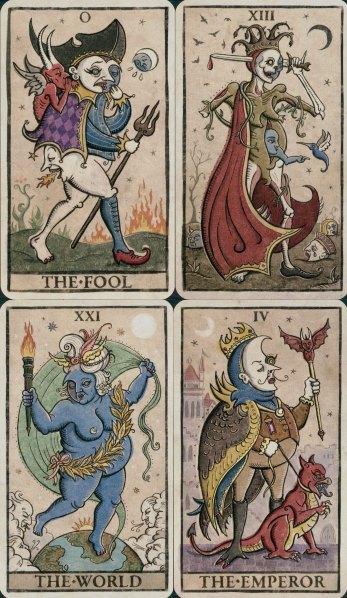
The Trionfi della Luna by Patrick Valenza, the creator of the well received Deviant Moon Tarot of 2008, is an amusing riot of images. It reworks the style of his earlier tarot, the figures with lunar crescent heads, but here he goes further and presents it as an old historical deck. Thus he gives the impression that it was printed, as with all decks before the emergence of full colour printing, in black outlines from a woodblock, then coloured using stencils. Of course, his deck is not printed this way, but he mimics the mis-registering of the stenciling so that the colour often falls outside the lines. Collectors who have reproductions of early tarots will immediately recognise this. This tarot is great fun - take a look at Death who stabs his own head with a sword, or the mustachioed Emperor with his pet dragon on a lead. This Majors only deck has a set of six cards in landscape format and an alternative image of the Devil.
11 November 2015
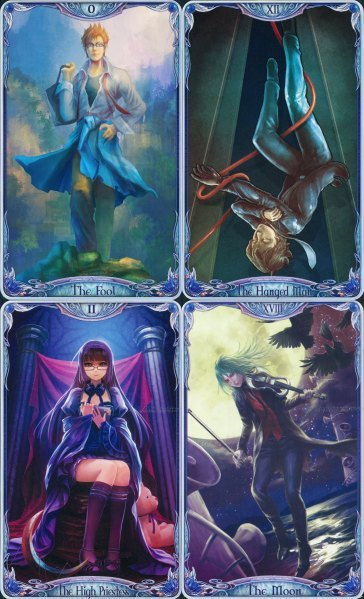
The Blue Tea Tarot from Hong Kong is a bit of a puzzle for me. It is a collaborative deck produced in the name of the Blue Tea College, which appears to be some kind of game, manga, graphic novel or television show - I cannot tell as I do not read Chinese, and Google translate is not very good on Chinese. It even has a Facebook page, but that does not throw further light for me on what this tarot is about. Anyway the artwork by a number of different artists is rather fine and it makes a nice production coming in a box with a beautifully printed book. It is likely to be the creation of a doujin or group of fans I detect a certain resonance with Harry Potter and Hogwarts, but I may be reading this into the imagery. It is difficult sometimes when one can only view images and be unable to read the text. Any help in explaining what the Blue Tea College is about will be gratefully received by this puzzled collector of tarot, who is a little bit remote (to understate the obvious) from young Chinese peoples' culture.
10 November 2015
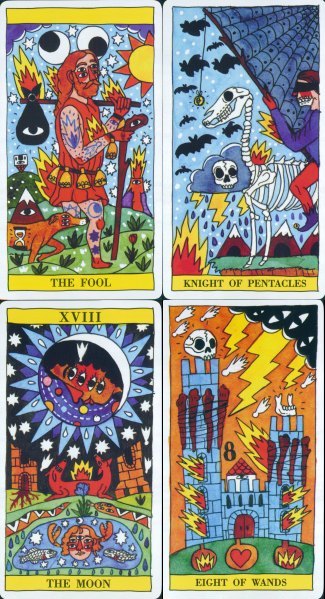
Another tarot which arrived recently is the Spanish Tarot del Fuego by Richard Cavolo, published by Fournier and easily available. It is a complete riot of colour. No subtlety here, no restricted palette, just straight in-your-face saturated colour. Also, as with the Juicy Tarot from Taiwan I mentioned here a few days ago, Cavolo adopts a graphic device, here creating figures with multiple eyes. We have noticed this device also in the Tarot de Sete of Herve DiRosa, France 2004.
9 November 2015
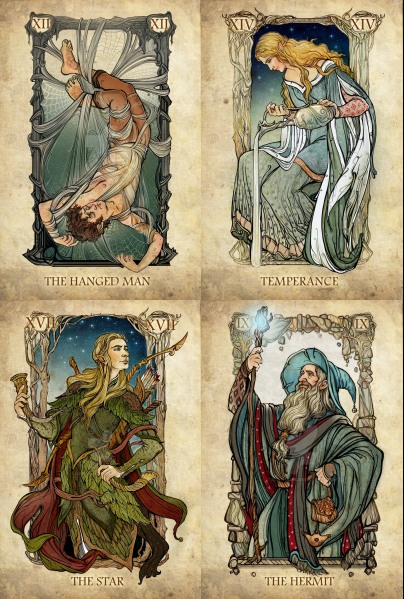
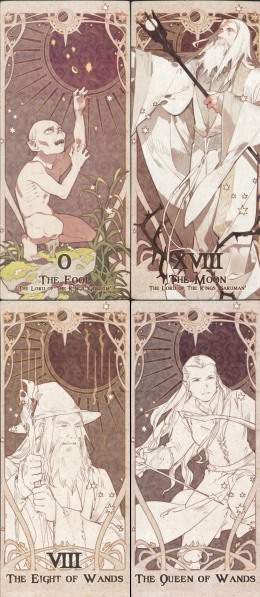
This Lord of the Rings themed deck by Russian artist SceithAilm on Deviantart is well known, with its images currently available on many web pages, but it is very worthy of being mentioned again here. In her work , which seems primarily driven by fantasy art, she uses both traditional drawing and digital methods. Her line work is exquisite with beautifully formed smooth curves such as we note in her Hanged Man, Temperance and others. I suppose one could not expect these images to be published in printed form, due to copyright implications conflicting with the current film version mechandising, but at least, with its presence on so many web sites, it will survive in the digital public space. It is well worth taking a look at her other work.
sceithailm.deviantart.com/gallery/
8 November 2015
I now have another tarot from Taiwan using the theme of the Lord of the Rings. Almost all the figures are depicted in long flowing robes and have anime style up-pointed triangular noses. Each of the figures seems to have been created in pencil, in a dynamic style, capturing the forms without fussing about in detail, and this perhaps gives them more immediacy. The Majors have been coloured while the Minors are printed using a more restricted palette of browns and greys. This brings up my count of actual printed tarots on this theme to at least four, including - the Japanese EA tarot, Peter Pracownik's Lord of the Rings Tarot of 1997, the Cite Books of Taiwan Lord of the Rings Tarot of 2004 which used, with full authorisation, images from the film trilogy which was then in production. I seem to remember other Far Eastern decks on this theme, but until I find the time to catalogue these, my memory fails me. There is another as yet unpublished tarot on this theme, with very fine artwork, which I will post out tomorrow.
7 November 2015
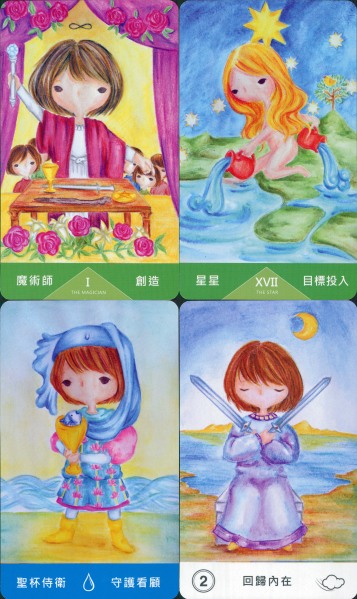
The Juicy Tarot from Taiwan is a rather fine Rider Waite clone targetted especially at children. The figures are all cute, child-like dolls, but interestingly the artist has adopted the device of not showing the mouth. We have seen similar devices on other decks, where the artist missed out some feature. Thus in the Ator Tarot figures have one eye depicted as standing outside the face, and in the Carnivale tarot majors the eye on the right is replaced with a symbol for the arcana. The imagery in the Juicy Tarot follows the Rider-Waite pattern very closely in both the Majors and Minors.
6 November 2015
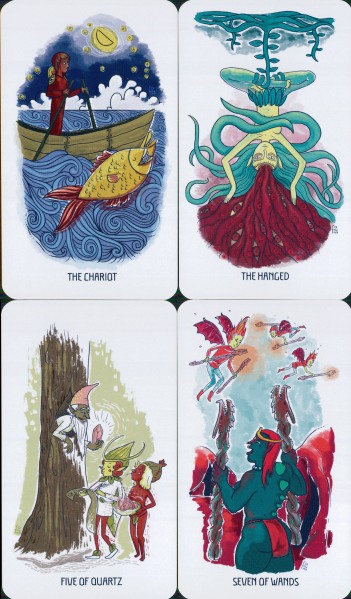
Until last week I knew of no tarot deck issued in Puerto Rico. The closest is the Universo of Rafael Trelles, an artist from that Caribbean island, but he actually created his deck in Tenerife, one of the Canary Islands, where it was published. Now I have my first Puerto Rican deck. This is Fanuna's Tarot. Fanuna is the nom-de-plume, or should that be nom-de-stylus, of Stephanie Cavina. It is a full 78 card deck, full of fairies, elves, pixies and gnomes. On first glance it looks like pen and watercolour, but it seems to have been created in a computer painting program. You can see some of her other work on her Deviantart page. Copies of her deck can be purchased on her Etsy page. My copy arrived very quickly from Puerto Rico. Though self-published, the cards were professionally printed.
www.etsy.com/shop/fanuna
5 November 2015
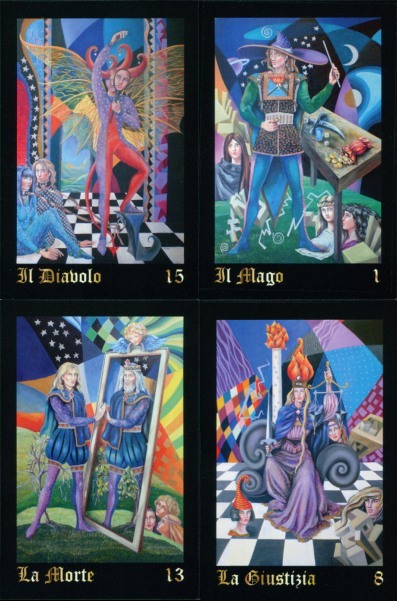
In contrast to the Scandanavian 'artist' I mentioned yesterday, here instead is a real artist who spends her time painting in oils rather than hanging around in trees. In May of 2013 Anna Maria Lo Bello held a solo exhibition in Turin's InGenio gallery on the theme of the Tarot Major arcana, for which she created a series of 22 original oil paintings on panel, 20" x 27". She was born in Sicily and now works in Turin. She spent part of her life living in Venezuela, and says that "the experience and the tropical atmosphere in which I lived, have influenced my vision of colour and composition, and they have been important in my artistic maturation."
Happily for us she has printed these images out in postcard size cards 6" x 4".
You can buy a set of these rather beautiful cards from her Etsy shop in a signed and numbered edition limited to only 40 copies so do get one quick!
It is no wonder that Italy is the birthplace of tarot art, when such fine artists as Anna Maria Lo Bello are still inspired by the imagery.
What an original and rather engaging depiction of the Death card.
www.etsy.com/shop/factoryoftheartideas
4 November 2015
I am afraid that I am a bit old fashioned and find it impossible to take conceptual and performance art seriously. It often seems like pathetic self-promotion and the courting of media interest, with little to do with what I understand as art. Recently I came across this rather amusing piece of 'art' news. It concerns the Scandinavian artist Hilde Krohn Huse who was was creating a video performance artwork in a Norwegian forest when the 'artwork' went terribly wrong. She was videoing herself suspended naked - one doubtless has to be naked for the media to take any interest - from a tree branch with a rope but at one point she was unable to untie the knot and found herself hanging upside down from the tree for some hours until she was rescued by a friend, only experiencing minor cuts and abrasions and some wounds to her dignity. The image rather reminded me of the Hanged Man, though I doubt this was her intention. Unsurprisingly, the art establishment has such pathetic ideas about art, that they jumped on this media sensation, and selected her video for the Bloomberg New Contemporaries 2015 exhibition, which supposedly highlights the most promising art students graduating in the UK. The artist Hilde Krohn Huse recovered from her accident in the forest and made the best of it, saying, "The video ends when the camera shuts off, but I was there calling for help for another 30 minutes. I felt sick when I saw the video for the first time, I experienced everything anew. But I slept on it and realized that the video is quite decent."
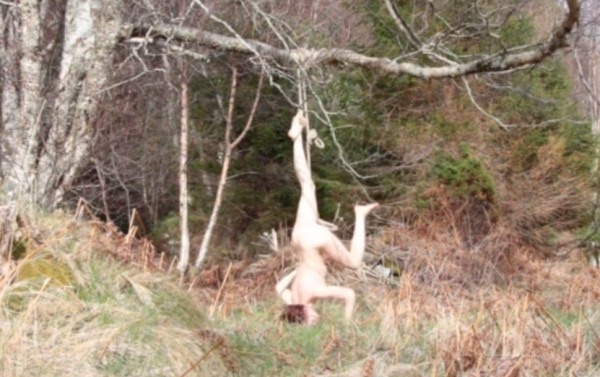
It would amuse me even more, if in a few years time, some tarot photo collage artist might use this image for the Hanged Man.
4 November 2015
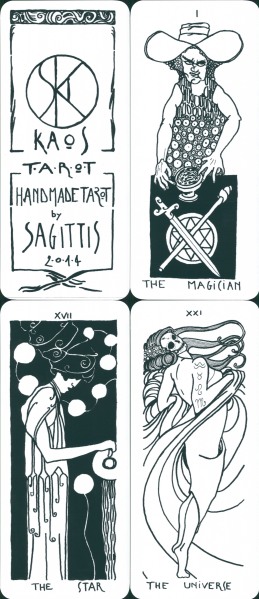
The last of the three tarot I bought from the Italian publisher is the Kaos Tarot. This is a departure from the doll based images of the other two, and instead explores tarot imagery from a more surreal perspective. The line drawing using a number of different thickness of pens, is often contrasted with solid areas of black. The images can be easily read as reflecting the tarot archetypes, but in some cases are rather strange and original conceptions.
3 November 2015
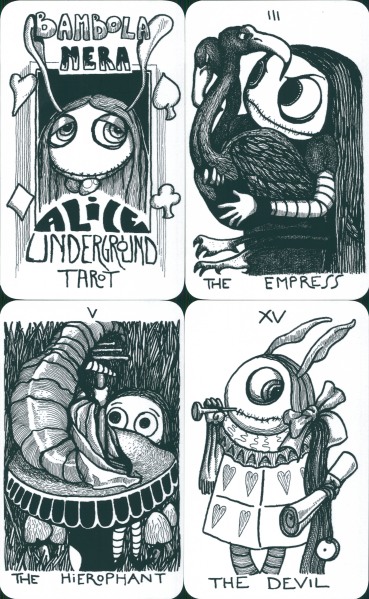
This is the second of the Tarots emanating from the Italian publisher, that I purchased recently. It features the Bambolanera voodoo doll like figure used in the first tarot this publisher created back in 2014. Here she becomes Alice Underground, and we see her depicted in various tableau reflecting Lewis Carroll's well known tale. I took a quick check of my collection and I can find five other tarots on this theme - The Wonderland Tarot, Fantasy Alice Tarot, Emi Tarot's in 22 Arcani, the recently published Alice Tarot, Alice in Tarot Card from Japan 2009, and I seem to vaguely remember another Japanese tarot on the Alice in Wonderland theme. Dominic Murphy, the British artist known for his wonderful Lost Tarot, also produced a set of playing cards on the theme of Alice in Wonderland which I was lucky to buy. Check his Facebook page for some further artwork based on the Alice stories.
2 November 2015
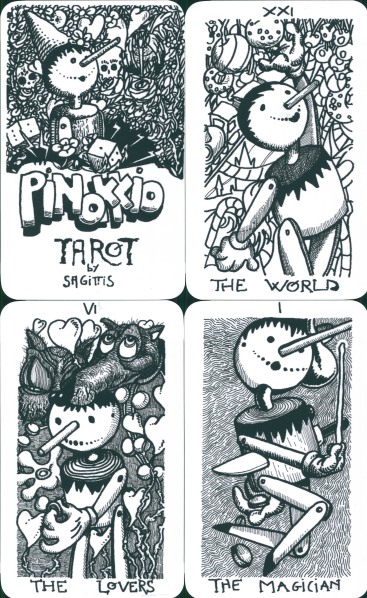
I have rather neglected posting on this weblog, partly due to my opening a Facebook page www.facebook.com/tarotcollection/ dedicated to my Tarot Collection, however, I will begin posting material up here as well, as people seem to miss the Tarot Weblog. Last week I bought three tarots from an Italian artist, Sagittis, who works primarily in pen line drawings. I really admire the style, and a year ago I bought two tarots from this artist, one of which was the original artwork. Usually the printed editions are 50 copies. Few people seem to know of this artist who has produced around 10 or so tarots in two years. These appear to be sold primarily through Etsy. Anyway here is the recently issued Pinokkio Tarot, Majors only in black line drawings. The cards are large and presumably not intended for divination, but purely as works of art. I already have three other Pinocchio themed tarots - the Tarocchi di Pinocchio by Iassen Ghiuselev, the Tarocchi di Pinocchio by Armando Valcauda, and Tarocchio Massimiliano Frezzato. I will post up the other tarots I have by Sagittis, over the next few days.
14 April 2015
I am now in the process of moving from my current address in Glasgow to the small town of Kilbirnie. I have been very lucky to have been able to buy a large flat there at a really modest price. I intend to move in June or July. As I have about 5000 books on alchemy, all aspects of symbolism and art, over 2000 tarot decks as well as a number of computers printers and about 500 paintings, this will not be an easy move. I am slowly beginning to box up all my items and expect this to take a number of weeks. I am now beginning to reach the point where I will start to box up my tarot collection. This means I must suspend selling items from my collection as they will inevitably be impossible to find in some box. So I am removing the links to my sales pages for the next few months. I expect to be able to begin selling items again in July.
I will continue to sell the few remaining copies of my Art Tarot Series throughout the move as these can all fit into a single storage box and thus be easy to access.
24 March 2015
Late in January this year the Italian costume and set designer and theatre director Cristian Finoia died at the young age of 39 while waiting for a heart transplant. He was one of the most promising of Italian threatre directors and was building an international reputation with productions in Japan and Qatar as well as most European countries. Cristian had so many plans, so many projects to work upon, so his death is a tragic loss to the artistic and theatrical community. There are some videos about his work on Vimeo and Youtube.
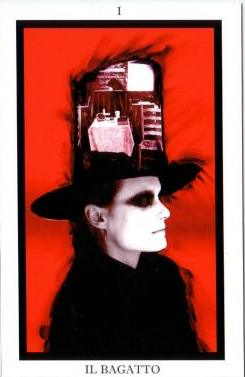
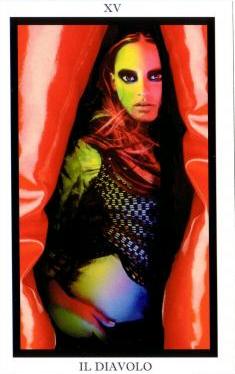
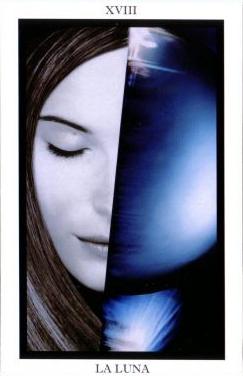
In early 2008 I bought a tarot he produced. It was self published and he only issued five copies, signed and numbered. It was expensive but I felt it was of significant cultural value that I wanted it in my collection. I wrote about it at the time in the entry for 25 Jan 2008 for my tarot weblog.

25 Jan 2008 Yesterday evening I was able to buy a rather rare and obscure Italian tarot 'I tarocchi di Cristian Finoia', 22 cards with original box and booklet, self published in 2007 by Atelier Finoia art studio in an edition of only five copies, signed and numbered. I have bought number four which was apparently the only one publicly available. The creator of this tarot is the stage and costume designer Cristian Finoia who has created sets and costumes for over twenty theatre and opera productions (including La Traviata, Aida, Idomeneo, Elisir d'Amore, Metamorfosi, Oberto). Strangely, I was able to buy this without any counterbidding, which suggests that few people are interested in collecting such pieces. I am quite surprised at this, because anything produced by a known artist in an edition of only five copies surely must be a good investment and worthy addition to a collection, even if it was just a promotional item given to some of his friends. Perhaps people are just not seeing the value in such pieces. Anyway this is my gain and other collectors loss. The artwork itself is rather captivating.
9 March 2015
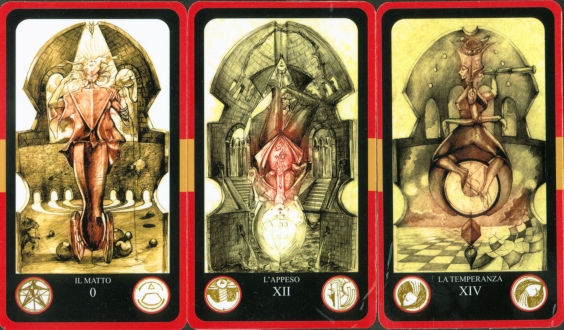
I had a look at the origins for the St Patrick's Well tarot of Ertan Aktas. This well was built built at Orvieto in Italy in 1527. It was called the Pozzo di San Patrizio and was designed by Antonio da Sangallo the Younger to supply water to the city in the event of siege. The well takes its name from St Patrick because of its alleged similarity with the cave the Irish saint is believed to have used as a retreat for penitence and prayer.
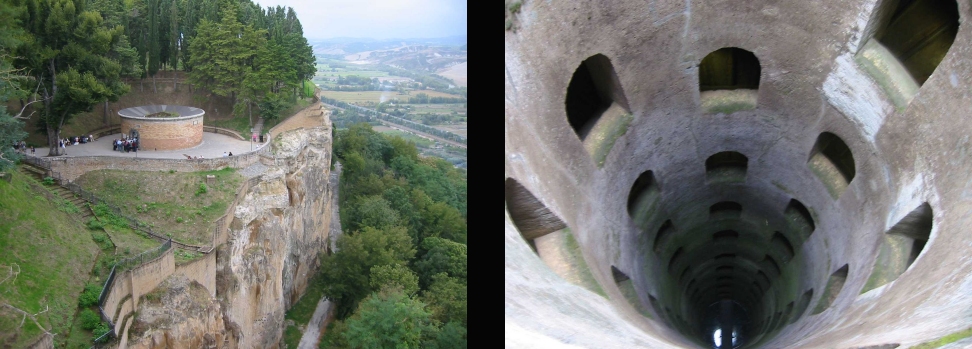
The ingenious design of the well uses two spiralling staircases forming a double helix going down to the water, built in such a way that those descending with their mules or donkeys would never meet those ascending in the opposite direction. The appearance of the well is evocative of the entry to Hell and it is this that Ertan Aktas has taken up as an inspiration for his tarot designs.
9 March 2015
Today I received the St Patrick's Well tarot created by Turkish artist Ertan Aktas. The artwork is very fine and detailed being based on some larger etchings. You can see his tarot designs on ertanaktas.wix.com/exlibrisandtarots and view some of his other work on his website. He has great abilities at drawing, and this underpins his paintings, etchings and prints.
28 February 2015
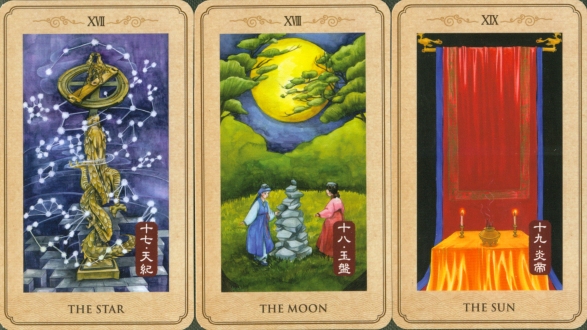
The Korean Cultural Heritage Tarot is another deck by Choi Eunha. As with the Misty Tarot the artwork is outstanding. Sadly, my knowledge of Korean culture is so limited that I cannot immediately appreciate the imagery associated with each card, but no doubt this will mean a great deal to the Koreans amongst us. No doubt each card emblematises some key facets of Korean history.
27 February 2015
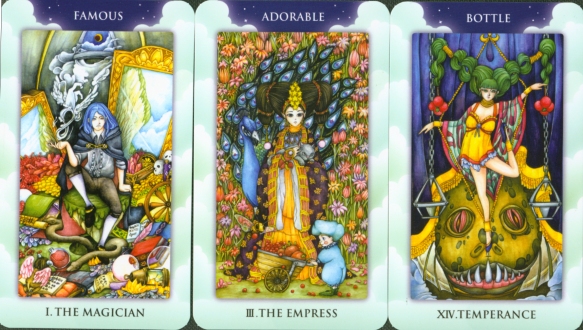
The Korean Misty Tarot, Majors only deck published in 2014 with an accompanying book has some excellent artwork. This is in pencil and watercolour, so there are no bold outlines, but the forms are blended into one another. The artist is Choi Eunha, a Kaywon School of Art and Media Arts graduate.
26 February 2015
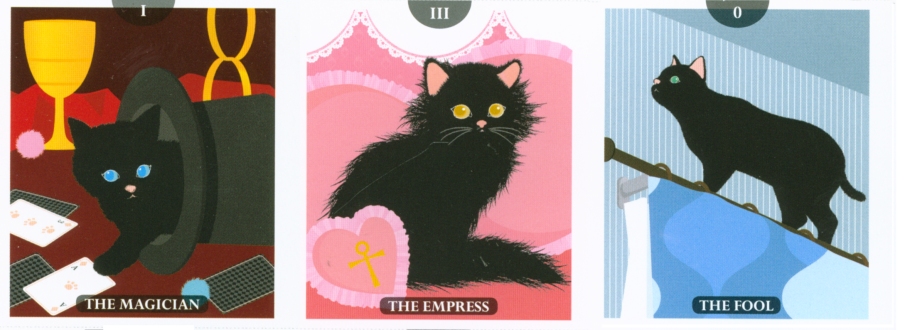
How on earth does anyone collect so many cat themed tarot? Well I will have to confide that the secret is to buy them as soon as they come out. So that is what I did with the Japanese Black Cat Tarot. It was issued with a Japanese young persons magazine in December 2014. In a few months it will be difficult to locate copies, and in a year or so almost impossible to find, but at least I have my copy. 22 cut out cards printed on thick glossy surfaced board.
4 February 2015
I am sorry that I have not posted out an entry on here for about a month as I have been very busy with other projects.
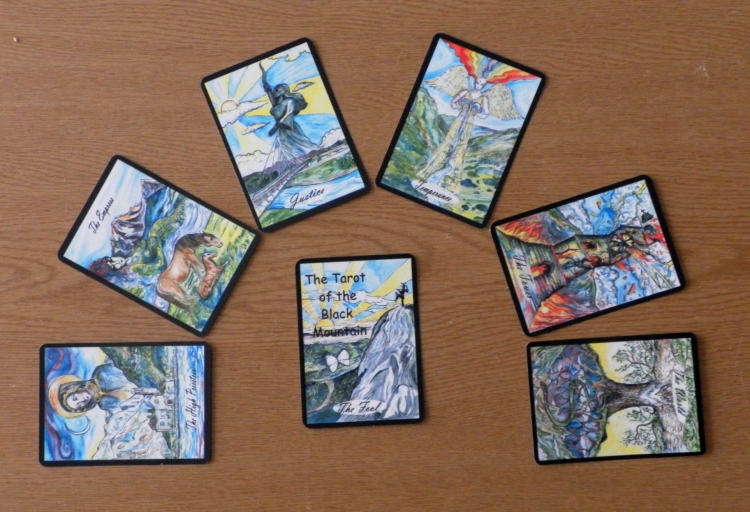
A few days ago I completed the production of number 29 in the Art tarot series. This is a small edition of Emily Carding's 'Tarot of the Black Mountain' which was originally issued with a book of poems published in Croatia, and it proved frustrating for some collectors who were trying to obtain a copy. As I understand the book is now sold out of its edition and even more difficult to source. So Emily Carding has asked me to issue it as a small edition in my Art Tarot series, which I was very pleased to do.
You can see and buy a copy through this page.
www.alchemywebsite.com/Tarot/art_tarot29.html
Only 30 copies are for sale so I expect it to sell out (as have other tarot in my series) within a week or so. So if you wish a copy - please buy quickly. I have kept the price low. Once it is sold out I expect it to fetch high prices on the secondhand market. There are only 3 copies currently left for sale.
4 January 2015
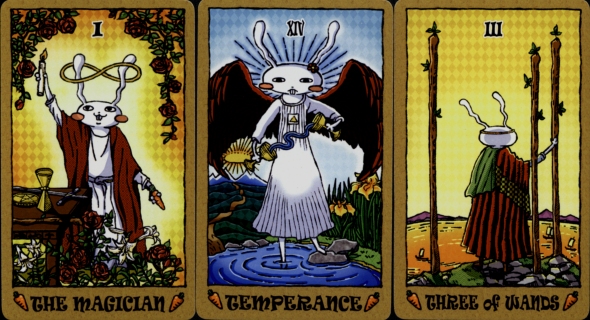
Back to animals! This time stylised rabbits in the Kimo Tarot with illustrations by Rinousagi. This is their second go at a rabbit tarot, they must be obsessed with rabbits. The first deck was called 'Usa tarot', nothing to do with the 50 states - 'usa' is japanese for 'rabbit. I suppose 'Rinousagi' means 'a lover of rabbits'. It shows. This time it is a full 78 card Rider Waite clone.
3 January 2015
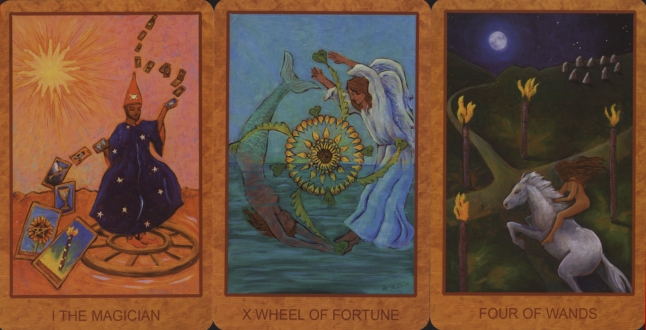
The Tarot de St. Croix was issued in 2013 by the american artist Lisa de St. Croix who is of South African origin. She writes "It was inspired by current affairs, personal experiences, mythology and synchronicity. This deck transcends time to portray the tapestry of life. The rich, vibrant colors of oil paint and the gold borders give this deck a warm and sensuous feeling." The artwork is certainly very fine and well executed. There are not many tarots created using oil paintings, so this is something special.
2 January 2015
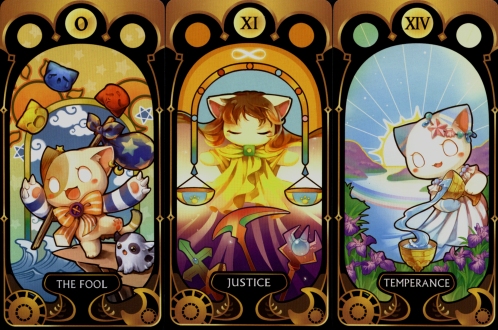
DNAxCat would appear to be some recent Taiwanese publishing phenomenon aimed at children - books, toys etc. Now they have issued a Tarot of DNAxCat which I have, obviously, now bought, but I am none the wiser as to what this strange title DNAxCat is about. At least it has cats. The large cards come in a rather fine strong lidded card box.
1 January 2015
A few months ago I discovered a painting featuring a tarot reading by the British surrealist artist Bridget Tichenor.
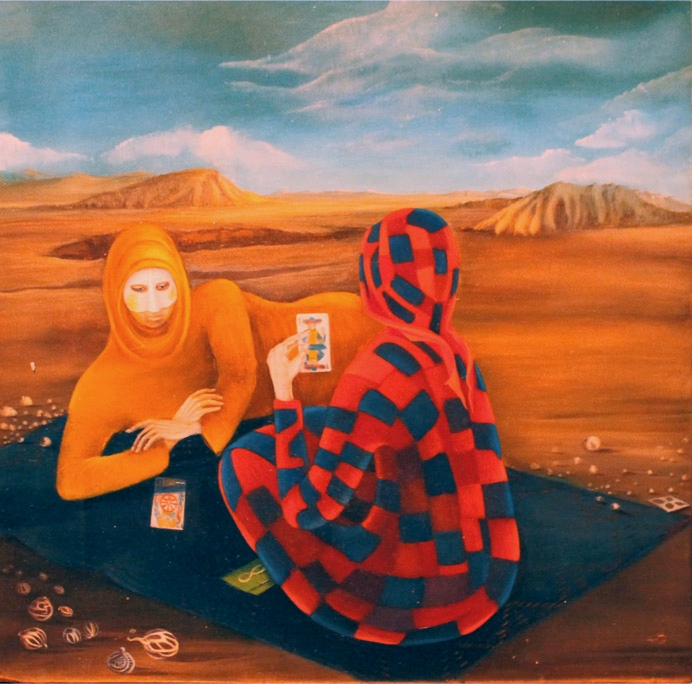
She spend most of the latter part of her life in Mexico where she devoted her time to painting. She is regrettably almost unknown but her work is engaging and delightful. I have devoted part of the tenth lesson in my study course on surrealism to her work. This is on the Exiles in Mexico - Leonora Carrington, Remedios Varo and Bridget Tichenor and can be seen on Youtube.
Study course on Surrealism Lesson 10
31 December 2014
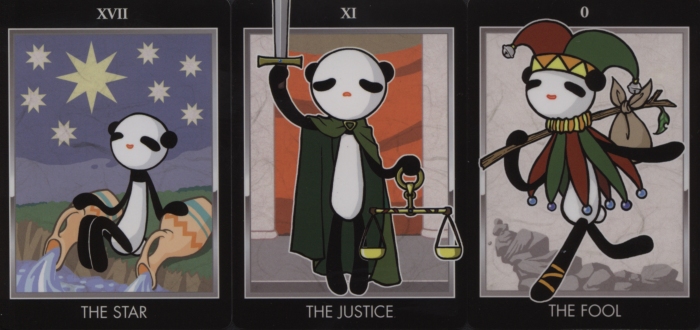
I thought pandas were from China not Japan. But one does not think factually when designing a tarot deck. So it should not be too surprising that this Iyapanda Tarot was recently issued in Japan. Japanese pandas seem to be rather slim.
30 December 2014
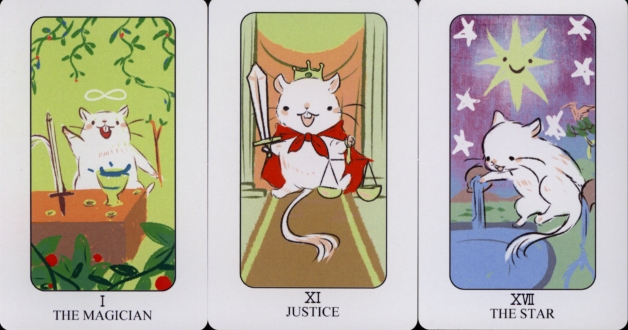
Animal themed tarots are ubiquitous. Cats, dogs, parrots, frogs, penguins, cephalopods have all made guest appearances. I could not resist the Japanese White Gerbil tarot recently published and available through my favourite tarot dealer.
17 December 2014
There is now only one copy left to sell of the Rotin Tarot.
www.alchemywebsite.com/Tarot/art_tarot08.html
If anyone wishes to buy the last copy please email me at adam@alchemywebsite.com
8 October 2014
I am sorry I have not had much time recently to put up many postings on this weblog. I have been rather engaged in creating my Study Course on Surrealism. I have now created two of the lessons and sketched in quite a few others. I have decided to issue it for free on Youtube and will upload the various lessons over the coming months. The first two are available at:-
www.youtube.com/watch?v=eJUmFr54TZE
www.youtube.com/watch?v=FngpGW1cvMw
There will eventually be about 25 or so lessons, making it quite a comprehensive study of the subject.
5 October 2014
Is there any interest at all in my pages on unpublished tarot designs ? I first started this project at the end of July to document the many wonderful tarot designs that had not been published. I put up a new page each day for almost six weeks, about 50 items. I got no feedback on this at all. During the last two weeks of September, my time was taken up with the publication of one of my alchemical books and I was not able to give any time to the unpublished tarot listings. Since then no one has contacted me about this, I have had no feedback, nada, zilch, not a dicky bird. So is it worth continuing ? I have so many calls on my time, so many other projects to work on. My Google Analytics report only very few hits on that page, so perhaps it is time to stop. It is a bit sad because I thought it was a useful thing to do to draw people attention to some of the unknown wonders of tarot art, but without an audience, it is mere self-indulgence on my part. I have researched and collected a list of some 500 plus items. I will continue to add to this database on my computer, but it seems that only myself, and perhaps a handful of silent viewers, have any interest in this material.
3 September 2014
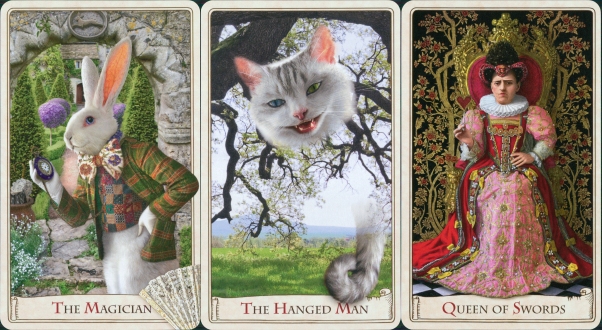
At last the long awaited Magic Realist Press Alice Tarot is published. It was designed by Karen Mahony with the complex graphics of collage and posed photographs by Alex Ukolov. I cannot conceive of how many hours must have gone into the artwork for each card. It is a great delight and well worth the wait. They have opted to issue the cards in a hinged clamshell solid box - rather a neat idea.
21 August 2014
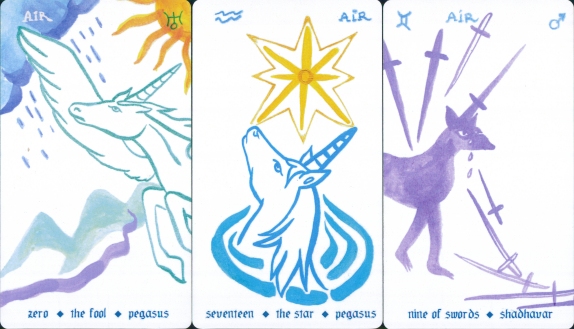
The Unicorns of the Universe Tarot was created by Rebecca Schoenecker and self-published using the Gamecrafter system. She describes this as "a traditionally derived tarot deck with planetary, zodiac and elemental associations.
11 August 2014
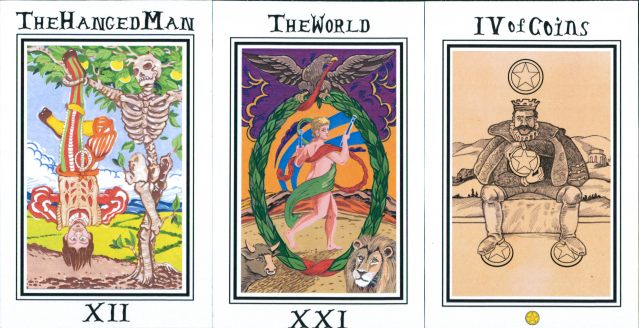
The Fools Tarot is published in the UK by Bruce Michael Baillie. It is a 78 card deck with the Majors in full colour but the Minors in sepia monotone. The Pip cards follow the familiar emblem sequence of the Rider-Waite, but the designs are somewhat in the style of the 16th century printmakers, Holbein and Amman. You can buy copies direct from the artist at www.brucembaillie.co.uk
8 August 2014
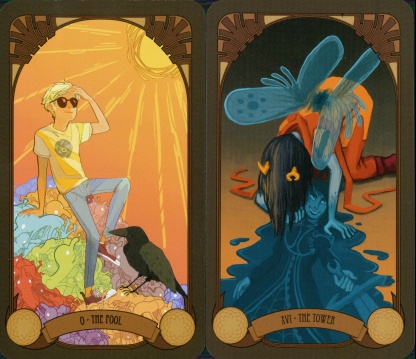
Homestuck is a webcomic written, illustrated, and animated by Andrew Hussie and is available on the rather low res mspaintadventures.com. The author Andrew Hussie has organised many of the users to contribute card designs so that he could issue the Homestuck Tarot, thankfully in high resolution.
5 August 2014
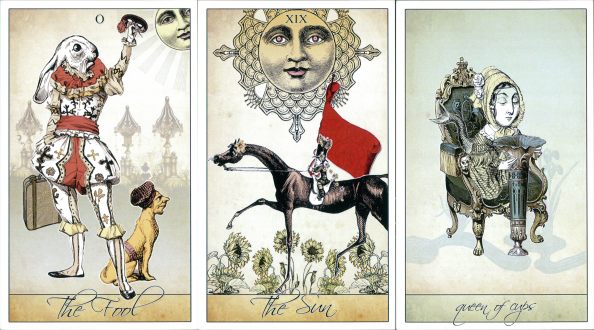
Bethalynne Bajema has now produced a third tarot. I first came across her work, the Sepia Stains Tarot, in 2010 before she had finalised it for printing and I was able to buy one of the 10 prototype decks. A year later she issued the Black Ibis Tarot, consisting of posed photographs of models, primarily female, wearing goth or retro clothes, with collaged headresses and some other elements. Now she has published the Isodore Tarot, subtitled "A Neo-Victorian tarot deck". This is named after the illustrator and caricaturist Jean Ignace Isidore Gerard Grandville (1803-47). Bethalynne Bajema has collaged images from Grandville's animal series and creatively reworked these into complex tableau. Supplied in a tin box. She has a great talent at digital collage. The deck is beautifully printed in offset lithography with the top black layer being printed in an ink containing some varnish which makes it stand out in relief on top of the background colour - a rather fine effect.
31 July 2014
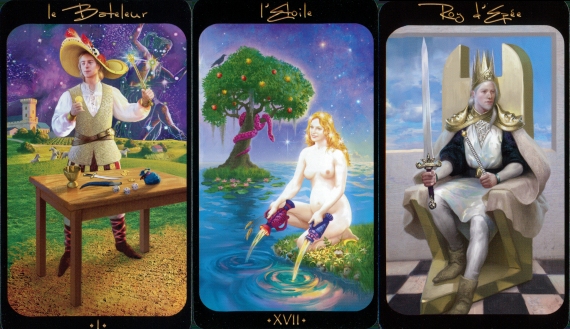
Mon Tarot Marseille was created by Emmanuelle Patrigeon digitally mimicing oil or acrylic paintings. The colours are vibrant and the artwork, though based on the traditional Marseilles pattern, translates the imagery into an entirely contemporary style.
30 July 2014
Over the years I have collected many hundreds of unpublished tarot designs on some graphic sites. Some of these are truly amazing. So I have decided to start a new page on this website on which I will occasionally post some images from some of these tarots. I will put a link on the bar above.
Click here to see the unpublished tarot designs page.
30 July 2014
I have just checked my inventory and three of my Art Tarot series are down to the last few copies. Unlike some other publishers I never reprint limited editions. So if you wish a copy of one of these perhaps it would be wise not to hold back for too long. The three involved are :-
Corneal Edema 5 copies left
Rotin 5 copies left
Ithel Colquhoun 10 copies left
30 July 2014
There are a small number of minimalist tarots such as the German Energetic Tarot and some tarots of Kabbalistic letters. I recently obtained the Tipografico Tarot published in Argentina. This merely shows the title and number of each arcanum. They are printed using letterpress in different coloured inks on a plain orangey brown card.
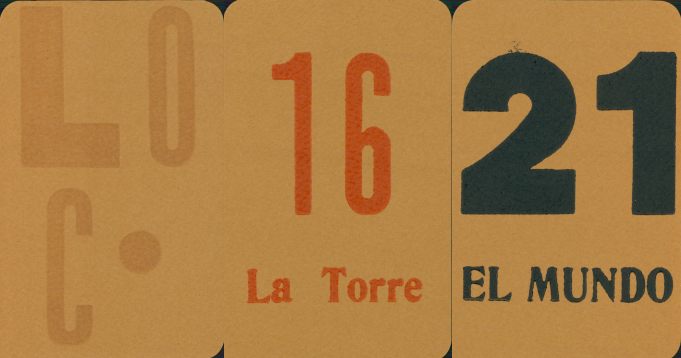
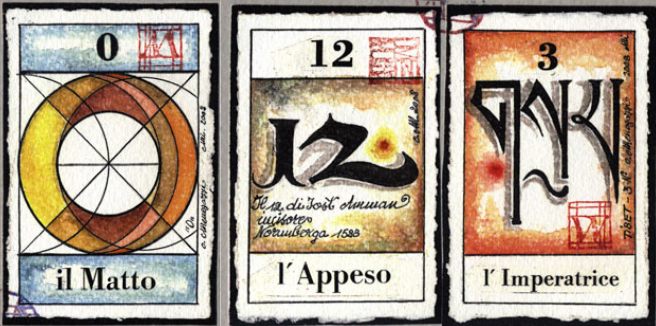
It has almost no artistic content. Compare this with what the truly creative artist Osvaldo Menegazzi did with the same idea in his Tarocco Numerico. Now that is the way to do it.
29 July 2014
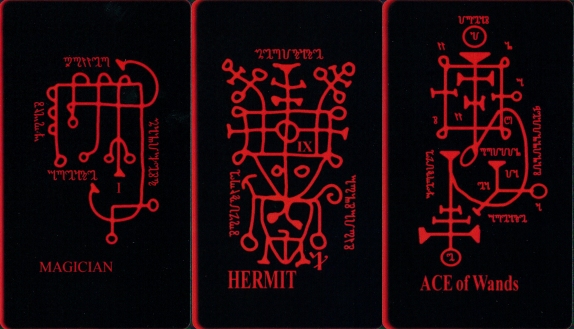
Gamecrafter is a print-on -demand system for cards and games, which has given creators of tarot designs an easy path to the production of a well printed tarot deck. This does mean that rather obscure and specialist designs can see the light of day. An example of this is the Wraithe Sigillum deck created by William Robert Wraithe. Wraithe has published a number of books on magical sigils, those strange forms of interwoven lines with terminators and cross forms which we find in 15th - 18th century magical manuscripts and some printed books. He is concerned with Enochian seals and sigils, the Key of Solomon, Agrippa, the 20th century artist Austin Osman Spare, the OTO, Books of Shadows and even the zombie cult. He has devised this set of tarot designs which I doubt will appeal to many of my fellow collectors. I bought a copy because it represents a particular esoteric style, but its elaborate structure entirely escapes me. Wraithe intends to withdraw this from Gamecrafter when 200 copies have been sold - I wonder how long that will take - perhaps he has a considerable following within the modern magical community.
28 July 2014
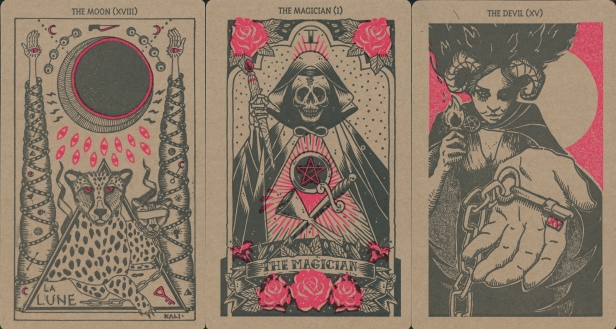
The Southside Tea Room is a well known venue located in Brisbane, Australia. Southside Tea Room teamed up with local letterpress printer Little Peach Co. and engaged twenty two local, national and international artists to collectively put their unique stamp onto a deck of tarot cards. They must have given the artists a clear idea of what they expected, as unlike many other such collective tarots, this one has a degree of coherence. You can buy it from their Etsy shop.
27 July 2014
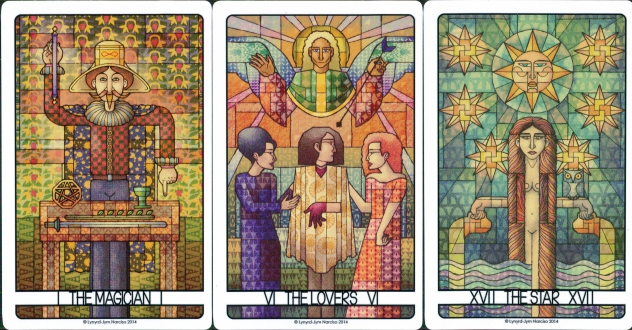
Lynyrd Narciso has been producing tarot designs for over ten years. Based in the Philippines he has not always found it easy to market his work, but with the help of some supporters in the USA, he was able to issue a number of decks. I, myself, was able to publish his Tarot ng Daigdig sa Balintataw which translates from old Filipino to "The world inside the pupil of the eye". I, and others, had noticed that he had been rather quiet of late but we were all delighted when he announced the publication of a new work the Tarot Resom. 'Resom' is not another old Filipino word, but the name 'Moser' reversed, and it refers to Ditha Moser the wife of Koloman Moser the Austrian artist who exerted considerable influence on twentieth-century graphic art being one of the foremost artists of the Vienna Secession movement. In 1905 they issued the Jungendstil Tarock, this word being the German equivalent to 'Art Nouveau'. So Lynyrd Narciso's latest deck is designed as a tribute to the Mosers. Happily, he has been able to do this using the Gamecrafter system which enables people to easily self publish sets of cards. I hope he will now begin issuing other sets of his designs through this system. You can buy this through this link www.thegamecrafter.com/games/tarot-resom
26 July 2014
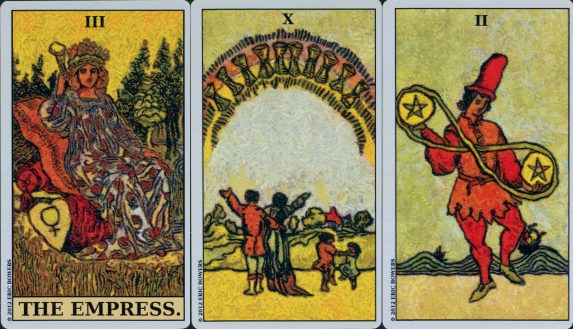
The Van Gogh Tarot appears to be a modern version of the Rider Waite digitally scanned and then pushed through the Van Gogh or some similar graphic filter used in Photoshop. In the blub about this deck the 'artist' states "each card has been repainted in a style that adds an artistic depth and enrichment to the classic deck". That raised a smile if not a chortle from me. How sad it is that someone wishes to associate this graphic mess to poor old Vincent. Van Gogh was dealt a rather bad hand by fate, now to continue the metaphor a rather bad hand of cards is being thrust upon him. To claim these graphic messes as having been painted stretches the idea beyond credibility - 'artistic depth', 'enrichment' - what a disgrace!
25 July 2014
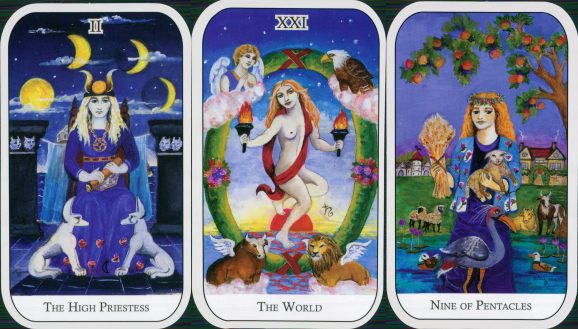
I have noticed recently a number of tarot decks emanating from Australia. Alison Muir McDonald's Watersprite Tarot arrived a week or so ago. Maybe I am getting old and unperceptive, but I am struggling to find the association with watersprites, which I suppose is okay as such things don't exist. Anyway dismissing the watersprites, the artwork consists of some rather fine watercolour paintings without pen outlines. Her backgrounds are carefully stuctured and I understand that she considers this important to giving a meaning and context to the foreground figures. A well conceived and executed deck. There is an extra 'Blank Card' which is not actually blank. The backs of the cards show two seahorses - are these the watersprites? I expect I will never know.
23 July 2014
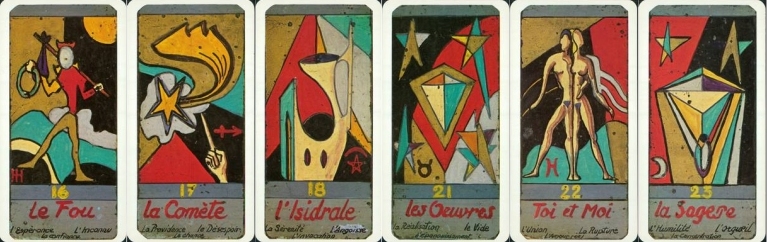
This morning as I was making up some French tarots and oracle decks for my sales pages, I came across a deck that I had entirely forgotten, l'Oracle Mercurale. The artwork, however, I found very engaging. These are small paintings in oils on board and essentially abstract in style though with sufficient figurative elements to give this a clear meaning. It is not a tarot as such but some of the images reflect tarot archetypes. It was published in 1983.
18 July 2014
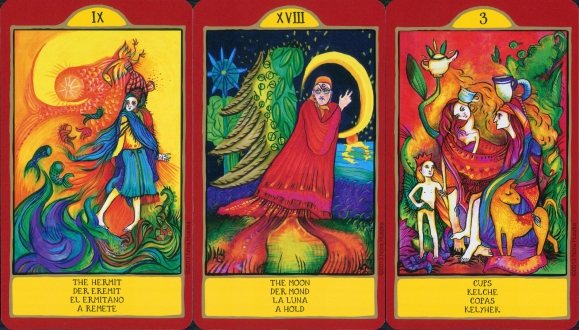
The Gypsy Palace Tarot self-published by Nora Huszka in Germany is a delightful riot of strong colours created in pen and brushed ink. It has powerful and engaging images. You can buy a copy through norahuszka.com/SHOP.html and also on Etsy.
17 July 2014
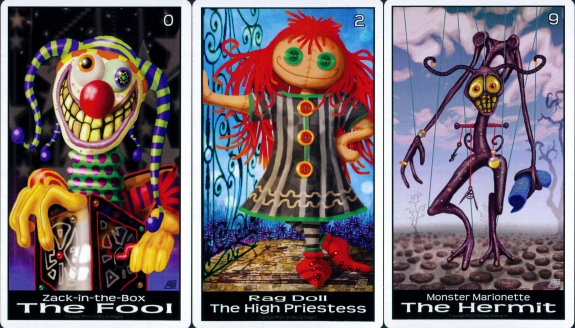
Over the last few decades we saw the rise of various major films and B Movies which explored the theme of malevolent dolls and toys - Child's Play, Poltergeist, Dolls, Demonic Toys, Puppet Master, and many others. The Twisted Toyland Tarot which I recently acquired reminds me of these films. The artwork is by Rodney Howington and the deck is easily available on Amazon. Just don't go looking for 'Twisted Toyland' on Google as you will get a bit of a shock.
16 July 2014
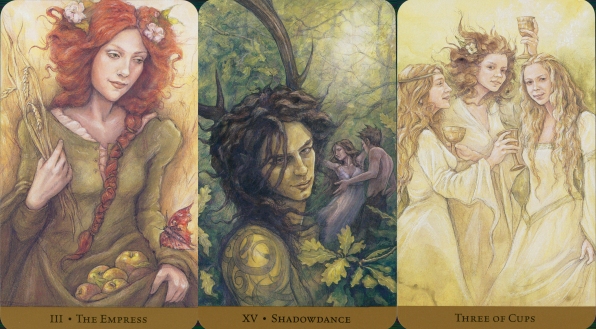
A few days ago I finally got around to buying a copy of the Tarot of the Hidden Realm. When I saw the box I immediately noticed the name 'Barbara Moore' as the author of the book. I decided to search my database to see how many tarots she has been involved with. There is the Silver Witchcraft Tarot, Shadowscapes, Steampunk, Mystic Dreamer, Gilded, Book of Shadows, Mystic Faerie, Vampires Tarot of the Eternal Night. If my arithmetic is correct that comes, with the Hidden Realm, to nine and the Beautiful Creatures Tarot is shortly to be published. What a prolific author ! I am not sure how much she is directly involved in the artwork but with her wealth of experience I expect most artists she collarorates with welcome her insights.
15 July 2014
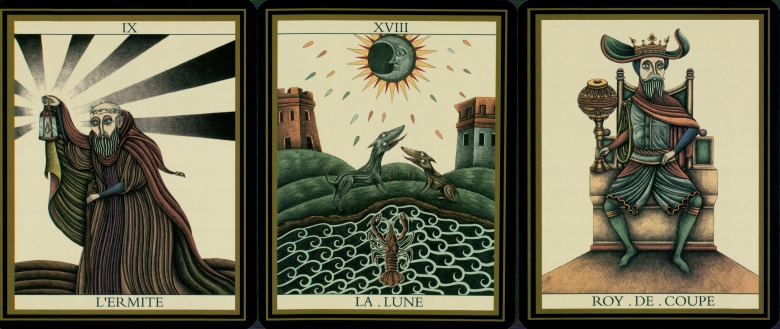
A week or so ago I bought a copy of the French Tarot Noir, created by Matthew Hackiere, which has some rather beautiful artwork. Born in North France in 1980, Matthew Hackiere studied at the school of fine arts in Tournai, Belgium, in 2005. He worked as a independent graphic designer and created visual identities for music groups. He released his first first comic, Macchabee Strips, in 2010. Supplied in a strong box with a paperback book.
14 July 2014
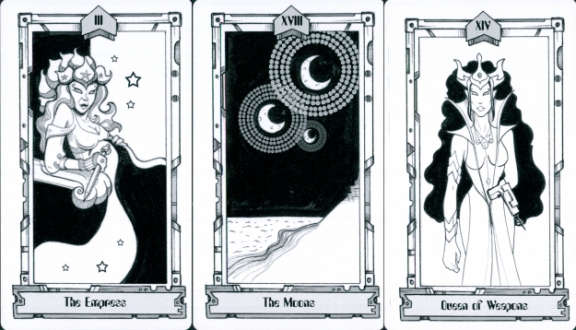
I recently bought a tarot from Gamecrafter based on the Machinations of the Space Princess Science-Fantasy role-playing game. This was created by James Desborough and mixes science-fiction and magic. It is a game of space pirates and beautiful alien princesses, of living planets and robot hordes. The Majors are renamed and though substantially altered, their imagery still reflects the tarot archetypes.
13 July 2014
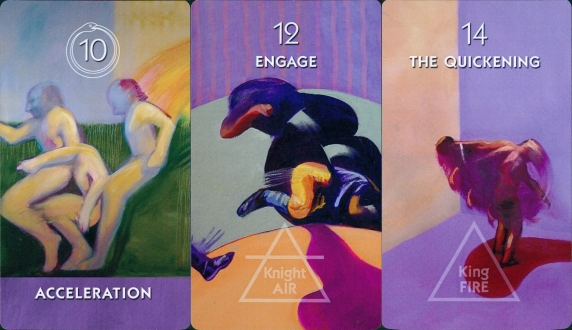
A Francis Bacon Tarot ! Well not quite. We are still awaiting that one. But meanwhile we can look at the Tarot of Creativity by Aliyah Marr. This deck is illustrated with original paintings that were executed over a 15 year period. It started out as a conceptual art experiment in 2004 which resulted in her first deck, The Transformational Tarot, a digital game that was exhibited in national art shows. It clearly shows some influence of the painting style of Francis Bacon with some areas of details smeared over with dragged areas of paint. The Majors are renamed and do not all link to the established tarot imagery.
11 July 2014
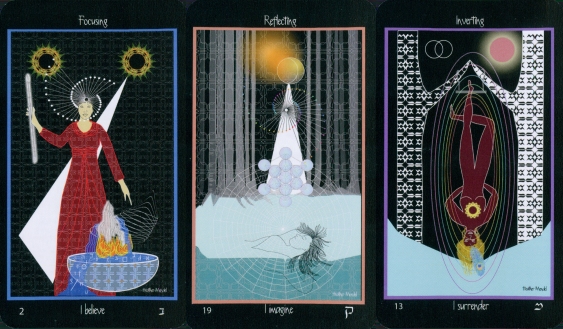
Many years ago I found the strange Greek word 'syzygy' when reading some of the Gnostic texts. Some of these conceived of their gods being in opposed pairs or syzygies. It was also used in astrology to describe the opposition and conjunction of planets, Sun and Moon. The word was adopted by Jung and the Jungians who decontextualised it and somewhat modified the meaning. Now Heather Mendel has created her Syzygy Oracle which, rather than being an unstructured set of cards, is a 22 card Majors deck together with 10 sephiroth cards. Mendel uses kaleidoscopic mandalas, fractals and sacred geometric designs. Underlying her imagery is a kabbalistic system. The 22 majors are numbered 1-22 rather than 0-21. They are renamed but entirely reflect the tarot imagery. The ten sephiroth cards are in the form of circular mandalas like kaleidoscopes. It was created using a vector graphics drawing program.
10 July 2014
Monica Knighton is well known for creating the Tarot of the Dead (1999) and recently the Stolen Child Tarot (2012). Now in the Healing Tarot, published by Schiffer, she uses her fine drawing technique to create a 78 card deck on the theme of the healing arts, exploring this idea through many facets.
9 July 2014
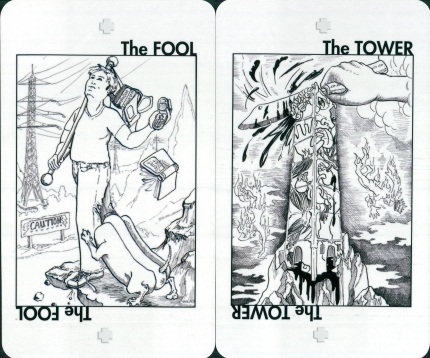
Last week I discovered a tarot that was produced in 2010 in the UK as a project towards a BA (Hons) Fashion Illustration at the London College of Fashion. The artist is Yeo Park and the designs are in pen and brushed ink and reflect the style of fashion illustrations. The artist produced a small batch, beautifully presented in a lidded box, and happily for collectors still has a small number of these left for sale. You can buy these direct from the artist at ParkYeo-Jung ylangylang47@hotmail.com
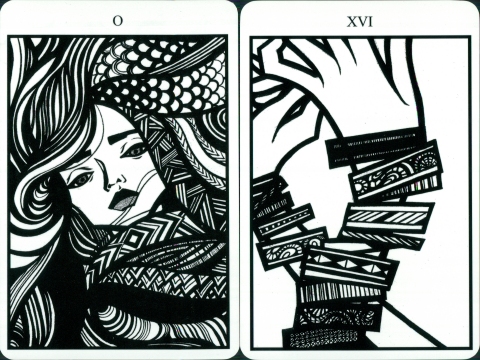
8 July 2014
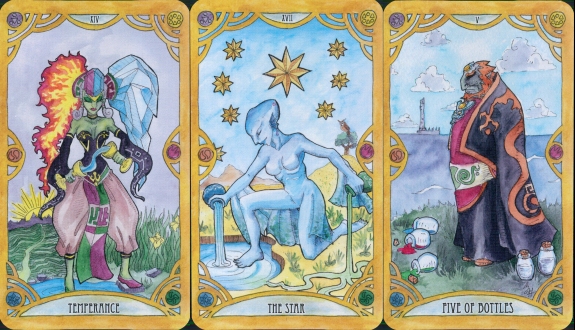
The Legend of Zelda is a fantasy action adventure game series created by Japanese game designers Shigeru Miyamoto, Takashi Tezuka and Eiji Aonuma for the Nintendo game consoles. Britt Hoyer has created this fan art deck based on the characters in the game. The pip cards follow closely the Rider Waite emblem sequence.
6 July 2014
Over this weekend I decided it was time to organise the many illustrations I have collected of as yet unpublished tarot decks. These I had gathered over the last decade from various browsing sessions and had been placed in all variety of folders on my system. So I have begun systematically reorganising them into named folders. There are now just under 400 of these with more still hiding in obscure folders. It does take some time to organise these, so this will have to wait till I have another block of free time. Some were consolidated into zip, pdf or doc files so it will take some more weekends to extract these into jpg files.
I have put them into my existing ThumbsPlus database of tarot card images. This I have been building since the Spring of last year, when I began scanning in all my tarot decks at 600 dpi resolution. This currently has over 1600 published decks entered. It takes an enormous amount of time to scan in cards at high resolution. I use this for my research and, in time, when all the material I have is entered, I will have a virtual library of modern tarot art. At the moment it amounts to 520 gigabyes so it is quite a challenge to backup. At one time I did have hopes that my physical collection of tarot art could be donated to a library and thus provide a resource for future scholars, but this was impossible as museums and libraries wanted an endowment of around one hundred thousand UK pounds ($170,000) in order to accept the physical collection. I, of course, do not have access to those kinds of funds. The virtual collection of images and my descriptive database will be more easily housed in some research library without needing a large endowment.
There are many tarot collectors, but I am one of the very few amongst them that want to collect tarot in order to document the phenomenon of tarot art. At the moment it is completely marginalised and ignored by art historians, but in the decades to come the format of tarot art will be appreciated by scholars and become part of the discourse of art history. I hope that my virtual library built upon my physical collection, will be useful to future scholars and researchers.
5 July 2014
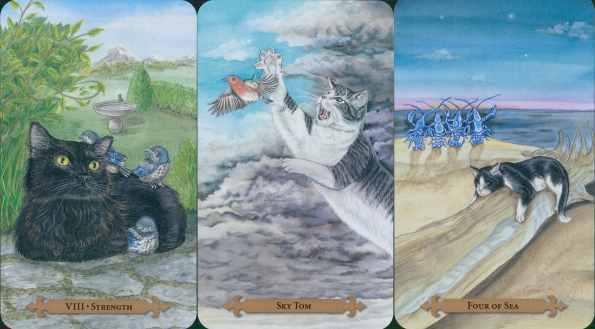
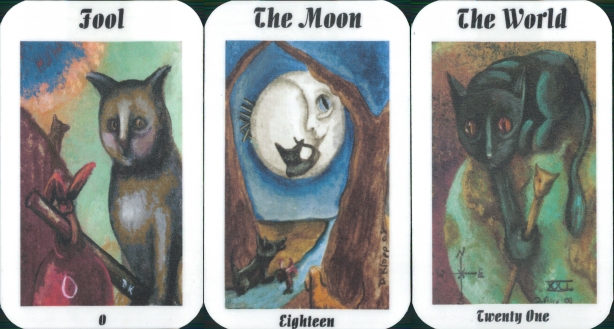
Now it is 'Mystical' cats that have found their way into a tarot deck. Black, White, Medieval even Bleu I can understand, but 'Mystical' is surely a difficult concept for a cat to express. Anyway these are rather fine pen and watercolour paintings. 'Strength' is rather cute with its inversion of reality with 'Sky Tom' perhaps closer to feline verisimilitude. The 'Four of Sea' appears to raid Lewis Carroll for the Lobster Quadrille which has gone entirely over my rational head, but well it is a 'Mystical' cat tarot so anything goes I suppose. This delightfully painted tarot is one of Llewellyns recent output.
Debra Klopp-Kersey had at go at the same idea back in 2008. I find she seems to have captured the idea more convincingly, and somehow persuaded my left-brain dominated mind to here give way to the right side. But then, what on earth is a left brainer doing taking an interest in tarot !
4 July 2014
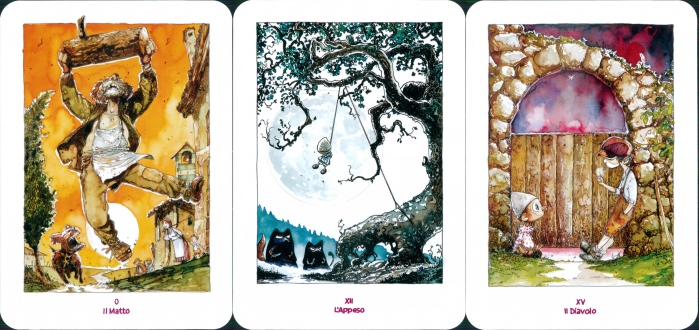
Pinocchio is one of the most engaging stories in modern Italian literature, being not merely an entertaining story for children, but having underlying allegorical elements that capture the interest of adults and attract serious literary analysis. The Tarocchio or Tarocchi di Frezzato was issued a few months ago and I have been able to buy a copy. This means I currently have three Pinocchio tarots ! Anyway this one is great fun and also has very good artwork in pen and watercolour. Frezzato is an Italian comic book author perhaps best known for his I custodi del Maser (Keepers of the Maser) series. He has very fine drawing skills.
3 July 2014
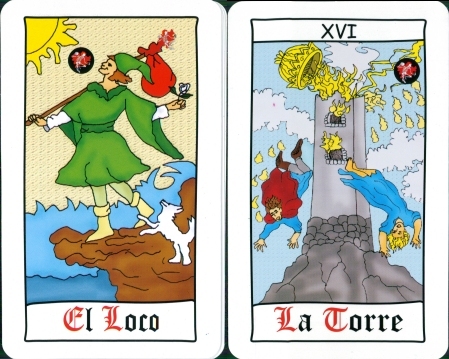
Yesterday I obtained a copy of a tarot from Peru. Not many tarots have been published in Peru and this one brings my total only to five. This is called the Tarot con la Santisima Muerte (the tarot with Our Lady of the Most Holy Death). This is a folk saint not usually sanctioned by the Catholic Church. She is usually depicted as a skeleton form. The 'Muerte' aspect does not really enter into the designs themselves but a small roundel with a skeleton is added to each image. I already have a similar deck published in Mexico. This Peruvian deck is essentially a redrawing of the familiar Rider Waite majors.
2 July 2014
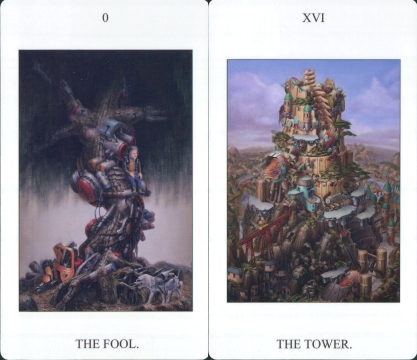
I recently obtained a copy of the Taimei Tarot through the well known dealer BabyDream. This is a majors deck with the original artwork by Takahiro Imai, Hiroki Kakinuma, Maiko Kitagawa, and Kaori Tamura, exhibited in December 2012 at the Taimei Gallery in Tokyo. Takahiro Imai and Hiroki Kakinuma work in oils. Maiko Kitagawa and Kaori Tamura work in pen and tempera. It has beautiful detailed imagery.
1 July 2014
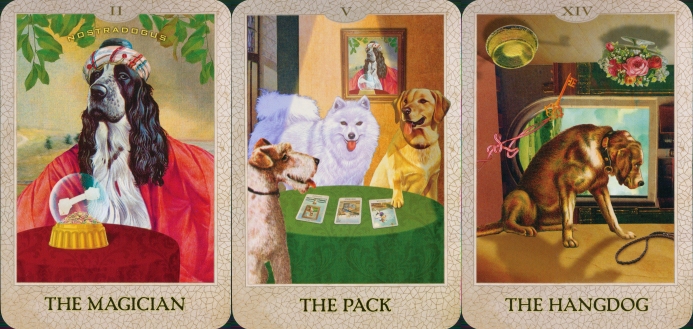
I have obtained a few more Cat themed tarots recently, but today I have the Original Dog tarot in my hands. This is a set of Eighteen Majors with twelve Minors (numbers 1, 3 and 7 of the four suits). The creator, Heidi Schulman, has a neat sense of humour, which can be seen in the Magician card which is subtitled 'Nostradogus', Card V 'The Pack' which shows three dogs at a table reading the tarot, and card XIV 'The Hangdog with its strange muddle of contradictory inverted and upright images.
30 June 2014
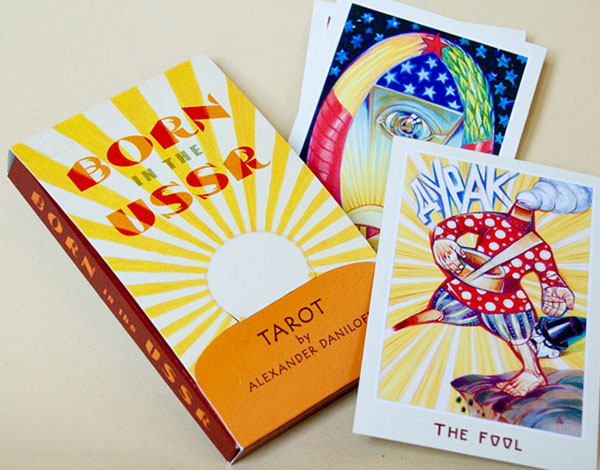
The Born in the USSR tarot is inspired by Soviet propaganda posters of the '20s and '30s which expressed the human enthusiasm for the construction of a better future. Alexander Daniloff uses this art style in an ironic way. You can buy copies direct from the artist at www.daniloff-art.it
29 June 2014
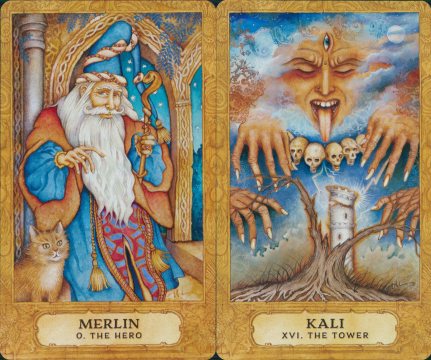
One of the recent issues of US Games is the Chrysalis Tarot. They certainly know how to find good artists and let them express their vision freely. Here we have some very detailed paintings into which are woven various elements and symbols. The Moon card is truly a tour de force.
28 June 2014
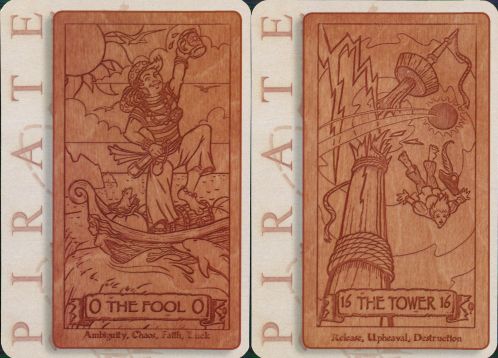
In early 2007 I bought a copy of the Pirate Tarot, a set of 22 'cards' in the form of 2 millimetre thin slices of cherry wood which had pirate themed images burnt into them using a laser engraver. The artwork was finely detailed and the 'cards' had the appearance of relief carved wood blocks from which woodcuts are printed though they were not very strong and easily damaged with frequent handling. Now Schiffer books has taken up these designs and issued a printed card full deck version. I must say I don't find the layout they have adopted particularly attractive, as they have chosen to print the card image on the left side of a card and have a large left margin with the word 'Pirate' in large print. Surely we don't need to be reminded in large bold type on each card that this is the Pirate Tarot. Why not just print the cards in the same format as the originals ?
26 June 2014
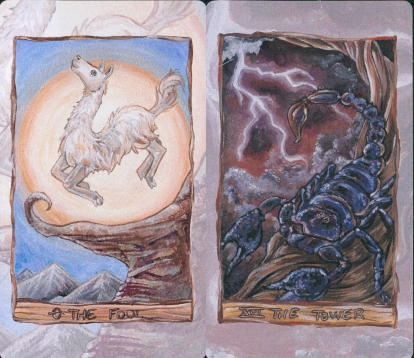
Joanna Cheung's Animism Tarot presents some delightful painted portraits of animals set in tarot situations. Not a human in sight! Her paintings are beautifully muted and sensitive. Of course it includes an additional "Happy Squirrel" card
25 June 2014
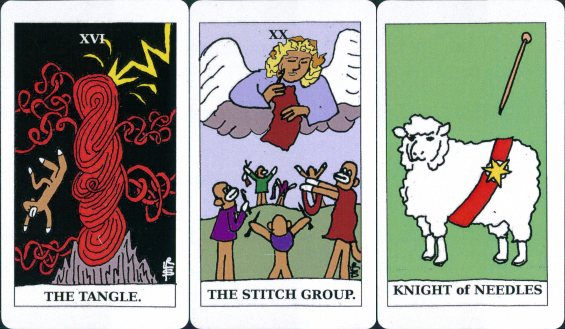
There are some strangely themed tarots out there ! I have recently acquired the Purl's Yarn Emporium tarot with its theme of knitting and wool. There is actually already a Knitting tarot issued in 2005 which luckily I also have. I suppose the Purl's Yarn Emporium tarot is intended as a promotional for their shop in Ashville, North Carolina, which sells wool and all the necessities for knitting. Naturally, the imagery is not without its delightful humour.
24 June 2014
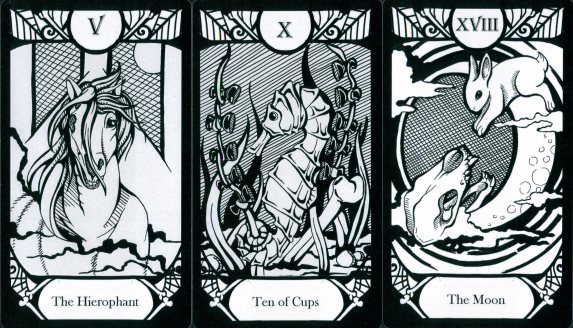
The Animalis Os Fortuna 78 card deck has some wonderfully bold and confident pen drawings of animals set in tarot tableau. It was created by Megan Weber who uses the nom-de-plume Zaheroux. You can see many examples of her work on Etsy, Deviant Art and other image sharing sites. Her colour work is also very fine. Anyway it is great that she turned her attention to create this tarot which is available through the Game Crafter at a reasonable price.
21 June 2014
A colleague has pointed out that my potential customers should be aware that the sales pages I create will not be immediately spidered by Google et al., but it might take a week or even more for the material in these pages to appear in search engine searches. Thus these are invisible to the wider world for a week or so, meaning that those keeping up with my sales pages will have first go at the items. I only have single copies available for sale.
I have just bought a batch of new tarots ! So why on earth buy items when I am selling off my collection? It seems perverse. Well selling my collection does not mean that I have lost interest in tarot art. It does give me some funds whereby I can purchase interesting new items. My intention in building my collection was to create a major reference resource on modern tarot, however, this proved so financially demanding that last year I was forced to reconsider my situation. Now the ongoing sales will help me buy new material.
20 June 2014
Now I have begun selling my tarots seriously, some of my potential customers have asked to be informed when I put up items for sale. I have set up an index page tarots_for_sale.html When I create a new page of items then I will put up a link on the right side of this index page. This could mean that people would have to check this page needlessly in order to see if new pages of items had been added, so I have created a couple of input boxes where people can enter their name and email address, which will be added to a list so I can contact them when I update the page. In order to make this fair, I will send these update notices out at the same time. As I live in the UK the only really fair time I can think of that would work for my European and American customers would be about 18.00 GMT (which is the beginning of the evening for Europeans) and corresponds to midday Eastern Standard time and morning in California - Pacific Standard time. I will also put up a mention on the Facebook page dedicated to the collection (see the previous entry).
It does take a long time for me to create these pages. I am in the process of creating a page for Australian tarots and it has taken up almost two working days. I will try and create a somewhat smaller page for items from Brasil, and upload the two on Sunday. In general I will have about 20-30 on a page and have these organised according to the publisher, the artist (where prolific), the country of publication, and in some cases on themes or styles. This will involve me in a great deal of work over the next few years.
16 June 2014
I have now set up a Facebook page devoted to my tarot collection. It will provide information about new additions and the items up for sale through my sales pages
You can subscribe to my Facebook page through :-
www.facebook.com/pages/Adam-McLeans-Tarot-collection/499577393397829
20 May 2014
The Siamese Tarot is a delightful production by Sukij P. from Thailand. It is a Rider Waite clone that locates the imagery within traditional Thai art and mythology. The artist uses the rather neat device of borderless cards where the image fills the whole space, but creates a border by reducing the saturation of the image in that area, so that the titles can be displayed. Beautifully produced and rapidly delivered to me in the UK from Thailand. They are available through the artist's Etsy shop ThaiTarotCards

8 May 2014
The Wayward Tarot Deck of 80 cards by Alexandra King describes itself as "A hand-drawn deck for the misfit, feminist, queer, anarchist and pagan folk" - so that leaves me out ! It draws on the Rider Waite as inspiration for the minor arcana emblems. Available on Etsy.

30 April 2014
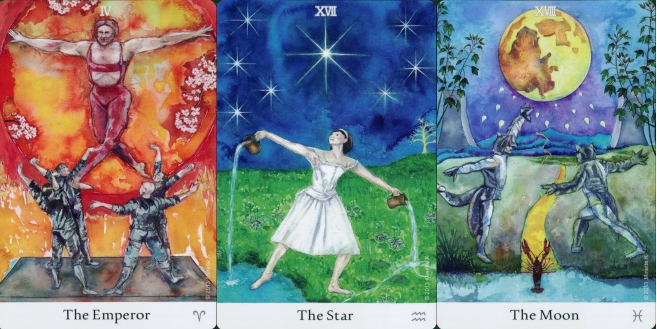
The Dancing Tarot from Japan is rather beautiful. The delightful watercolour paintings by Minette K. are on the theme of dance. Minette describes her work as "a unique reworking of the Rider-Waite, drawing on the world of ballet for the human figures, and the mountains, plants and scenery of Japan for the card backgrounds." These are for sale on Etsy.
28 April 2014
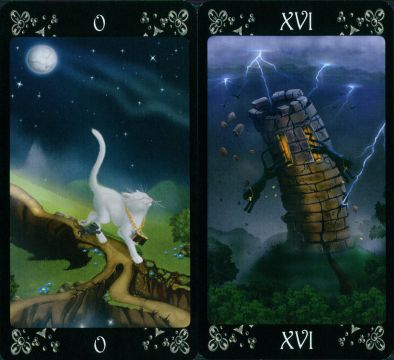
The Black Cats Tarot from Lo Scarabeo arrived today. It is, of course, a 78 card deck in the familiar size and packaging. The artwork is by Maria Kurara and is created digitally but mimicing acrylic painting. Interestingly she shows the Fool as a white cat, and card XXI, the final card of the Majors, depicts a white cat emerging from a black cat suit, seemingly suggesting that a black cat is a white cat inside, a strange form of dualism.
24 April 2014
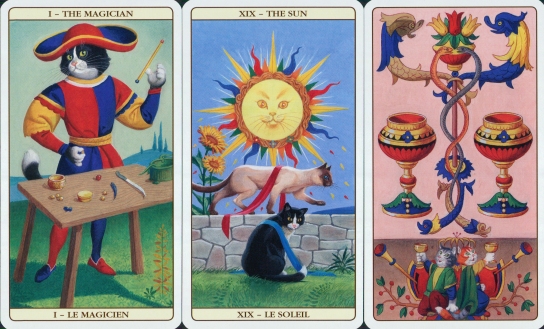
The Marseille Cat Tarot from Lo Scarabeo is a rather fine production. Sometimes Lo Scarabeo seems to cast around for some new idea upon which to build a tarot deck, and some of these have, sadly, proved to be rather poor. Here they have stuck close to traditional forms and artwork, the Marseille images with Cats depicted in luminous watercolour, and the result is quite magnificent. I have their Black Cat Tarot in transit to me at present so will add this next week to the weblog to make a trio of new Cat tarots.
23 April 2014
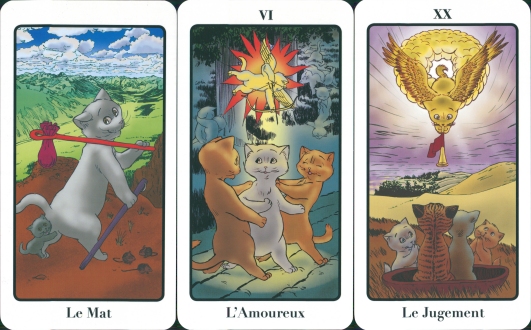
With great felicity, today I added another cat tarot to my collection. The illustrator Christian Gaudin has produced for the French publisher Relie an extensive series of books on a cat theme - Yoga for Cats, Zen for Cats, Kama Sutra for Cats, and now Le tarot des Chats. Supplied in a well constructed box with a book written by Alejandro Jodorowsky the well known filmmaker, author and great enthusiast for tarot.
8 April 2014
A few weeks ago one of my fellow collectors in the USA, who specialises in fine art tarots, alerted me to an interesting Italian work. This was a collaborative art deck celebrating the Contrada del Leocorno's 2001 win in the long running traditional Palio di Siena horse race. Through the good offices of one of the artists involved in this project, I was able to obtain a copy of this tarot deck. The cards are massive, being A4 in size.

3 April 2014
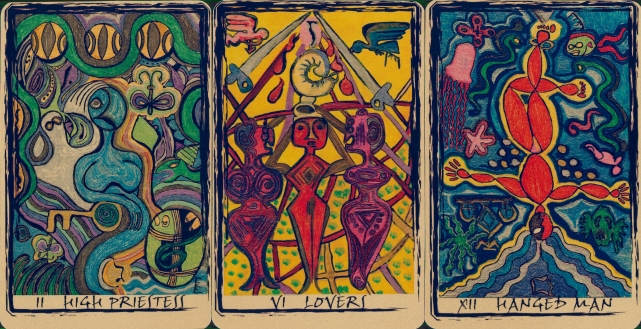
Erik K. Lerner created the artwork for the Radiant Spleen Tarot in 2004 but has only now been able to publish it. It is a 22 card deck with large cards supplied in a box. The thin transparent colours are printed onto gold surfaced card to produce a delicious radiant effect.
2 April 2014
I have reformatted my Database of Modern Tarot Art, adding a number of new fields - among which are details of names of suits and court cards. I have moved the sample images to the top right. There is still much new data to be entered, but with nearly 2000 items the database is already proving to be a useful research tool.
1 April 2014
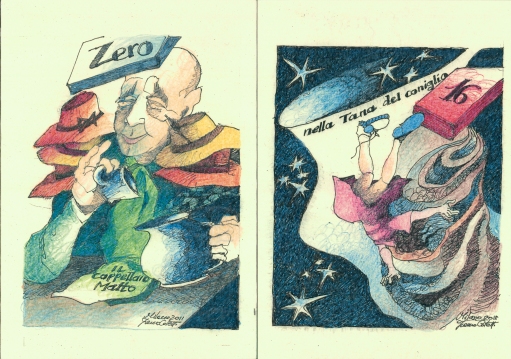
I can remember at least three tarot decks based on Lewis Carroll's Alice in Wonderland, and there are many more that have referenced imagery from that story. Now the amazing tarot publishing company Il Meneghello has issued a deck Emi Tarot's by Franco Coletti based on Alice. The edition is very small, only 12 copies. The imagery for the Tower is very neat, as it shows Alice falling down the rabbbit hole as an inverted tower.
28 March 2014
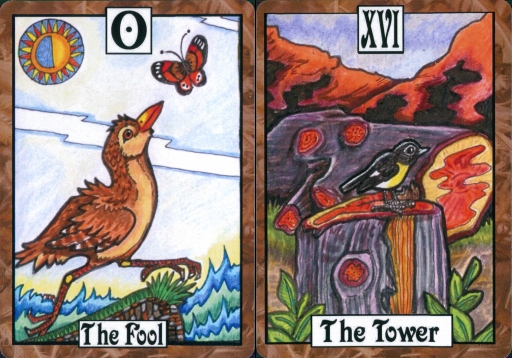
There are not many tarot decks emanating from New Zealand, however, I was happy to have been able to obtain a copy of Angela "LemurKat" Oliver's New Zealand Naturally Tarot which celebrates the unique flora and fauna of New Zealand. The artwork is delightfully observed and intensely coloured. This is available through Gamecrafter.
27 March 2014
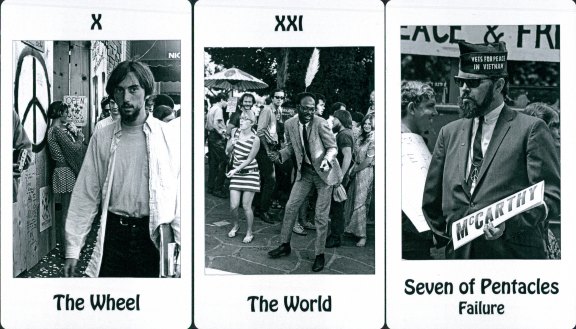
I recently bought a copy of the 1969 tarot and another recently published tarot, the Counterculture Tarot neatly resonates with this. This is a series of black and white photographs reflecting the anti-establishment, anti-war, anti-racist counterculture of the late 60s and early 70s in the USA.
26 March 2014
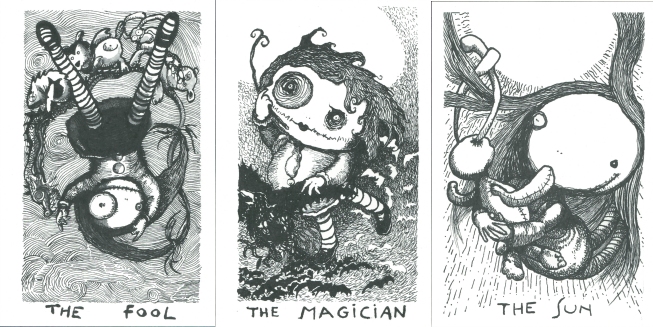
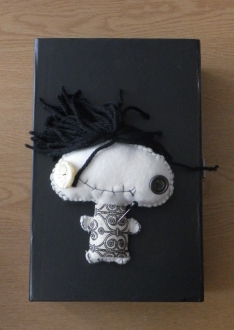
Yesterday I received a rather delightful tarot. This is the Bambolanera Tarot a majors deck of large cards which comes in a large black box in which is also a hand made doll. The artwork, by Layla, is in pen with some grey wash. The edition is limited to 50 copies. The image in the cards is a voodoo doll as sold by voodoodollys in Italy. I am the proud possessor of number "01".
25 March 2014
I have now added 250 more tarots to my tarot database and there are now 1927 items included in this. This is providing a good listing of modern tarot decks. I still have to add my substantial holdings of Japanese, Chinese, Korean and Taiwanese, with some other material which should bring this up to about 2500 items. I have now removed the link to the tarot reference collection list as this is now redundant. I will instead create an alphabetical listing of all the items currently in the database. Progress has been slow as I have so many other projects to work on - I have, for example, since the last update in November published three books.
7 March 2014
February was a bit of a washout for me as far as my tarot activites were concerned as I was working intensively on producing two new books in my alchemical series, so I have a backlog of newly acquired tarots to add to the weblog.
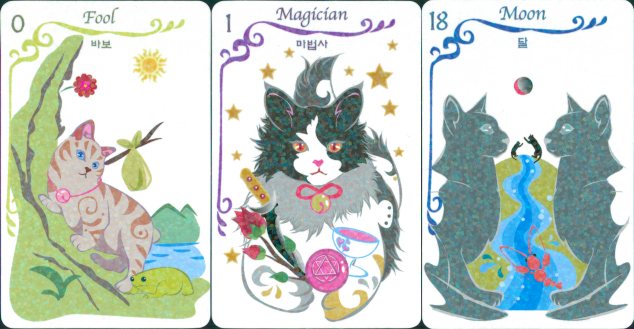
First, there is a new cat themed tarot from Korea. This is the Irresistable Cat Holic Tarot. The Majors and Minors come in separate printed tin boxes. The stock has built in sparkles, small patches of that holographic foil which catch the light forming a rainbow effect. The artwork is spare and lean with no clutter of imagery, each card presenting the image of a cat set in a conventional tarot scenario. This will be one that the hardcore cat tarot collectors, of which I am one of the prime adherents, will surely have to add to their collections. The publisher is silverforest.kr but they can be purchased easily through Baby_Dream on Ebay.
23 January 2014
The Spiritual Tarot was issued in 2013 in Japan as a book and card set. The artwork is by Akira Uno with the book being written by Mayu Ueda. Those who collect Japanese decks will remember the Mayu Ueda Tarot issued in 2000. Akira Uno is a well known and respected artist who has contributed to many exhibitions. He was born in 1934 and is still working. You can find many examples of his work on Google images.
22 January 2014
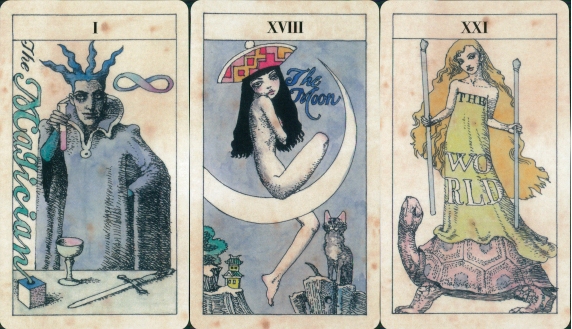
The 1969 Tarot was created by San Francisco artist Jane Rades back in 1969 when she was in her early 20's. After letting it languish for forty years she has now been able to publish it through the use of the Gamecrafter. It certainly evokes that influential period in american culture.
20 January 2014
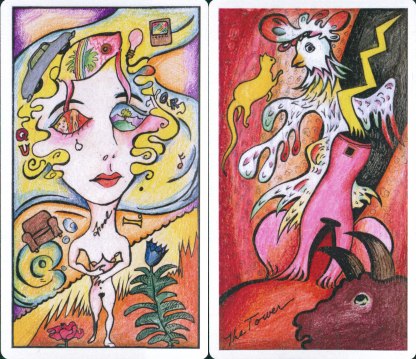
The Tarot of the Zirkus Magi was created to illustrate a fantasy novel by Doug Thornsjo. I now have a copy of the majors which was published in December. Copies can be obtained from his publishing venture 'Duck Soup' www.ducksoup.me Apparently he is currently working on a full 78 card deck. The artwork mimics early circus posters but with some clearly surreal elements.
15 January 2014
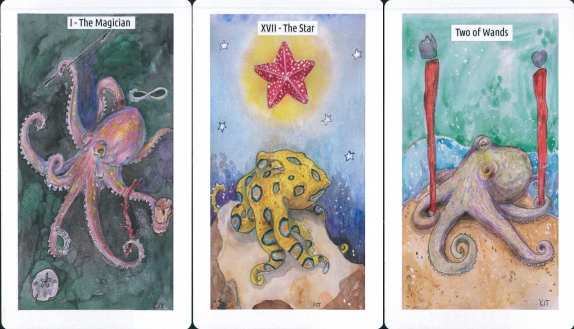
There are cat tarots, dog tarots, ones based on foxes, rabbits, badgers, penguins, and even snails, but this one surely trumps all of these - the Cephalopod Tarot. As soon as I heard of this I could not resist buying a copy. Cephalopods are sea based creatures, whose most obvious features are their large head and set of tentacles, many of them also squirt ink or can eject a jet of water in order to move quickly. The main creatues coming under the class Cephalopod are the octopus, squid, and cuttlefish. Kit Garcia, based in Austin Texas, obviously an enthusiast for these creatures has created this Rider Waite clone, and placing these creatures in tableau reflecting the tarot imagery. She has self-published the deck through the Gamecrafter. Well printed and supplied in a flip-top box.
7 January 2014
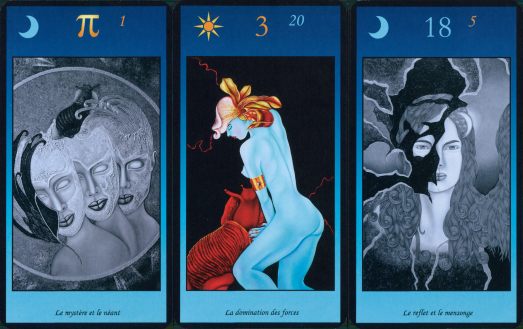
Yesterday I received a copy of the Beatrix tarot. Its creator, Sylvie Breysse, is an artist particularly given to the use of the colour blue, often depicting the human body in luminous blue tones. She has created a number of sets of cards related to tarot including L'Oracle bleu, Le Voyage d'Iris , Chloe "le Miroir de l'Amour". The Majors for her Beatrix Tarot are renamed but the association with the arcana is still visible in the artwork. Twelve of the Majors are coloured and active, while the other ten are in monotone grey and passive. She is well connected to the world of celebrity in Paris, with the Italian-born French fashion designer Pierre Cardin being one of her supporters and a major collector of her artwork.
6 January 2014
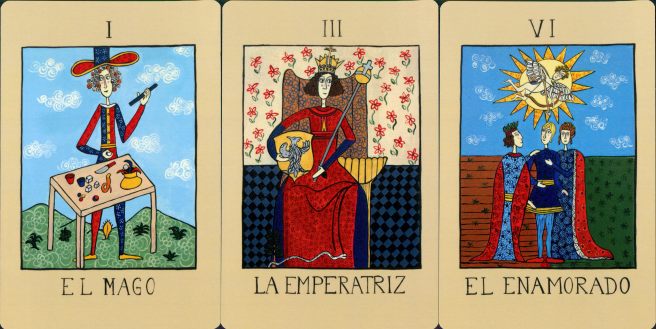
The Argentinian artist Maria Bertone exhibited her tarot paintings at the Maria Bonita Gallery in Buenos Aires in January 2013. These were created in acrylic on wood about 35x 25 cm. These designs were then issued as a limited edition tarot deck of only 50 copies. The designs are simple but very good quality. These will be impossible to find shortly.
3 January 2014
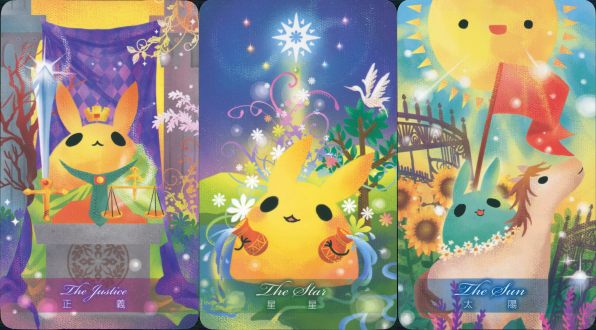
My first tarot of 2014 is the Rabbits Tarot self-published by a Taiwanese artist using the name Minijump. This is a rather cute child oriented majors deck. The designs appear to have been made entirely digitally, but incorporate a canvas-like texture, to give the appearance of being painted on canvas.
31 December 2013
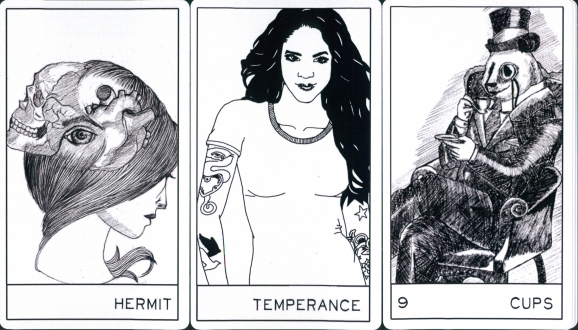
The Kundalini Tarot is based on a series of pen and pencil drawings by Adana Washington. She has published this though Gamecrafter. We are all now familiar with the publish-on-demand system for books which is now used by many publishers. Gamecrafter is doing this for game cards, thus providing an easy way for an artist to print and sell their tarot designs without requiring an investment of capital, or long hours laminating, cutting up cards and making up boxes. I have bought some of the Gamecrafter productions before and they appear to be of good quality, so I went ahead and placed an order for a number of items from them which should arrive in a week or so. Adana Washington is now working on the designs for a new tarot which I expect we will see published next year.
30 December 2013
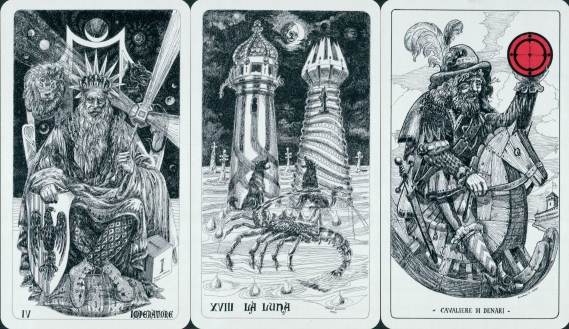
Today I received a copy of the Fantarocco by Franco Anichini, which I bought through one of my Italian contacts. These are detailed drawings created by Franco Anichini, painter and engraver, and former teacher of Design and Art History at the Liceo Scientifico in Viareggio. The 78 card deck was issued to raise funds for the Rest Home of the Sacred Heart in Viageggio.
19 December 2013
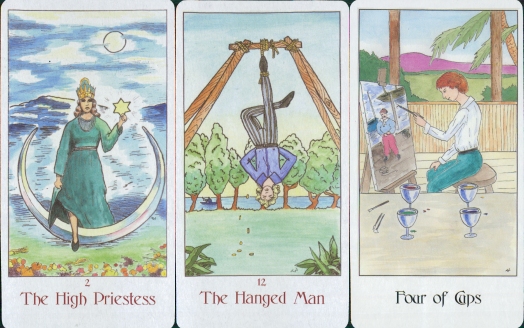
I recently found the Perceptive Tarot by Tom Weismuller on Ebay. I am unable at the moment to find any information on the artist or his concept for his tarot deck. Why it is named the 'Perceptive Tarot' is unclear to me, but is is a redrawn version of the full 78 cards in a somewhat naive drawing style. The minors, though emblematic, do not directly follow the Pamela Colman Smith pattern though the imagery reflects this in some ways.
17 December 2013
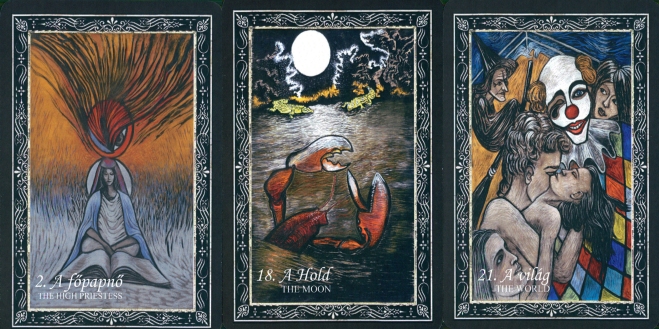
Yesterday a rather fine book of poems arrived from Hungary with the the text in both English and Hungarian. This is the Tarotversek or Tarot poems by Banki Balint. The book comes with a set of wonderful tarot cards. I bought these on Ebay through the dealer catfan1729. The deck and book arrived very quickly from Hungary.
9 December 2013
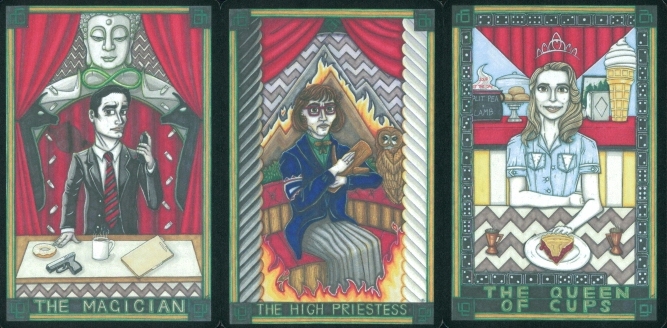
Some years ago I remember watching some of the episodes from David Lynch's television series Twin Peaks, with his wonderful convoluted plot which plays with the expectations of the viewers. Now, Claire Laffar has created a 78 card tarot based on the characters from the series. She has drawn images of these characters and set them in a little tableau of imagery related to their part in the series. Remember the famous cherry pie motif or the Log Lady. You will find them here. I really enjoy such tarots. You can buy them through her shop on Etsy.
4 December 2013
A rather amusing deck from Canada has recently been published. This is the Tarot Waiting to Happen. For these tarot designs Andrew McGregor adopted the device of visualising what the figures in the twenty-two trumps were doing just before they were frozen in time as the familiar tarot images. Some are rather amusing in a postmodern way. The Lover is seen hanging around a bar. The Hanged Man shows a mantrap baited with a rather fine cake. You can buy copies through www.thehermitslamp.com

21 November 2013
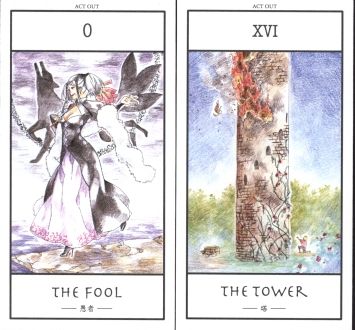
The Act Out Tarot issued this year in Japan, would appear to be a doujinshi or fan art deck produced by a fan of the Sound Horizon group. Sound Horizon is a Japanese musical group with composer Revo as the leader. They call themselves the "fantasy band" and have released their works that closely resemble suites. In 2001, Sound Horizon participated in the comic market as part of a dojin music circle and released their first story CD, Chronicle, an all-instrumental track CD, with occasional narration, background chorus and sound effects. Anyway, whether they had anything to do with this tarot or not, the tarot imagery is quite delightful.
20 November 2013
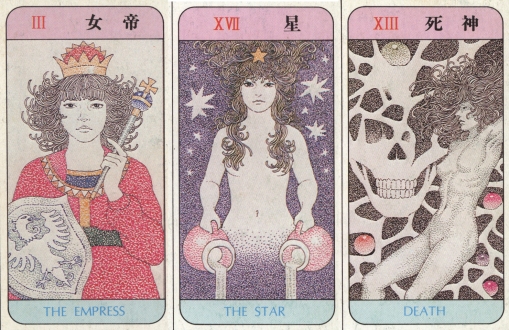
Today I received an old tarot given away as a gift in the popular Japanese My Birthday magazine. These adopt a Western art style rather than Magna imagery. The artist uses a dot method for the solid areas of colour. Unfortunately, I do not have any further information on the date of publication or the name of the artist.
7 November 2013
I have now updated my Tarot database to 1683 items. I took this opportunity to put the items in alphabetical order. I have also added three new subsections, one of Polish another of Swiss tarot, and one of the other European countries with lesser output and added some extra items to the Russian material. There are, of course, many more items to add, and these sections are not exhaustive. I am gradually working through the many storage boxes and shelves I have, and systematically adding items to the database. Things are moving forward now at a reasonable pace and it is likely that in a few months time I will have entered about 95% of the items I hold. At that point I will be able to devote time to editing the database, correcting errors and omissions and at that stage I will ask for the assistance of some of my fellow collectors to correct my errors.
There are on the Internet many listings of tarot decks. Most of these seem to be drawn up by enthusiasts and can be flawed by their opinions and subjective views. I am attempting to draw up a scholarly fact-grounded database which will stand the test of time and be a reference source on the wonderfully broad mass of modern tarot art.
5 November 2013
One of the great delights of researching tarot art is that one discovers some truly interesting artwork and artists. Yesterday I was looking at the wonderful Akron Tarot and decided to look into how it was created. On first glance it looked like pen or pencil drawings that had been modified or collaged in some computer graphics program, but on looking deeper I discovered that the artist Siegfried Otto Huettengrund (1951- ) had developed his own graphic printing technique of wood engraving and after intensive work had found international recognition, winning a number of prizes for his artwork.
He works on wood panels or laminated veneers of hardwood. The main tools he uses are gravers and a bracket with four needles. For the needles he used Buechel 60 sewing machine needles, the finest of their kind. In order to keep these needles as fine as possible, the artist ground them with a hard Arkansas oil stone - thus the needles keep their sharp points longer. He print from these panels using high-pressure, similar to wood engraving, woodcut and linocut prints. The inking was done with a hand roller and a variable high pressure press in order to avoid squeezing the plates. The images were later hand coloured. It certainly enabled him to create some intriguing imagery.
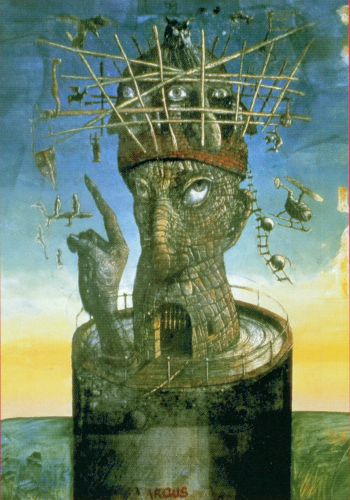
4 November 2013
Today I received from Poland a copy of the Tarot Apocalipsy. This has rather fine pen drawings by Robert Sobota and sensitively coloured by Magdalena Walulik. Titlas are in English was well as Polish. The imagery of this tarot is based on an unorthodox, esoteric interpretation of the main Christian symbols and images. Copies can be bought from their website www.swiatoslawnowicki.com
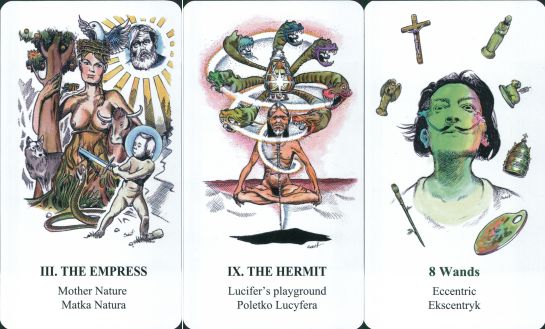
31 October 2013
Le Dernier Cri, the French publishers of some rather gruesome adult comics, produced three tarot Tarot Corrumpe 2007, Tarot Tare 2011 and Tarot de Mars 2012. It has now given its special style to the Tarot of Marseilles under the title Tarot Caro.
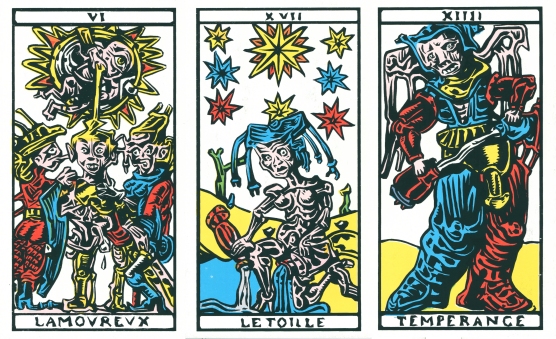
31 October 2013
Over the last few days I have entered information into my database on tarots published in Poland. After the weekend I should be able to upload a section on the Polish Tarots, of which I have about thirty items. The main database currently has 1650 items, but there are many more to add, I have not yet started on the USA items, nor the boxed tarots, and there are many hundreds of Japanese, Taiwanese and Chinese tarots not yet added to the database.
28 October 2013
I have now managed to create Japanese, South American and Russian entries in my tarot database. The South American and Russian sections are almost complete, but the Japanese entries are only about 40% of my collection, and it will take some time to enter all the data for these. Over the next few weeks I intend working on the collections of Polish and German tarots. I will probably consolidate the entries for other European countries into one section. At last progress is being made with this long delayed project.
22 October 2013
I have begun to create and upload the latest upgrade to my tarot database. I have added about 400 items to the current database and created a new structure to make finding things easier. I have been able to program the database and manipulate the output using an additional program to create various subsections - initially based on county of publication. At the moment these lists of items are incomplete, as it needs me to input information on more tarots. At the moment there are 1530 items, and around 1000 more need to be added. It is very intensive and exacting work.
22 October 2013
Although I am not collecting as fanatically as I was up to recently, there are occasionally items which I cannot resist buying. The most recent is the Bonefire Tarot from Australia. It has delightful and deliciously coloured artwork and a coherent drawing style. You can get copies direct from the artist Gabi (Gabrielle West) at www.bonefiretarot.com
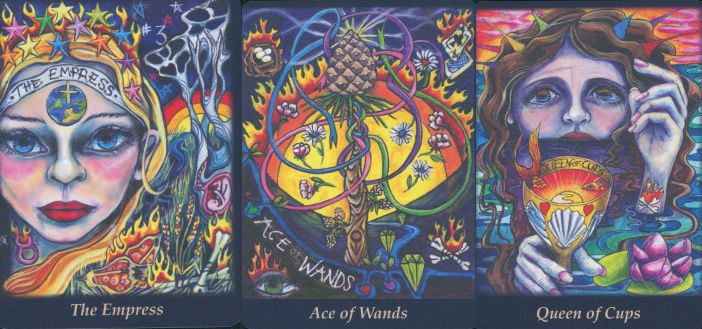
8 October 2013
Vera Sklyarova has produced a number of tarot decks many of which are now very collectable. When I have time I will draw up a list. I have now received a copy of her Paracelsus tarot which has just been reprinted with an extensive book and a DVD by www.yarasvera.ru. The minors substantially follow the emblematic sequence of the Rider-Waite. The deck also includes seven chakra cards and one card of the seven deadly sins.
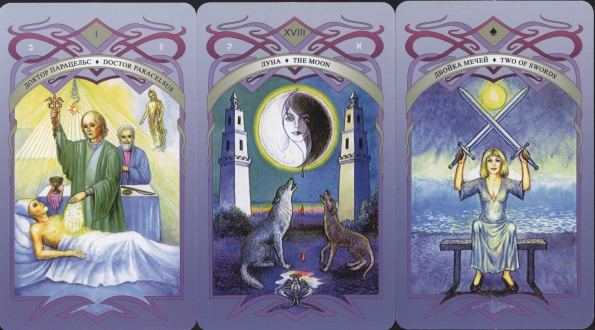
6 October 2013
Another recent Russian tarot from www.yarasvera.ru is the Psychology-Magic-Professional Tarot. This was devised by Felix Eldemurov one of the founders of the Russian Tarot Club. The images were created by Ilya Pankratov. This is quite unusual as it consists of three sets for each of Majors, coloured differently in golden-yellow, blue and red. The golden-yellow corresponds to everyday practical problems, blue to the psychological background to a problem, and red to the magical aspect of ther problem. There are two additional cards XXIII Animus and XXIV Anima.
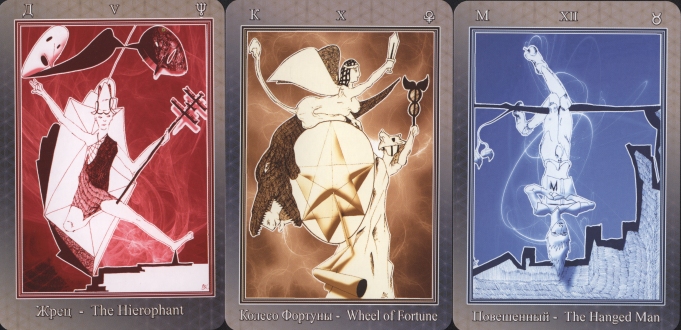
1 October 2013
I have just received a new cat tarot from Russia. This is the Cat-A-Vasya created as digitally collaged photographs placing various cats in tarot inspired contexts. This is a full deck with a little booklet with full descriptions in Russian and with summaries in English. Cat tarots are, of course, like cats, always amusing. You can buy copies through www.yarasvera.ru
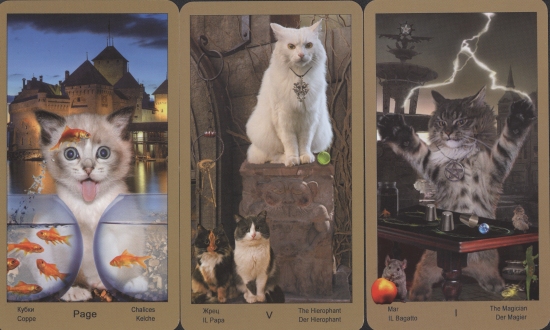
1 October 2013
Almost exactly a year ago I bought El Tarot de las Mafias issued by the Italian publisher De Vecchi in a box with compartments for the 78 cards and a small explanatory booklet. This week I have Tarot para Chicas a companion volume by the same publisher in the same format. The Majors are renamed and have for the most part non-standard images, but the Minors are conventionally structured. The cards are edged in gold leaf. This would appear to be the French Tarot des Filles in a Spanish edition.
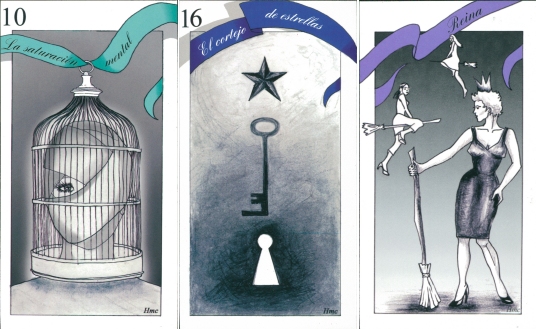
21 August 2013
The Tarot of the Golden Serpent sold out during the afternoon. I was rather overwhelmed by the rush of orders. One of my contacts, indeed the first person to buy a copy, had said to me that it would be sold in a day. I was amused and dismissed this as her enthusiasm, but she has been proven right. I am sure the quality of the artwork is entirely the driving force behind its rapid sale. I must say that when I first came across Sebastian Haines images a few years I was very impressed and I wrote to him encouraging him to complete the series, and this eventually turned into an offer to publish his deck. Obviously many others recognised the value of his work. Although publishing such small editions at a low price, does not make much money, it has encouraged me to continue the Art Tarot series, so I am on the lookout for good quality artwork that I could publish. I would love to be able to publish the Amun Ra deck but that one, sadly, seems to have slipped away from me.
20 August 2013
The latest tarot, number 28, in my Art Tarot series is now available for sale. It is the Tarot of the Golden Serpent by Sebastian Haines.
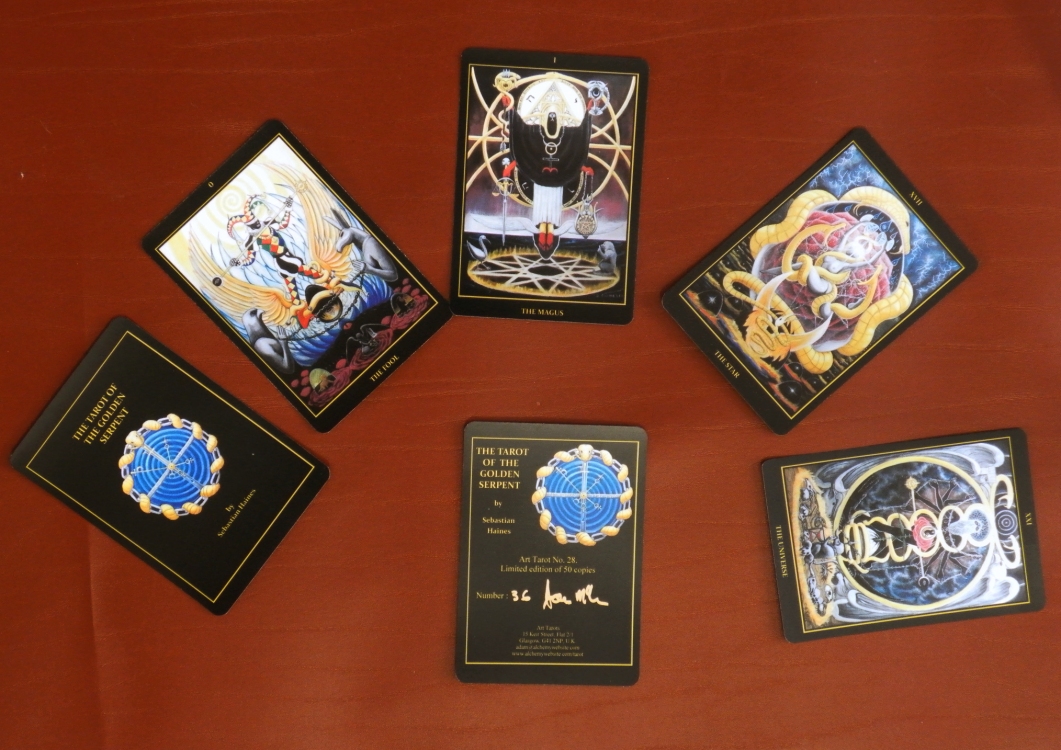
You can see the details here. This is an edition of fifty copies and only 30 of which will be for sale.
Judging on previous issues, this will sell out quickly so do not wait a few weeks otherwise you might miss out.
14 August 2013
Today I am cutting up into cards the next item, number 28, in my Art Tarot series. I hope to finish this and begin selling copies next week.
It is a rather beautiful deck influenced by esoteric symbolism, and the artwork is exquisite.
13 August 2013
I recently bought a Japanese Children's tarot with non-frightening humourous skeleton images. Issued with an extensive descriptive book.
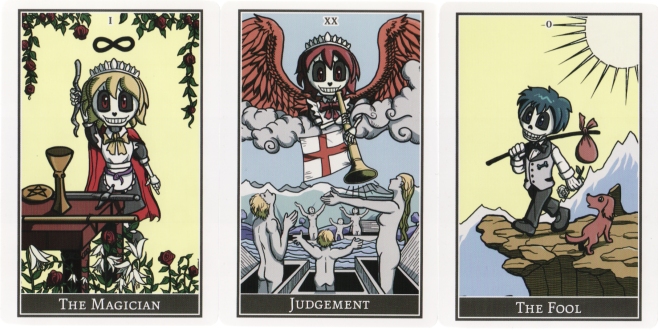
25 July 2013
I have found a way to structure the output of my Art Tarot database on the website. At the moment it is output as large files with hundreds of tarots on a single page. This means it takes a considerable time to load even on fast internet connections. I have been able to find a way to write a program that outputs the information onto a single page for each tarot. Then the user can navigate through these. It also means that the pages can be individually indexed by Google, so the user is not dumped at the beginning of a page and have to scroll through to find the information they wish. I am still testing this but I expect to be able to put the new system online sometime next week.
I had to find a way around the limitations of static html in order to create some of the elements on the pages. I struggled and struggled to find some way within html using java and css techniques, but eventually had a inspiration to write a routine in an external program and run the pages through this to make the necessary modifications. Once I have it loaded onto the internet I will be able to create a search routine for it using the Zoom Search engine.
8 July 2013
Back in January this year I announced a project to devise a database of unpublished tarot designs. There are so many wonderful depictions of tarot that never achieved publication and I felt we must find some way to list and draw attention to these. Stacy Flinn has volunteered to take on the task of creating the entries for this database, and I will edit and structure it for display on my website. You can see the latest version of this here There are currently 168 entries.
8 July 2013
A month or so ago I bought three tarots from Our Inner Power. The artwork is by Maria Bochsler. Here are some samples from her Egyptian Tarot, a full 78 card deck with fully emblematic Minors, which depart somewhat from the Pamela Colman Smith archetype. She created these using coloured pencil in a delightfully naive style. I will show her other decks over the next few days. You can buy these from her website www.ourinnerpower.com
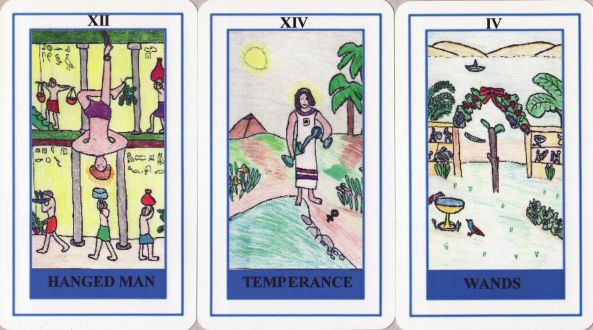
4 July 2013
Yesterday, the Inner Realms Tarot arrived in the post. This is another item in the growing list of tarots published by Schiffer, and comes with a descriptive book in one of their familiar solid cardboard boxes. The imagery, created digitally, is for the most part composed of patterns of light describing forms in dark space. Some of the images are quite astounding. Imposed on these are keywords and associations. The artwork is by Saliere, who has a great interest in spiritualism. Certainly the artwork reflects the spectral world. The deck and book is easily available through the usual retail sources, as Schiffer Books are well distributed.
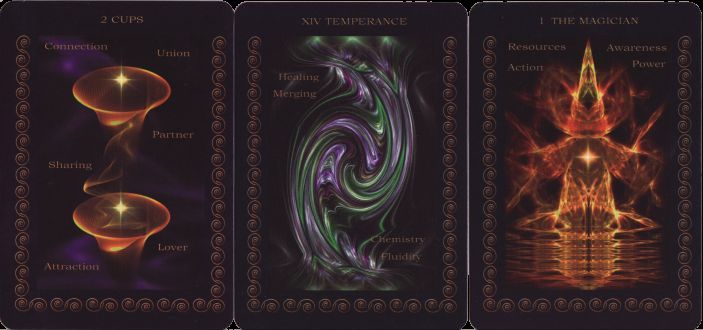
3 July 2013
I have now updated my online database of tarot artwork. There are now close to 1200 items catalogued, about half my collection. I have only been able to add 100 over the past year as creating entries, scanning cards and writing descriptions is extremely time intensive, and I just do not have sufficient free time to do this. The database is a service to the tarot community and I do not make any money from it, indeed it consumes money in the form of my time. I am not subsidised so I have to make a living from selling my books and my art tarots. The time I spend on this is money lost from other projects.
The database will be substantially developed over the next few months as I am employing someone to work one day a week to add entries. I will cover this from the sales of my art tarots and from selling off items from my collection.
You can see the database on this page
I have also fixed the menus on the left of the screen which had a formatting fault.
1 July 2013
The Tarot of the Dark Dawn was created by Rick Roth and Cody Stoltz. It is made to appear as if it is an old worn deck, that has been much used for decades. This is a means for hiding a trick, for the backs although seeming the same are actually printed to have certain areas appearing more worn than others, thus with a simple key one can identify the card when it is face down. This simple magic trick could be quite astounding if done sensitively.
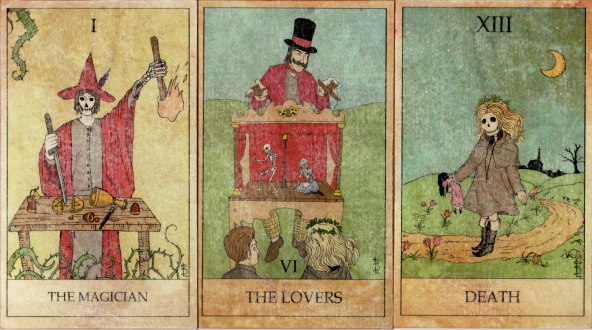
27 June 2013
Things have been rather busy for me the last few weeks so I have neglected my Tarot Weblog.
A while ago I bought two copies of the Efflorescent Tarot by Katie Rose Pipkin. She created the images for this deck, based on the Rider Waite, but seen through the idea of flowering. Her pen drawings are delightful and she finds new ways of realising each image, being particularly adept at creating dramatic tableau. Happily, she issued her black and white pen drawings and also her sensitively and subtly watercoloured version. I am not surprised that it took her two years to complete this project.
Both decks are available on Etsy.
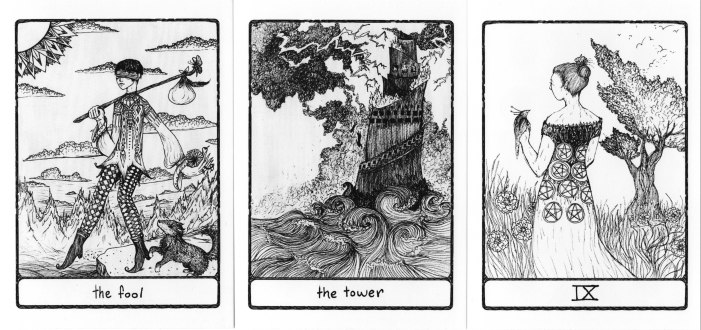
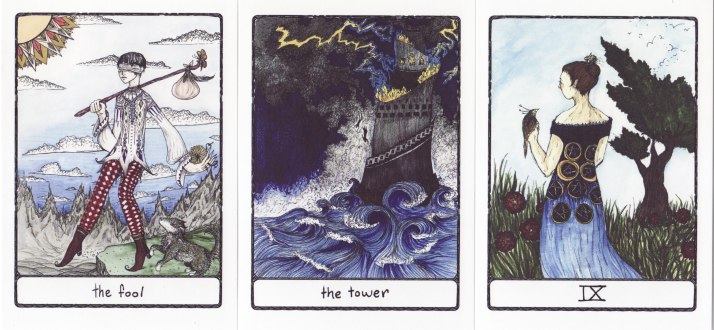
30 May 2013
There is now a great change in my situation. I was hoping that I would be able to preserve my collection as I get older. But after trying various ways to raise the necessary funding, I found this to be impossible. There is not enough interest from galleries and institutions in tarot as art. It appears that most art historians and gallery administrators have closed minds about the art work of tarot and were not even willing to look at my project to preserve a reference collection. It seems I am, in this matter, a little bit ahead of my time. No one that I contacted in the art administration world seemed willing to put their head above the parapet and promote my project. Sadly, I am no longer young enough to tough things out for a decade or two until awareness of the importance of tarot art broadened.
So I am left with only one thing to do - to close my collection and begin selling off the decks. These will of course go to the few people, my fellow tarot collectors, who value the art as much as I do. So I am very comfortable with this. Perhaps one of my fellow collectors will in time find the resources to preserve their collection for posterity. I have a site on Ebay and have already begun in a small way to sell some items, but it will probably take about 5 to 10 years to sell most of the collection off, as it takes some time to make up each auction.
I will, of course, be documenting each tarot deck, so my collection will not be entirely lost, but instead translated into a virtual one residing on some hard discs on my computer.
I am, however, very attached to my Japanese tarot collection and I will probably keep this together and only sell it later in five or ten years time, hopefully as an entire collection.
It is a bit sad, but I am getting older and I cannot leave my collection to my partner Franzeska and my sister Moira to sort out after I die. That would be so unfair to them.
I started collecting tarot because I saw something of value in the artwork and wanted to research it. Having this material led to my creating my Study Course on the Artwork of Modern Tarot. After 2010 I came to realise that I had gathered together a comprehensive collection, which could be the basis for a scholarly resource for the study of tarot art. I then became engaged in trying to find some way of guaranteeing its permanent foundation. After a couple of years trying through my contacts I realised the futility of this as there was a profound indifference on the part of art administrators.
I have many other projects to work on, my alchemical publications which continues to attract interest and my artwork. I will now have some extra time for painting, and I am already planning to make a facsimile painting of Bosch's Garden of Earthly Delights.
5 May 2013
There are so many Egyptian themed tarots that I have lost count - probably 30 or more. I have recently acquired one from Argentina produced by Iluminarte. It is a well printed full 78 card deck in a flip top box. The 22 Majors follow the conventional images, but seen through Egyptian forms. The 56 Minors are not divided into suits with Pips and Courts but instead present depictions of abstract ideas.
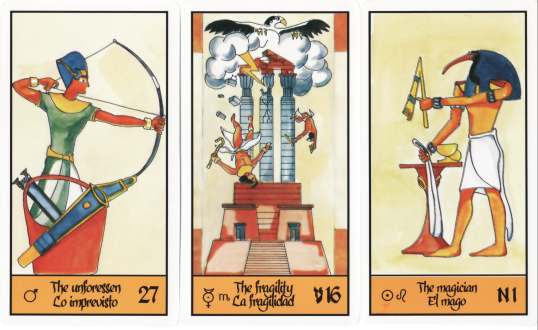
4 May 2013
I recently obtained a rather fine Rider Waite clone from Taiwan produced by Cheerjoy. This is a full 78 card deck targetted towards a child audience. The artwork is in pen and watercolour style, but nowadays graphic artists, particularly in the far East, are so skilled in computer imaging, that this could well have been produced digitally. One looks for the tell-tale signs of water flows on paper in background flat areas of colour, but these are now mimiced digitally, so it is often difficult to tell.
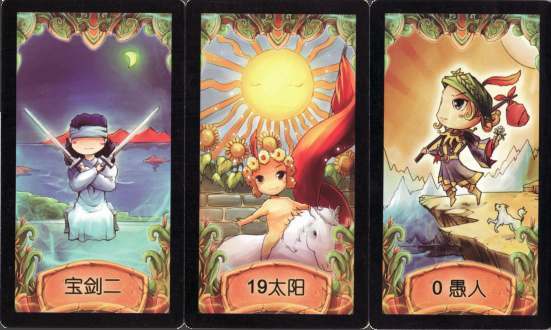
3 May 2013
The Secret of Love Tarot is a 78 card deck issued in China. The designs are rather engaging. It comes in a solid cardboard box with one of those magnetic catches often used in Chinese and Taiwanese tarots. Included is a fine gold trimmed black velvet cloth. Available through Baby_dream on Ebay.
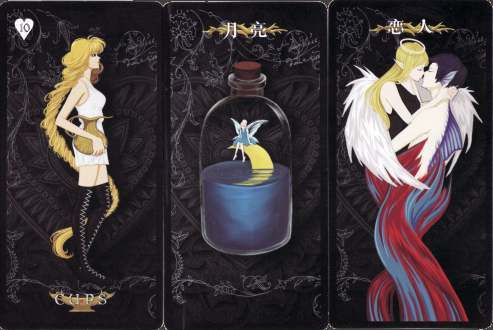
2 May 2013
Beth Seilonen's Owl's Arcana has just appeared. It is an edition of 100 supplied in her familiar boxes with a black velvet bag. You can see many of here amazing tarot designs on www.catseyeart.com
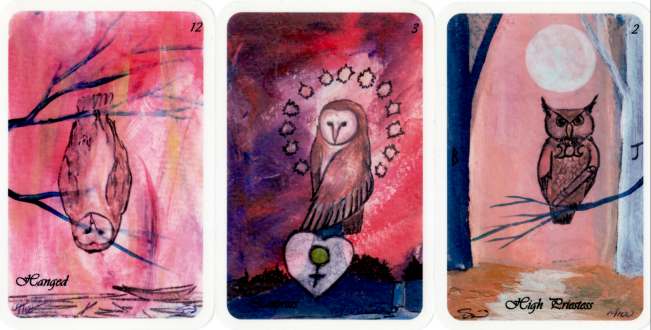
2 May 2013
The Greater Mysteries Tarot is now fully sold. The edition sold in just over one week.
30 April 2013
I just found this wonderful painting by the surrealist artist Leonora Carrington. It is entitled Maja del Tarot and was created in 1965. Here I show only the right hand side of the painting which shows images of the major arcana on the dress of the female figure who is depicted like a Queen in a set of playing cards.
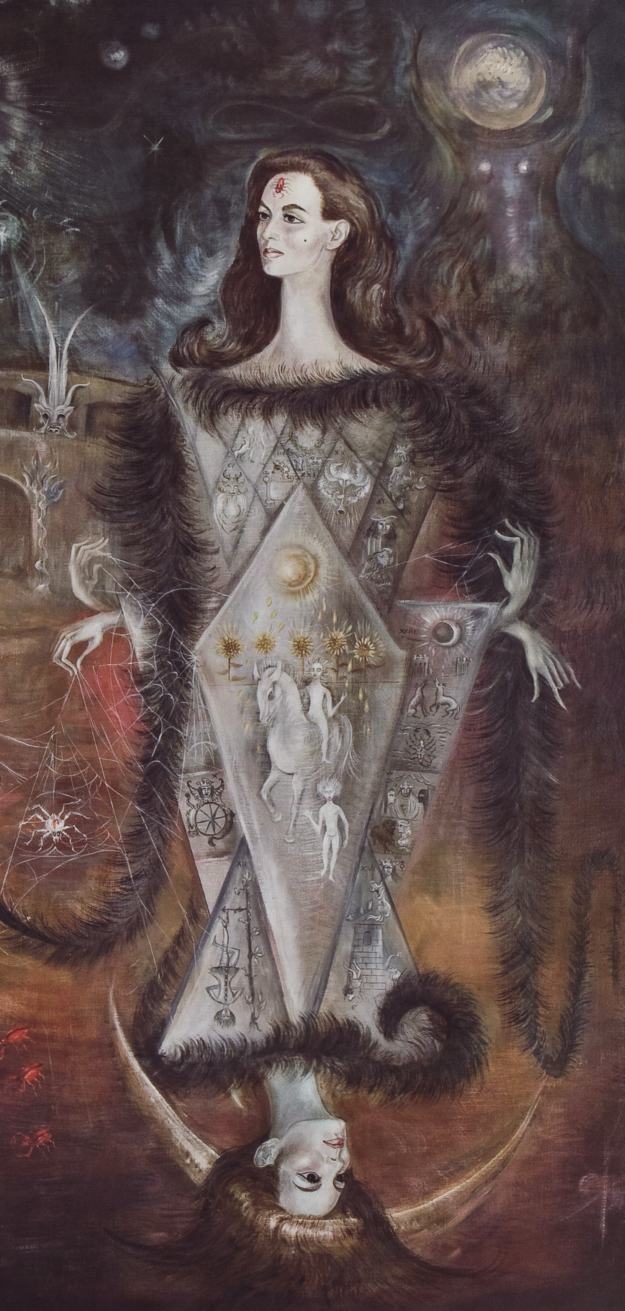
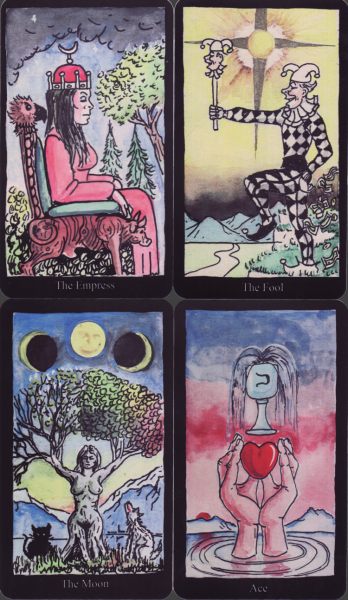 29 April 2013
The Greater Mysteries Tarot which I published as number 27 in my Art Tarot series a week ago on the 22nd of April is now almost fully sold, with only three copies left. This deck was created in the early 1980s by an artist friend of mine.
As I have been quite absorbed recently in producing this tarot I have not been able to find the time to create entries for this weblog, but hopefully should be able to return to this over the coming week. April has been a busy time for me !
15 April 2013
For the past year I have been trying to find some way of preserving my extensive tarot collection for the longer term. As I am now 65 it is unlikely that I will have more than 10 years of active creative life left so I feel the need now to plan ahead. I feel deeply unsettled that as things stand, in the case of an early death, I would have pushed the problem of my collection onto my partner Franzeska and my sister Moira, who are the executors of my estate. It would be entirely unfair to burden them with this responsibility. So over the last year I have been trying to find some way of funding the preservation of the collection. I have now come to admit that this is not going to happen. Having approached a number of people and institutions and tried to work out some strategies, it has become obvious to me that there is little interest in the artwork of tarot outside the existing tarot community. The preservation and continuance of my tarot collection would need my funds. I am not a wealthy person, indeed for years I have lived below the average wage for people in the UK, spending all my available money on my alchemical research, publications and tarot collection. So I have no funds left with which to endow the collection.
I have now come to the conclusion that I will have to disperse and sell off the collection. This in itself is a considerable task with 2500 items to sell, pack up and post out, so I cannot leave that till I am too old to be able to follow this through. So I have decided to do this gradually over the coming ten years.
I recently sold off some of the duplicate items in my collection on Ebay, so I expect I will now begin to work gradually through and sell off the main items. During this slow process I will document and research each tarot in my collection so this information will not be lost. I will continue to buy some of the more interesting items, but there will be little point in adding any more mass market items to the collection. I have an especial fondness for the Japanese tarots so I may keep this part of the collection together and continue to grow it - perhaps when I am older this part of my collection could be somehow kept together, sold on, say, to a particular individual who shares my enthusiasm.
Having come to this decision, I feel a great weight has been lifted from me, as I now have a clear way forward.
I began seriously collecting tarot some ten years ago when I realised that one had to own decks in order to study tarot artwork - there were no libraries holding copies where one could go to study them. As I gathered more and more items, it became obvious that I had accumulated a significant resource for the study of the artwork of modern tarot. Sadly, few people share my interest and the appreciation of the value of tarot art seems to be close to zero. I expect in the years to come this art genre will be appreciated, but in this era I seem to be a little bit ahead of the times. Were I twenty years younger I might struggle on hoping things might improve but with only a decade or so left to me I find myself with no alternative but to disperse the collection and return it item by item to the tarot collecting community.
11 April 2013
The W.T. Horton Tarot I published last week unexpectedly sold out in around three days.
This made me think of publishing a rather wonderful set of tarot designs by an old friend of mine, the surrealist artist Robert Ellaby.
This a full 78 card deck. I hope to be able to publish this in a few weeks time.
You can see some of these designs on www.alchemywebsite.com/tarot/Ellaby.html
03 April 2013
Response to the publication of the W.T. Horton Tarot has been unexpected with only 4 copies now left of the 30 copies I have for sale. So I expect this will sell out in the next few days. It gives me heart to continue this small scale publishing.
The Marie-Claude Purro Tarot, the Alchemical Wedding Tarot and the Fortuna's Wheel Tarot are also now sold out. This means that eleven of my Art Tarot decks are now fully sold out.
01 April 2013
During the last two weeks I have been working on producing the next item in the Art Tarot Series, so number 26 is now available to purchase. This is the W.T. Horton Tarot created by Koretaka Eguchi from the early 20th century illustrations by W. T. Horton.
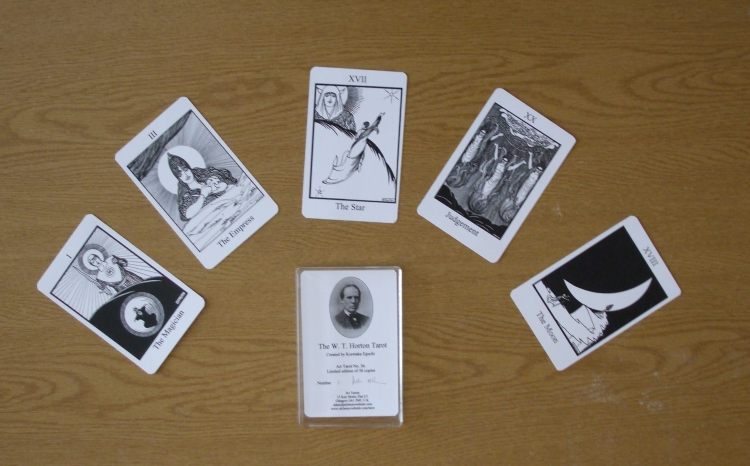
I would also like to point out that three of the Art Tarot decks are immanently about to sell out - the Marie-Claude Purro, the Alchemical Wedding, and the Fortuna's Wheel. Buy immediately otherwise these will be fully sold out and no longer available.
22 March 2013
Few people in the tarot community appear to have much interest in the artwork. In Italy, tarot as an art format is still preserved and many professional artists have created and exhibited tarot designs. The art world in Italy seems very open to gallery exhibitions on the theme of tarot. An exhibition of Massimo Biondi's designs for a 'Manierando Tarot' was held in the Palazzo Medici Riccardi Florence 30 November 2012 - January 2, 2013. These were printed up into a deck of cards. Massimo Biondi's surrealist works mostly seem to feature the human hand.
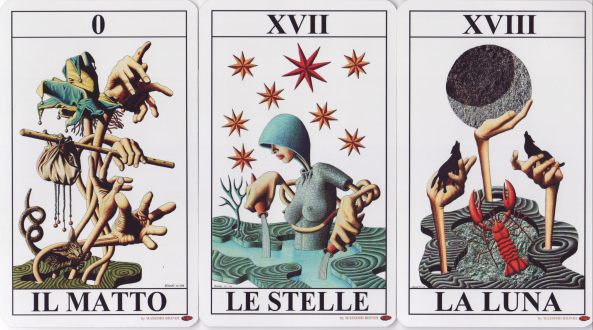
19 March 2013
I have just obtained through the good offices of Baby_Dream a copy of a self-published Chinese Tarot created by the rather accomplished artist Kaipin. The pen drawings are delightfully cursive using thick and thin lines.
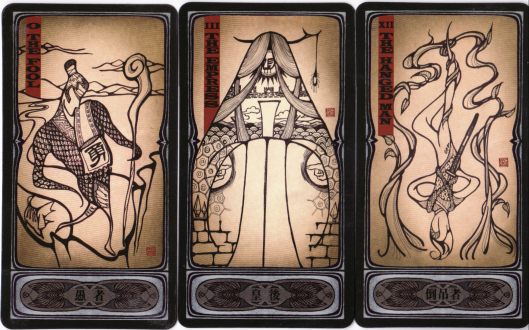
18 March 2013
Unlight is an online Role Playing Game which uses cards. The Epic of Unlight Tarot is a fan art production, not intended as actual game playing cards but images and characters from the game placed in a tarot context. There is at least one other Unlight fan art tarot.
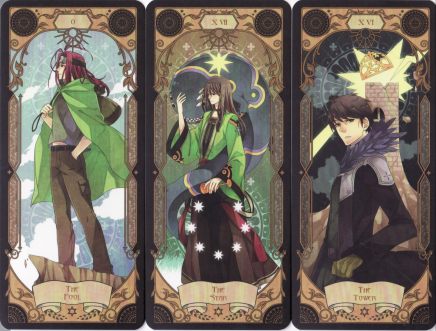
13 March 2013
The Kenzo Psy-Chic Tarot was issued by the fashion label Kenzo as a promotional item at a showing of their fashion items at the Maria Luisa store in Paris in Autumn/Winter of 2012.
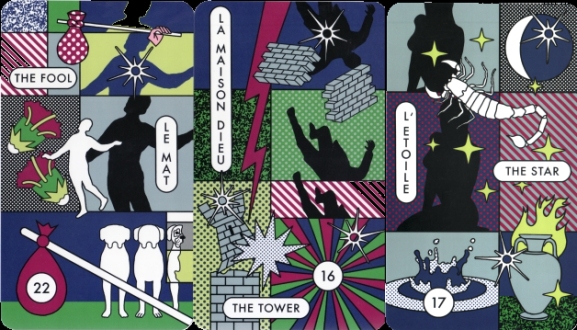
12 March 2013
I recently obtained a rare Greek tarot. It is named as the Gypsy tarot, but there is no Gypsy imagery on the cards. Instead it is a hybrid set of tarot and restricted playing cards. Set of four conventional playing card suits, with values 7, 8, 9, 10, Jack, Queen, King, and Ace thus 32 cards (22 of which bear the tarot Majors). Clearly intended for divination. Images of Rider-Waite majors are used on the cards. I am not sure of the date but it is likely to be from the 1970s or 1980s.
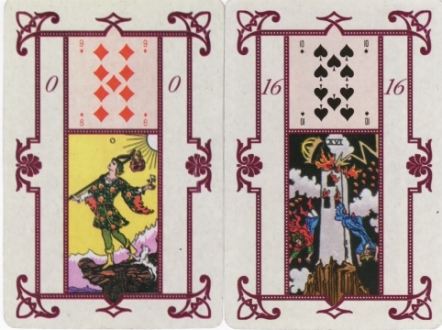
8 March 2013
This deck was first issued in 2008 under the title Peace Tarot, but has now been reissued with the title Japanese Tarot Deck. Misuzi Itateyama makes strong, decisive brushed ink black outlines which she then colours with watercolour. She has had a number of exhibitions in Japanese galleries, and also works for the graphics industry. She describes her work as contemporary Japanese style art. This deck has been made into an app for Android.
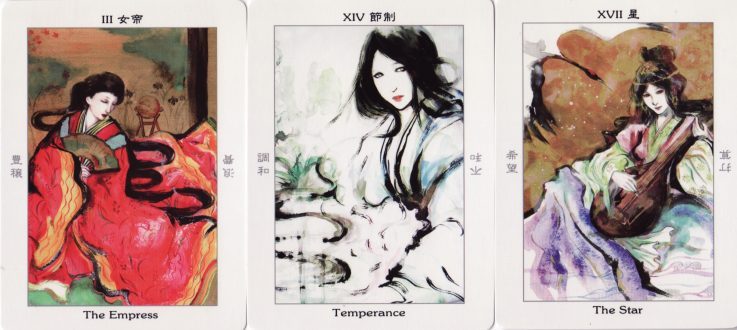
7 March 2013
A number of people have created tarot designs based on Disney cartoon characters, however, these breach the Disney copyright and invariably never get published. So it was a great surprise to me that I have managed to obtain an authorised Disney tarot. This was published by Epoch Co. in Japan, probably sometime in the 1980s. Epoch Co issued computer games and often produced sets of cards as a promotional item for these games. They had a commercial connection with Disney who allowed them to produce some games based on Disney characters, for example Donald Duck and the Magic Cap. The majors deck that I now have includes characters from Snow White, Robin Hood among others.
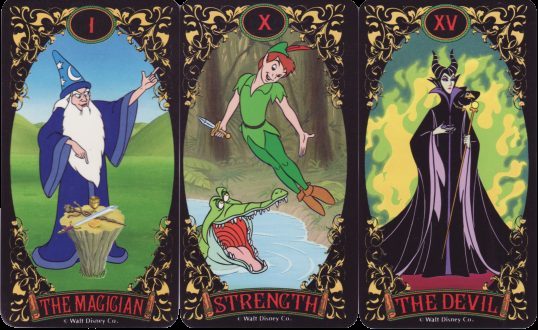
4 March 2013
Tarot de Los Suenos (Tarot of Dreams) is a delightful Rider-Waite clone, published as a deck and book set in Argentina late in 2012. The artwork by Silvia Ordoqui is in soft and subtle watercolours. A trifle expensive with the shipping from Argentina but well worth buying. It is a fine addition to the South American section of my collection.

26 February 2013
The Tarot of Curiosities is a rather well conceived and executed photocollaged deck. Often one finds collage rather lazily done, but here the images are well chosen. Dark in tone, primarily back and white, but printed in full colour which allows for the restrained but judicious use of colour to accent some of the images. I found this on Etsy.
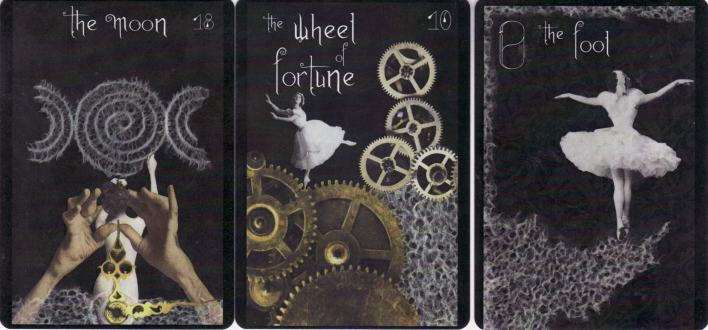
21 February 2013
I must apologise to my US contacts. I have been selling some of the duplicates from my collection on Ebay. Most of these are on Buy-It-Now terms, but I decided to sell the Phantomwise Tarot as an auction. Unfortunately, I forgot to make the auction end at a time when US contacts were awake and able to bid, as many people like to bid in the closing moments. For future auctions I will adjust the time to suit US contacts as well as the European. I intend to auction off some of my own personal copies of the out of print Art Tarot series, one each week for the next month - Phantomwise, Aleph, Alchemical Emblem, Arto, Sidhe, Diary of Broken Soul.
The Mermaid Tarot by Dame Darcy adopts a style somewhat reminiscent of mid twentieth century american advertising art. The backgrounds are printed to make them appear yellowed with age. The Minors use the sequence of images established in the Rider Waite. A rather fine production, well worth collecting.
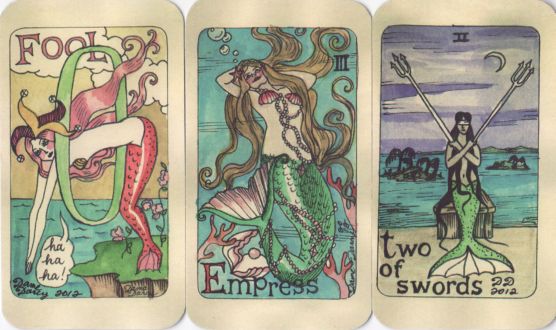
19 February 2013
From Taiwan comes the rather delightful Rope Doll Tarot illustrated by Anna Soung. This is a full 78 card deck with fully emblematic Minors. The Minors follow, though in Anna Soung's unique style, the sequence of the Rider Waite. You can see this in the Three of Swords, piercing the heart. The artwork is made to look like pen and watercolour, but it is more likely that it was fully orignated digitally. It is brightly though sensitively coloured with key tones being used for each suit. Well worth buying. As always with Far Eastern decks, the best source is Baby_Dream on Ebay.
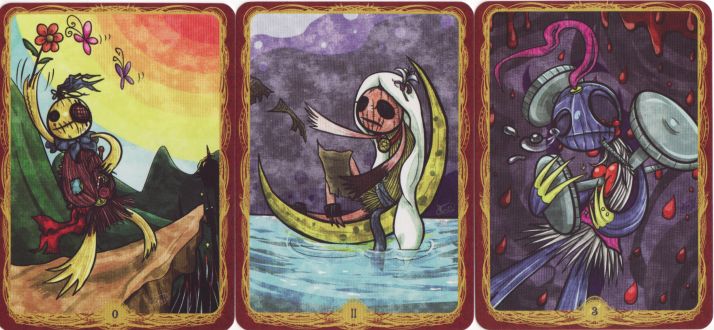
18 February 2013
The New Wave Tarot celebrates the style of pop or rock music from between the late 1970s to mid-1980s with ties to the original wave of punk rock. The creaor of the deck, Amanda Lee Stilwell, collages photographs of the various personalities, such as Gary Numan, Steve Strange, Siouxsie Sioux, Kate Bush, et al., within a tarot arcana context. This is a 22 card deck, but Amanada tells me she is working on a full 78 card deck.
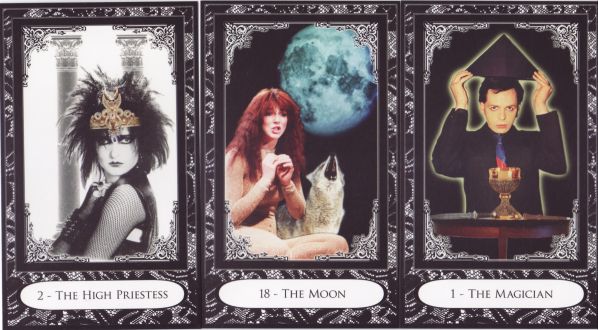
15 February 2013
I have now managed to get Ebay to lift the restrictions on selling and I have begun selling off surplus tarots. I have already sold nine items and will be adding many more over the next weeks. I usually sell these on Buy-it-Now terms as this is easiest for the purchasers. Next week I intend to auction one of my copies of the long out of print Phantomwise Tarot.
15 February 2013
I recently obtained a copy of the Muti Arcani, which is a deck issued as a result of a collaborative exhibition on the theme of tarot, organised by Giuseppe Iavicoli at galleries in Italy in 2012. The 22 card images are in different media. As I love painting, I have chosen three of the paintings which most appealed to me.
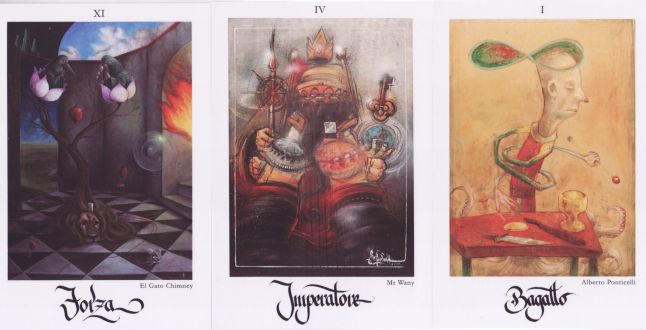
3 February 2013
I have decided to sell off the duplicates in my tarot collection in order to raise some funds towards supporting the Centre for Tarot Art project. I have set up a few items on Ebay, but I have found their system to be extremely frustrating as they are limiting me to only selling a handful of items at a time. It seems that, although I am a long term member of Ebay (dating back over 10 years) and have a 100% record as a purchaser, they expect me to start selling as a complete unknown, restricting how many items I can sell a month, imposing a strict financial limit per month, not allowing me to use offline listing software in which to prepare auctions and not allowing me to sell directly on Ebay.com I am really disappointed with these restrictions. I suppose eventually these will be overcome as I gradually sell items, but as I have about 100 tarots I wish to sell, if they only allow me six items a month (or a $300 limit), it will be years before I can sell all that I want to. Their Customer Advisors are unable to alter these conditions, as they are forced to stick to the rigid rules. How can any established business sell items on Ebay with these ridiculous limitations ?
Anyway you can see one of my Ebay listings on this link. I am selling as AlchemyBookshop and you can set this in your Ebay as one of your favourites in order to get information when I am able to add more items. I have some very interesting items to sell.
2 February 2013
The Blue Birds' Tarot is a rather fine Japanese majors deck. The artwork uses a restricted palette on top of strong pen drawings. Many of the cards have blue birds depicted. The Devil and the Moon are magnificent. It was created together with the professional fortune-teller Maki Mikami. The original paintings were the subject of a one man show in November 2012.

1 February 2013
The Peace Tarot is self-published by Misuzu Itateyama. Rather beautiful watercolour paintings, with no hard outlines. It celebrates traditional Japanese culture.
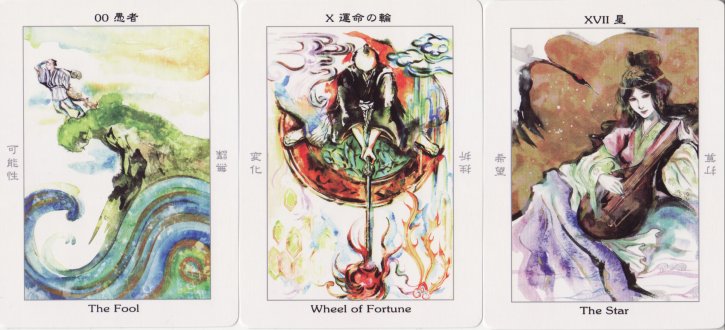
31 January 2013
Many of us collectors have been looking for an item for some years. I first came across the Carbonic Tarot in 2005 in Kaplan's Encyclopedia Vol IV. I was so impressed by it that I attempted to contact the artist Adriano Carmago Montiero in the hope that I could publish an edition in my Art Tarot series. Unfortunately I could not locate the artist. So it was a delightful surprise to find a copy on sale by one of my favourite Italian tarot dealers. It was drawn in pencil, that is graphite or pure carbon, and thus the title for the deck. Unfortunately the cards are very small and I am sure they don't do full justice to the original art, which I expect were much larger drawings. It was published, together with a book of explanation, in Brazil in 2007.
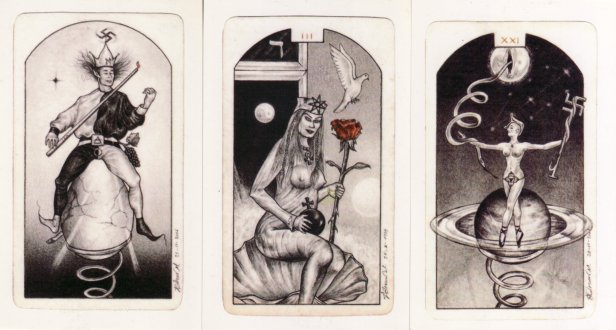
25 January 2013
I have set up the information in Stacy Flinn's database onto a web page.
www.alchemywebsite.com/tarot/unpublished_tarot.html
This is, of course, merely a provisional layout and I will modify this over the next few months, but it will give you some idea of what it will look like eventually. There are many remarkable tarots that have never been published and I hope this project will bring them to peoples' attention.
I have also set up some pages on tarot art, Tarot exhibitions, The Masjutin Tarot, The Mebes (1937) Tarot, The Kashmir Tarot and the Chapel at Avenieres.
www.alchemywebsite.com/tarot
24 January 2013
For the last week I have been working on the production of the next tarot in my Art Tarot series. This morning I completed this and made up the cards into sets in their boxes. I will announce this next week and open it to purchasers. I have given my regular customers the opportunity to buy a copy early, as the previous tarot I produced sold out in only a few weeks.
17 January 2013
El Tarot del Inconsciente Anonimo (The Tarot of the Anonymous Unconscious), by the poet Leopoldo Maria Panero, a deep and gloomily poetic vision of the world of the secrets and the symbols of the unconscious. This is a book with a set of printed cards. Each card is accompanied by a poem, a description and an interpretation. The main themes that Panero explores are alchemy, magic, psychoanalysis, homosexuality, madness and death.
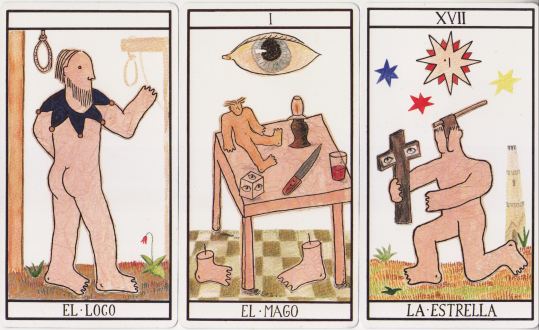
14 January 2013
Alice in Tarot Card is a 16 page stapled book containing 11 tarot card designs based on characters from Lewis Carroll's Alice in Wonderland. The designs were created digitally by Kashima, a freelance Japanese artist/illustrator. A number of similar artbooks illustrated by her have been published in Japan Sheer Magic, Eros & Thanatos, Delta of Venus , among others.
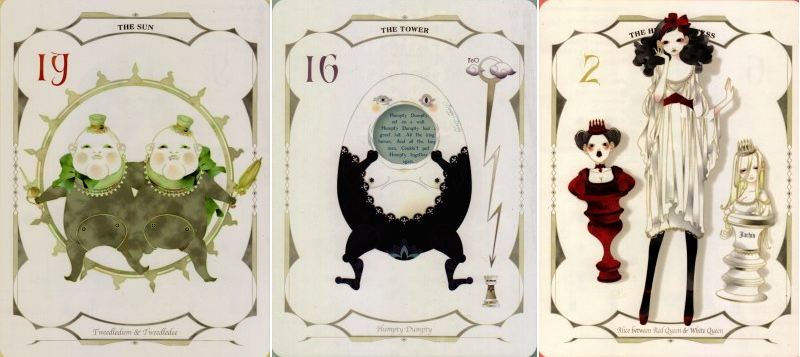
11 January 2013
In parallel with the descriptive catalogue of published tarots which I hope will be completed before the Summer, I have happily found a colleague, Stacy Flinn, here in Scotland willing to help build a catalogue of unpublished tarot designs. I myself have gathered some hundreds of these over the last years and as some of these are astounding, it would be good to have these in a catalogue which I could eventually place on this website. I will report on progress with this later. I have called on members of the Tarot Collectors Forum to help by sharing information about such unpublished tarots.
10 January 2013
The Psychic Force Tarot is a Japanese fanart tarot. It seems to have been created by a number of a number of artists, thus it is a doujinshi or collaborative fan art deck. Saikikku Fosu is a 1995 fighting arcade game created by Taito which was later ported to the PlayStation in 1996. In 2006 it was released for the PlayStation 2.
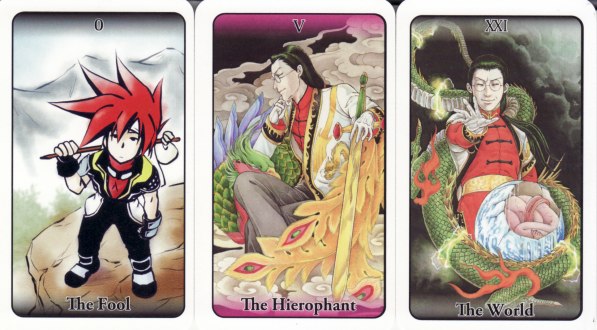
4 January 2013
The Chinese Classic Tarot issued together with a substantial book in one of those large strong cardboard boxes with a magnetic fastening, is a 78 card Rider Waite clone. The artwork by Nicola Soki is executed in the medium of oil painting, which is refreshing to see when so many Far Eastern tarots designs are produced digitally. Her majors show some rather interesting new ideas. The Minors stick close to the established emblems of the Rider Waite but realised in her own style and with some creative variations.
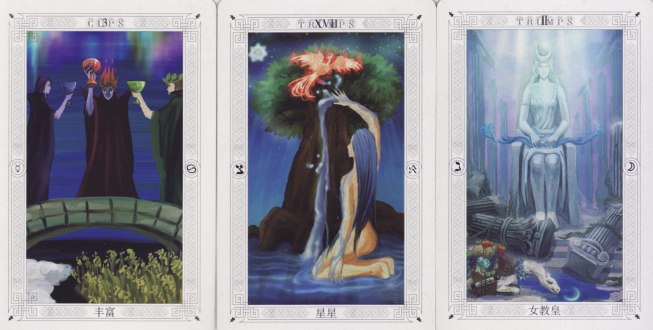
3 January 2013
Tarot as Muse is a promotional and benefit project for the Ink People Center for Arts in Eureka, California, created by a group of artists in Humboldt county. Supplied in an envelope with a booklet containing each artist's statement about their artwork.
Go to their website to buy a copy www.inkpeople.org
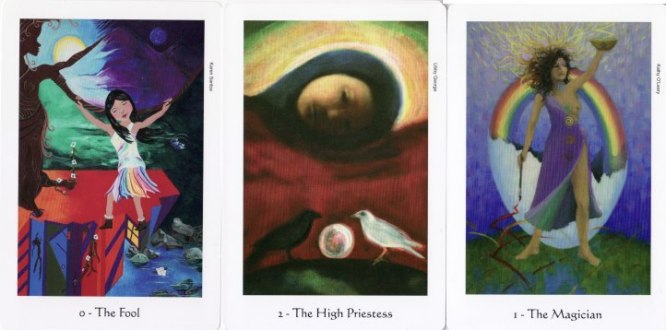
2 January 2013
The Moscow Sheharezada's Tarot or a Guestworker's Journey is one of those tarots that reflect social history. It is painted in a naive style by one of Moscow's best known Tarot readers 'Moscow Sheharezada'. It appears that she may be an immigrant to Russia, and the majors depict the journey of a guestworker or immigrant from some primarily Muslim country shown in the Fool through to the Lovers, then travelling to Moscow by train, finding work on a building site, living in a tin shack - the Chariot through to the Hanged Man. He then meets a woman and begins to settle down into a better domestic situation, in Death and Temperance. Then there is some problem over money and he is arrested, put into jail, a sequence shown in the Devil through to the Moon. After his release from jail, he buys a ticket and flies back, presumably, to his native country, depicted in the Sun to the World. The Minors stick very close to the Rider Waite emblematic sequence, though depicted though events in the life history of this guestworker. I suspect few people will want to buy this deck, but they are missing out on a significant use of tarot as a vehicle for social comment.
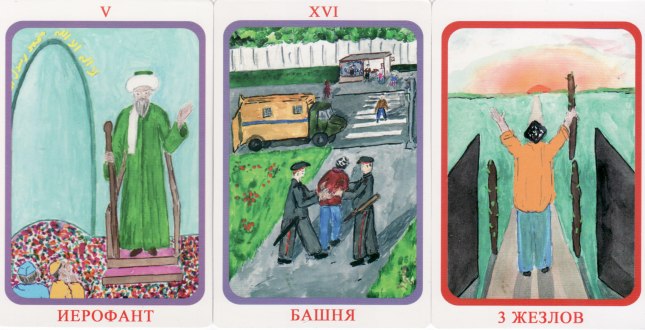
31 December 2012
Ame Zaiku is candy art in Japan, food sculptures usually on sticks like lollipops, created by hand, often by street vendors on the spot, from mizuame (boiled sugar starch) with applied strong food colouring. This tarot draws on this candy art form for inspiration. The creator "Ame" has also written and self published two children's books the 'Little Kingdom' and the 'Little World'. These tarot designs seem to relate to the 'Little World' book.

29 December 2012
I don't usually buy oracle or similar non-standard 'tarot' decks, but I just had to have this one, for three reasons. First, it is called the Jung Tarot, secondly it was designed by the prolific Ryuji Kagami and thirdly it has 22 cards. It consists of cards illustrating some of the more familiar aspects of Jungian psychology. There are nine pairs of cards, each pair having a dark and light aspect, corresponding to the classical Jungian archetypes perhaps seen through a Joseph Campbell lens, the Persona, Hero, Shadow, Anima, Animus, Mother, Father, Puer, and Senex. The four remaining singleton cards are the Self, Transition, Synchronicity and the Four Functions. The imagery does not align with the tarot archetypes though there are similarities.
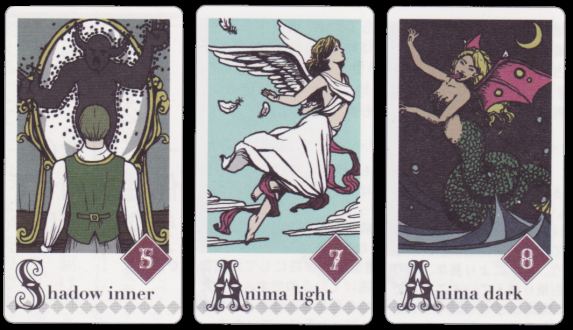
28 December 2012
The Stitch Rabbit Tarot is a cute production from Korea. Intended for children, it depicts a soft toy doll involved in various activities related to sewing - working with pins, spinning thread, using a sewing machine and playing with bobbins.

27 December 2012
I find I have built up quite a backlog of items to comment on in this weblog. The first of these I will mention is the Halloween Tarot by Rodney Howington. The artwork is digital and very saturated with the forms sharp and contrasty, which creates a rather delicious effect. There are a few decks with a Halloween theme, but this one is outstanding.
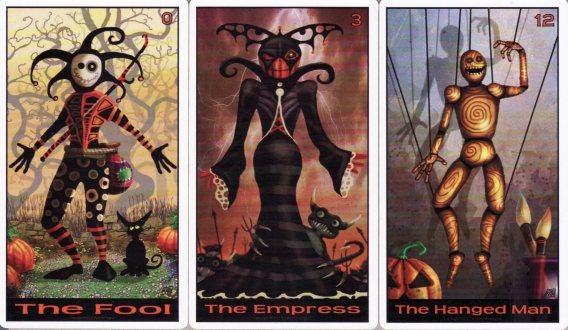
13 December 2012
Some ten years ago I began seriously collecting tarot cards and artwork. This grew out of my interest in allegorical and emblematic art. Now in 2012, I have about 2500 items in my collection which is recognised as currently the largest and most comprehensive in the world. I have not been selective but gathered everything I could afford. I have recently realised that I have in my hands an almost complete documentation of the artwork found in modern tarot designs.
I am concerned now to find some way to preserve this collection as a scholarly resource documenting the amazing phenomenon that is tarot art. To this end I intend to set up a Centre for Tarot Art, a body which can act to preserve the collection and avoid it being broken up and sold off piecemeal when I die.
In the last 50 years an enormous amount of creative energy has been focussed on the tarot. Well over three thousand tarot decks have been designed and published in some form. There is a delightful variety of ways in which the various designers and artists have realised new tarot decks. The tarot with its tight structure of 22 major arcana each based on a clear image, and the 56 minor arcana with its four suits of pips and court cards, might seem a restriction on the creative imagination, but the opposite appears to be the case, as there are some astounding interpretations and reworkings of tarot imagery to be found. This recent evolution of the tarot suggests that it has now become a kind of emblem book reflecting the social history of our age back to us.
The Centre for Tarot Art will require some substantial funding. This is unlikely to come through the established world of government art funds, as most art historians at present seem unwilling to recognise the genre of tarot art and instead dismiss it as ephemera. This is partly because they have not been able to examine and appreciate the breadth of artwork found in modern tarot. There are no public collections of tarot art, which is ignored by most museums, libraries and special collections, so access to tarot artwork remains in the hands of individual collectors. My collection could provide a foundation for scholarly studies of the material if it could be kept together and made available to the public.
In the longer term, substantial funding would be necessary to endow the collection so it could be gifted to some museum or library. This would probably require a large sum of around £100,000 ($160,000) which the receiving institution would invest to provide a modest income stream to help pay for the costs of conservation and making the material publicly accessible. As I am 64 this cannot be left indefinitely, and I would hope to be able to find some solution within the next five years.
In the medium term, there are a number of projects that could be undertaken to research the material I have at hand and to promote interest in tarot art. It is essential to have a descriptive catalogue made of all the items. I have already created such descriptive entries for just over one thousand items, but as I have to earn a living through my publications, this is taking too long as I cannot devote the time to it. I feel that it would be best to try to find someone to undertake this. It might suit an art history student as a summer job. This would probably cost about £2000. There are many educational projects I can think of that could be undertaken to try and promote interest in the artwork, exhibitions, conferences, publications, which would require similar modest funding.
If this project fails to raise the necessary funding, then in the closing years of my life I will have no alternative but to return the material to the tarot collecting community through selling off items piecemeal. This would be a missed opportunity.
6 December 2012
As I am approaching the established retiral age of 65, and know that I cannot expect to be able to sustain my intense workload for more than another five years or so, I am becoming increasingly aware that I have to make some provision to preserve my work on the art of modern tarot. Most people will understand that I am not your usual sort of collector. I have not done this as an investment, waiting till the prices of rare items have risen in order to sell later. I also have collected in order to study and document tarot art, so my collection is not skewed by personal preferences, but truly represents tarot art from the 1960's onwards.
I have two problems to solve.
Firstly, what to do with my collection when I die or become unable to work with it further. I have explored the possibilities of donating it to some institution but they inevitably raise the matter of a considerable endowment to help with the costs of conservation and making this available for public consultation. Such an endowment is beyond my means. At the moment, in the case of my death, my executors would have no alternative but to sell the collection off item by item.
Secondly, as I have to continue to earn my living from publishing my books, I find I have very little free time to devote to developing and researching the material in my collection. I have only been able to produce a detailed description of less than half the items in my collection. It is obvious I need help with cataloguing and researching this material. I cannot afford to employ someone, even part time, to assist me in this.
The only solution I can see to these two key problems is to seek financial support from the wider community of people interested in the artwork of modern tarot. Of course people will not give an individual such as myself money to use as they will, so I am minded in months ahead to explore the possibility of creating a Centre for Tarot Art and actively seeking financial support for this. Should sufficient support be available I would be willing to donate my collection to this Centre for Tarot Art. The funds could be used in a number of ways :-
* Part of the funding would be used in the first year to employ someone to complete the descriptive catalogue.
* A core funding would be invested in order to provide an endowment to an institution, such as a library or museum, in order that the collection could be preserved. Given my age I would expect this would have to happen within the next ten years.
* Part of the funding could be used to promote interest in the artwork of modern tarot, through issuing a scholarly Journal exploring the many aspects of tarot art, or by organising conferences and exhibitions on the theme.
I have tried to find a wealthy individual to come forward to support this idea, but to date have not found such a sponsor. Some people have suggested I use systems such as Kickstarter to try to raise such funds. My collection of 2500 items is probably worth close to £100,000 ($150,000). I estimate that the minimum funds required to establish a modest Centre for Tarot Art (limited to researching and preserving the collection) would be around £50,000 ($75,000). Anything less than this would not see the project through to fulfillment. Funding above this figure would probably allow for the organisation of publications, conferences and exhibition projects.
I would welcome any suggestions as to raising funding, and possible contacts with individuals who might be able to help financially.
Sadly there is no museum or centre for tarot art in the English speaking world. I have the material but not the resources to create this. I need help with such a project.
14 November 2012
In 2010 Alexander Daniloff created 22 tarot paintings as the subject of the exhibition 'Cartomania' in the Galleria Quadrupede in Rome. In association with this a majors tarot deck was published. I was able to obtain one of the few remaining copies and posted a note about this on this weblog on 19 Mar 2012. Alexander Daniloff has now created a full 78 card deck with new artwork. This is a signed limited edition of 450 copies. One interesting feature of this deck, which I don't remember seeing elsewhere, is the provision of alternative numbered versions of Strength and Justice, so one can have both a Marseilles and Rider Waite ordered deck. You can buy copies direct from Alexander Daniloff's web site.
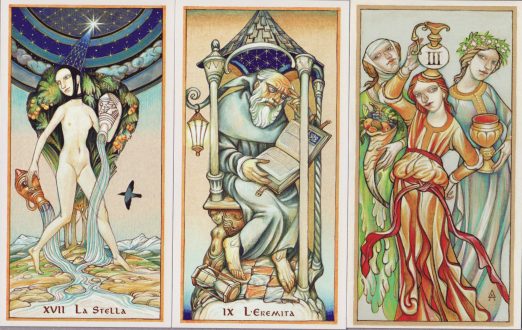
13 November 2012
Saint Seiya is a Japanese manga series written and illustrated by Masami Kurumada and serialized in Weekly Shonen Jump from 1986 to 1991, later adapted into an anime TV series by Toei Animation. It continues to hold a considerable fan base and there have been at least three tarot decks issued. Now there is another. This is the Tarot for the School of Athens a fan fiction by Suixinsuiyuan using the Saint Seiya characters. The artwork is by Tachibana is very fine in a naturalistic manga style. Needless to say this was self published in a small edition and will probably be impossible to source in a few years, like many of these self published Japanese tarot. Decks such as these are truly collectors items so I wonder why more people don't rush to buy up the few remaining copies.
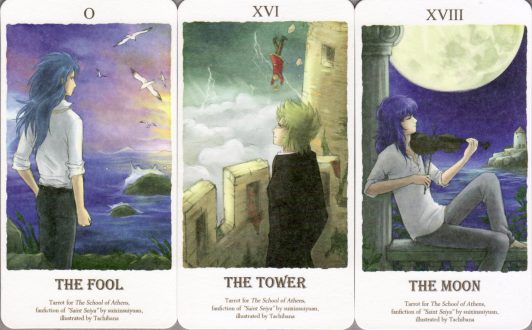
12 November 2012
The title of the Wild Unknown Tarot, I initially supposed, referred to the primal forces which underlie our life, but checking the website I noticed that the artist, Kim Krans, quotes a line from the 1975 Bob Dylan song Isis - "So I cut off my hair and I rode straight away, For the wild unknown country where I could not go wrong". The Wild Unknown is also the name of their home in upstate New York which is a retreat and centre for their band. Check their page for a video of their Family Band. There are no human figures depicted in this deck, only objects, trees, plants and a menagerie of reptiles, birds and animals. The artwork is created in fine pen drawings, subtly coloured in small areas with watercolour, thus leaving the images to impact on us primarily as pen drawings. The deck comes in a strong box and can be purchased from www.thewildunknown.com
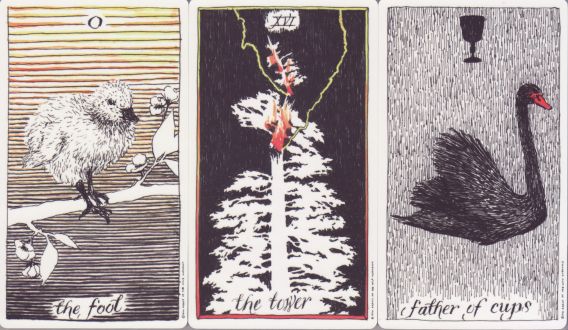
9 November 2012
The Book of Azathoth Tarot has just been issued by Nemo's Locker. Azathoth is a deity in the Cthulhu Mythos and Dream Cycle stories of H. P. Lovecraft which was used in novels by a number of later writers. He describes his deity in 1926 in The Dream-Quest of Unknown Kadath, "Outside the ordered universe is that amorphous blight of nethermost confusion which blasphemes and bubbles at the center of all infinity - the boundless daemon sultan Azathoth". This tarot draws on the imagery from Lovecraft's complex mythology, and was created as wonderful pen drawings which are here printed in sepia. You can buy a copy from www.nemoslocker.com
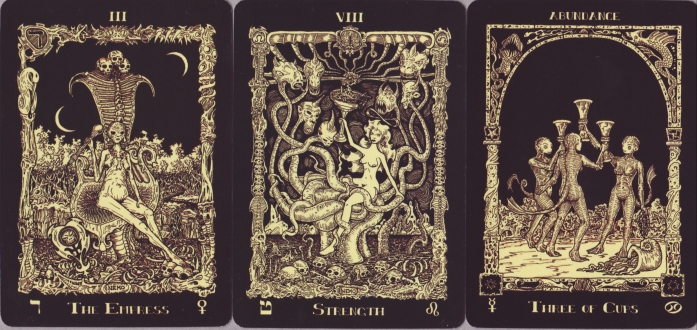
8 November 2012
I have been very busy recently printing up copies of two new books in my alchemical series, and thus unable to give much time to my tarot collection and this weblog. I have quite a pile of items that I would like to bring to peoples' attention through the weblog, and I hope to find time over the next few days to update these pages.
22 October 2012
Nicholas Roerich (1874-1947) was a Russian painter who felt a strong spiritual connection to the idea of Shamballa. He was great traveller and a prolific artist, painting usually on card in tempera. There are a number of museums dedicated to his artwork, the best known being in New York. One can think of him as a Russian Symbolist. His work is figurative and often set against backgrounds of Himalayan mountain landscapes. A Ukrainian publisher has now issued a tarot based on his paintings. This is supplied in a strong box with a descriptive book (in Russian). It is a rather beautiful production. Collectors should buy copies before they disappear from the market. It is an expensive set but worth every penny, and unless it is taken up by a USA publisher, it will remain obscure in its Ukrainian edition, and become very collectable in future. The artwork, though not originally conceived as tarot images, is a great delight.
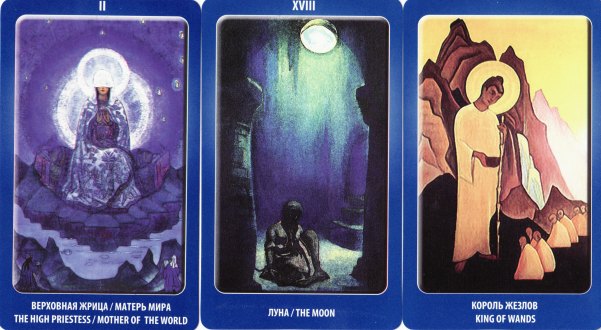
20 October 2012
The Tarocchi di Fiabesque was published by MBVision in collaboration with the International School of Comics in Florence. Fiabesque is a cultural event that takes place in the medieval village of Peccioli at Christmas time. The event is organized around the universal theme of storytelling. Street artists, designers, musicians, dancers, writers and creative people of all kinds contribute to the construction of a unique event, which has its foundations on the pillars of fantasy. This tarot was created as part of this festival in December 2011 and January 2012.
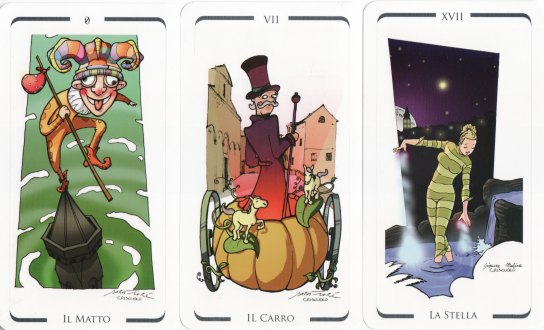
19 October 2012
The domain of Tarot has never been one which respected truth and reality, with its many supposed histories and the often ridiculous interpretations that people project onto its imagery. For most people it is all really a bit of fun and not amenable to a coherent history. The recently published The Lost Tarot of Nostradamus should really be named The 'Lost' Tarot of 'Nostradamus' as the images used in it were neither lost nor had anything to do with Nostradamus. Despite these historical inaccuracies it is a rather fine production, being issued in a box complete with a 160 page paperback book. The creators of this tarot have drawn on a series of images found in a number of early manuscripts entitled 'Vaticinia Pontificum' or the 'Vaticinia de Summis Pontificibus' dating back to the Greek Byzantine period which were augmented by incorporating aspects of the celebrated papal prophecies of the medieval Abbot Joachim of Fiore. In the 14th century a number of delightfully illuminated parchment manuscripts were created. You can see illustrations from a number of these on the Internet and they have been known to and described by scholars for many centuries. So these images were not 'lost' in any sense of this word. Secondly, Nostradamus (1503-1566) was writing some two centuries after these 14th century manuscripts were created, so these had nothing at all to do with him. The connection was made a few decades ago by two Italian journalists more interested in writing a sensationalist popular work than presenting the truth. But does this matter one jot in the world of tarot? - No. Just have fun looking at the delightful artwork.
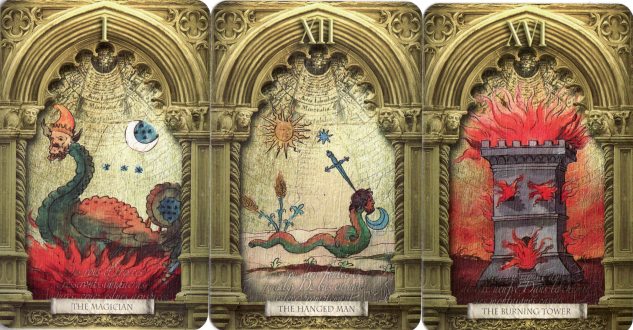
17 October 2012
Dishonored is a new computer game released in the last month on the X-Box platform. As a promotional gift for those who pre-ordered the game, the company supplied a tarot deck. This is primarily intended as a Jeu de Tarot for the 'Game of Nancy' the complex rules for which are supplied with the deck. The deck has the familiar 22 + 56 structure, though the trumps do not directly link to the tarot archetypes. The pips are in playing card style. The images used in the trumps appear to be based on characters in the computer game. I don't play computer games so I was not going to buy the game just to get the tarot deck, but happily a number of purchasers of the game have decided to offset the price they paid by selling off the tarot deck on Ebay. So it is easy to get a deck at the moment, but one must expect this flood of copies to slacken off in time.
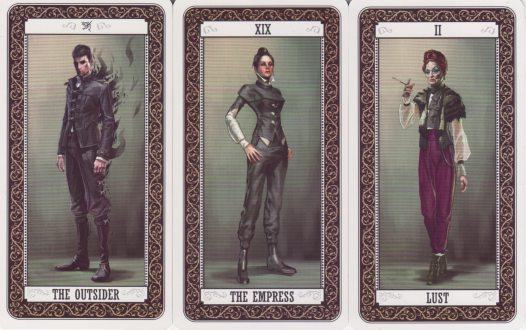
16 October 2012
El Tarot de las Mafias is a rather well produced deck issued by the Italian publisher De Vecchi in a box with compartments for the 78 cards and a small explanatory booklet. The version I have is issued in Spanish by De Vecchi Barcelona. I do not know if an Italian version is to be issued. There are 22 Majors and the full Minors. In many of the Majors the imagery departs considerably from the established tarot archetypes. The minors are fully illustrated. The artwork is dark and brooding, being in pen and ink washes. This is an unusual tarot which many collectors will wish to add to their collection.
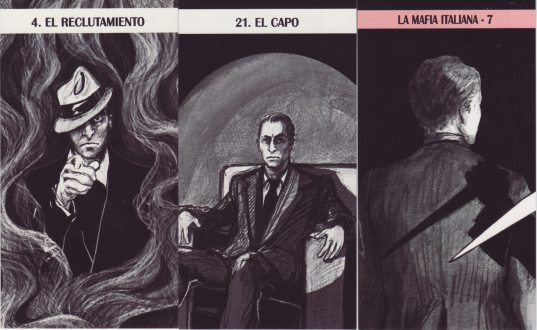
15 October 2012
In a couple of weeks time it will be Halloween, so it is timely that I have just obtained a copy of the Trick or Treat Tarot produced in Korea. This is a very jolly and amusing little tarot. I obtained this through the good services of the dealer Baby Dream. It comes in a folder with a rather fine Korean book with full page illustrations.
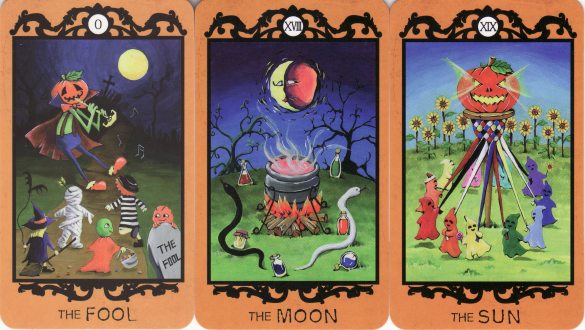
12 October 2012
In the last entry I showed a tarot, each image of which was created in under 15 minutes. The Tarot of the Absurd by Jessica Rose Shanahan, apparently of black and white line drawings, hides behind this smooth flowing exterior, an enormous of work on each image. Although these mimic pen and ink, they were in fact created in a vector graphics program. Each line and point of each curve had to be painstaking entered by hand. I cannot imagine how many hours went into creating the artwork. This painstaking work shows in the smooth flowing curves and the lines that delightfully trail off into the background, however, this is not a technical exercise, but a work full of humour and expression. Jessica Rose Shanahan is able to use the demanding medium of vector graphics to create a deck which communicates directly with the viewer, each card image being a little narrative scene, full of humour and drama. You should buy a copy before they sell out www.barefootfool.com/tarot
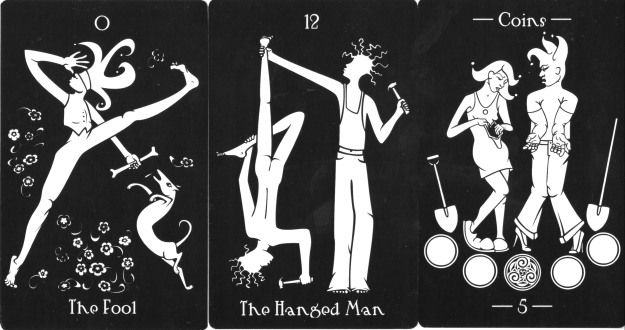
2 October 2012
The Lazy Afternoon Tarot was created in 2008 and 2010. Each card was conceived, drawn, inked and coloured in under fifteen minutes. Now that could well be a recipe for a disaster, but these designs are really neat. In the Majors Karen West often finds fresh images, while her Minors are a reworking of the Rider Waite emblematic sequences in an original way. There are three Lovers cards to cover some of the various permutations of partnerships. Karen West also recently produced the Mathematics Tarot in an entirely different style (see entry for 24 September 2012.
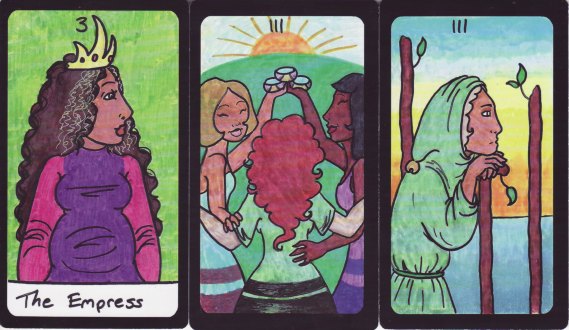
1 October 2012
Dominic Murphy is a UK based artist with great inventiveness and skill at drawing. His artwork is often dark and yet full of humour. He is very prolific and has produced a few decks of cards, some on one of his favourite themes of Lewis Carroll's Alice. I recently bought his Cheshire Cat set of playing cards. He has been working on a tarot deck for some time and it has now appeared. He calls it the Lost Tarot as, apart from the standard 22, he has added a further "lost" 32 Majors to produce a deck of 54 Major arcana. I was surprised and delighted to find that he had reused the artwork for one of the alchemical images from the Splendor Solis manuscript that I commissioned from him last year for the backs of the cards. His artwork is not expensive and people should consider buying some of his amazing drawings or even asking him to make a work for them - I found him easy to work with and very professional. You can see his work on his website www.dominicmurphyart.com His tarot is currently on sale through his pages on Ebay where he uses the name 'homelyvillain'. But you better be quick as they are selling fast.
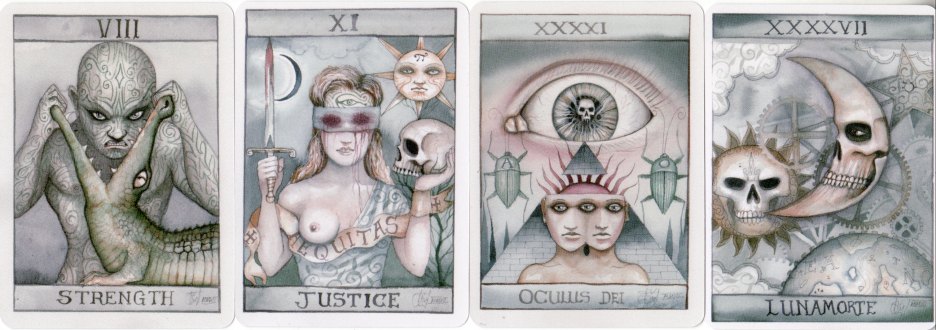
30 September 2012
The Wicca Moon Tarot is a recent UK publication created by Shirlee who runs the Wicca Moon shop in South London, which you can see on www.wiccamoon.org.uk I do like to see tarots created as paintings and these images are a great delight. I expect some of the faces are portraits of her friends as they are sensitively painted. The deck is unusual in that Shirlee opts to paint a single card for the King and Queen for each suit. I expect this is to avoid putting one sex above the other, following true wiccan philosophy.
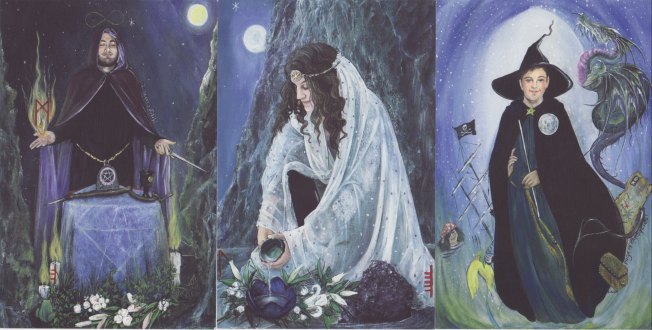
29 September 2012
The Dark Carnival Tarot was created by Rachel Paul, a Juggalo or fan of the Insane Clown Posse hip hop duo from Detroit. I must confess that I had to do some online research to source the urban slang used in the deck and accompanying book. The suits, for example, are Gats, Axes, Duckets and Faygos. Gats are guns (probably the term derives from the Gatling Gun), Duckets are coins, easy when you remember your Shakespeare, while Faygos are cups and this is derived from a ghetto soda pop which apparently is often sprayed over the audience during Insane Clown Posse concerts. There are apparently 57 flavours of Faygo. The book is opaque in places as I suspect one has to know hip hop slang and the lyrics of some of the Insane Clown Posse to appreciate the references. The artwork is astounding and totally in your face. Rachel Paul has developed a confident coherent style, a visual language in which she is able to articulate the tarot images. The Majors are delightful and she is even able to translate the emblematic sequence of the Rider Waite Minors into her own pictorial language. She has real strength in her drawing. Certainly one of the most memorable tarots of 2012.
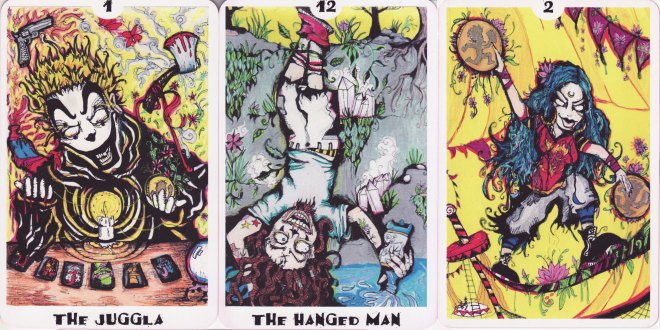
28 September 2012
As many of the readers of this weblog will have realised, I collect tarot art appearing as illustrations in books. So I was happy to obtain a copy of Michael Jacobs' Ten and Twenty Two subtitled "A Journey through the Paths of Wisdom". This was published in 1997. Jacobs presents a complex analysis of the tarot through Kabbalistic ideas. The book is illustrated with 22 full page images.
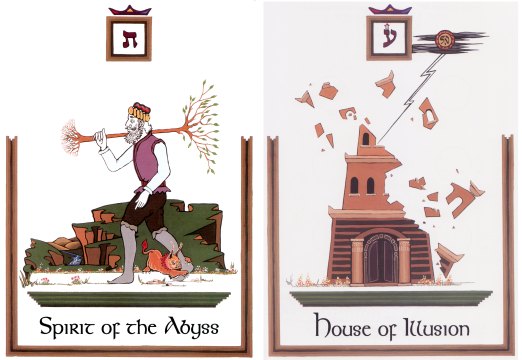
27 September 2012
The Threefold Oracle deck by Tara Cochrane is based on the idea of the Triple Goddess and thus is composed of three separate versions of the Major Arcana, each in a different art style. Many of the cards are renamed, but all reflect, in different ways, the established tarot ideas. You can buy a copy through the company Gamecrafter.
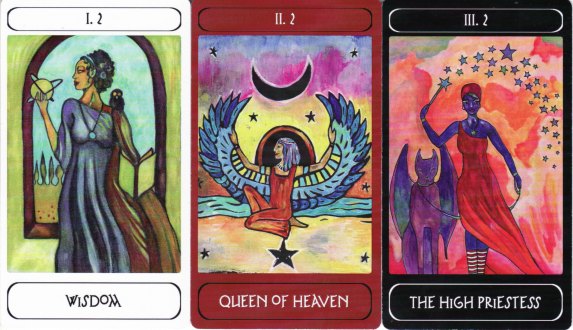
26 September 2012
Lisa Chow has recently produced a rather fine tarot based on her drawings which were the subject of the exhibition "Oracle" at Space Montrose in Houston, Texas in April 2012. Her pen drawings are a great delight. Available through her website www.lisachowart.com or on her Etsy shop (lisachow).
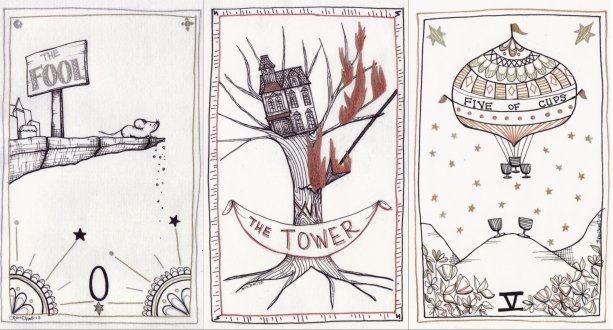
25 September 2012
In recent years Zombies have broken free from their pulp fiction and B-movie origins and emerged as a mainstream genre for comic books and feature films. So it is not at all surprising that the last few years has seen the appearance of a number of Zombie tarots. This Zombie themed deck has been collaged in 1950s advertising poster style. The imagery either depicts zombies with their flesh in tatters or people armed in order to defend themselves against being attacked. The cards are provided in a strong cardboard box made in the style of a box of shotgun cartridges. The enclosed book, made to look aged, presents the theme of the Zombie apocalypse.
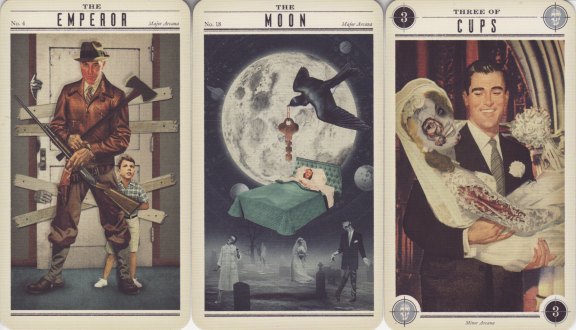
24 September 2012
When I was a teenager I studied abstract mathematics. Later my life went in other directions, but in the last two years I have returned to trying to understand the abstractions of modern mathematics. So when I saw that someone had produced a Mathematics Tarot, there was no way I could resist buying one immediately. I now have it in my hands. The creator of this tarot, Karen West, has been rather clever in choosing mathematical ideas to somehow reflect the ideas behind the Majors, though understandably it was not entirely possible to extend this throughout the Minors. It was a challenge but the result has worked out well. There are few subjects or areas of human culture that tarot has not touched. The Fool is one of the chaos fractal patterns known as the Lorenz attractor, The Magician is the Uncertainty Principle, the Empress is Potential Energy, while the Emperor is E=MC2 the mass energy equivalence. The Tower is the Fermat Conjecture and the Star the Reimann Hypothesis. The edition is limited to 50 copies, so go to Etsy and buy one soon.
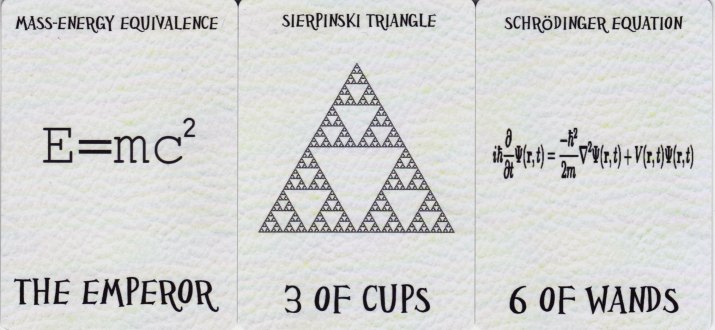
23 September 2012
A few days ago I was privileged to receive a copy of a personal tarot deck created because a friend of the artist Mimi Manderly wrote a story as a gift for her, including her as one of the main characters. The story was called 'The Sempra Deck', and a deck of tarot cards was central to the plot. So Mimi Manderly created an actual deck as a response to the story, and circulated it amongst her friends.
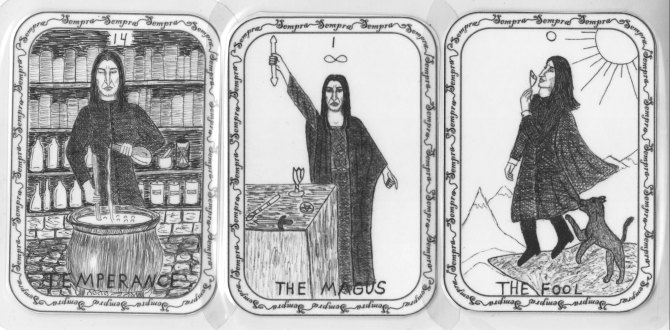
22 September 2012
Vera Sklyarova is the most prolific Russian tarot designer. One day I must draw up a list of her work. Anyway, thanks to the generosity of one of my Russian contacts I now have another of her tarots, the In Your Hands Tarot. This uses references to chiromancy (reading the lines in peoples' hands) as the subject matter for the deck. The artwork is delicate watercolour drawings, printed with a low contrast. A fine production.
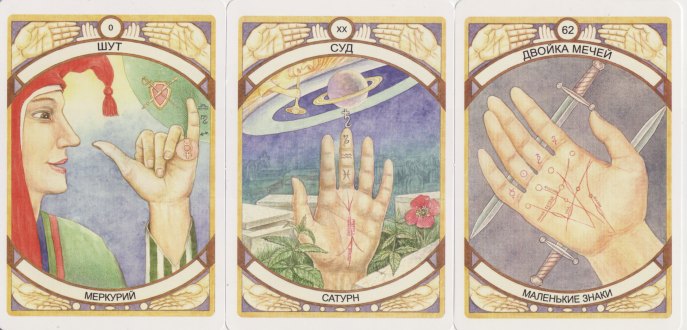
21 September 2012
The Robo Tarot presents an anachronistic and stylised view of robots, located more in 1950s and 1960's science fiction illustrations than in modern designs for robots or their depiction in contemporary fantasy art. Each card is numbered in binary. Available on Etsy.
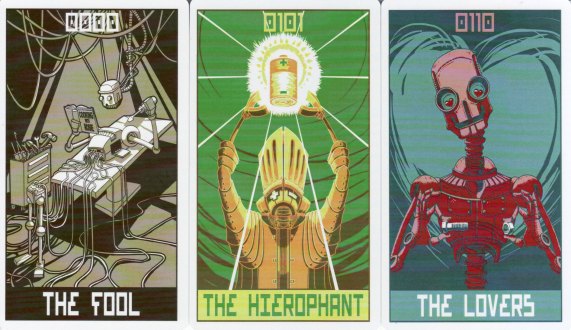
20 September 2012
This tarot was printed as part of the First Stuckist Tarot Card Exhibition of the original artwork, held in London at the Islington Arts Factory from 21-28 September 2012. The original idea for this exhibition was by Elsa Dax and the project was managed by Ella Guru, both of whom contributed paintings to the exhibition.
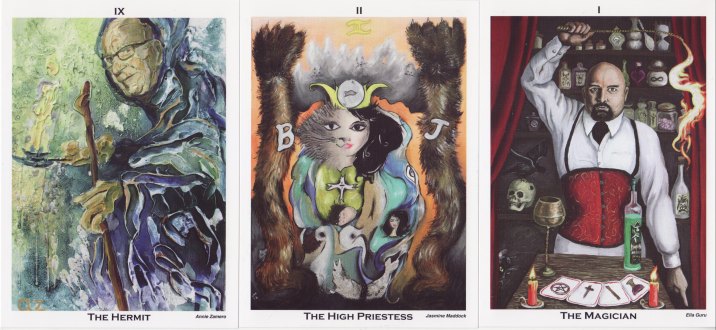
Yes, the Hermit does depict Rupert Murdoch as St Anthony Abbot from a early 16th century painting by Pontormo.
19 September 2012
Many collectors will know the strange, enigmatic yet intriguing tarot l'Oeil de Myrddin from 1994. Its creator, Philippe Rouchier, has now created a further deck Les Arcanes de l'Etoile (The Arcanas of the Star). Though he now works primarily digitally, Rouchier's training in traditional painting clearly shows in the way in which he models figures. For this tarot he uses drama, depicted in the faces and postures of the figures, to convey the idea behind each of the arcana.
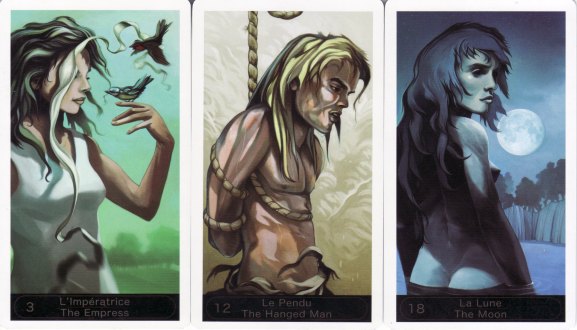
15 September 2012
I have now received the Norse Mythology Tarot created by Kurohane Shizumi. This tarot is inspired by gods and aspects of Norse Mythology. Thus :- The Fool - Fenrir, The Magician - Ymir, The High Priestess - Brunnhilde, The Empress - Frigg, The Emperor - Odin, The Hierophant - Heimdall, The Lovers - Frey and Freyja, The Chariot - Nidhogg, Strength - Thor, The Wheel of Fate - The Norns, and so on. You can still buy copies on Etsy.
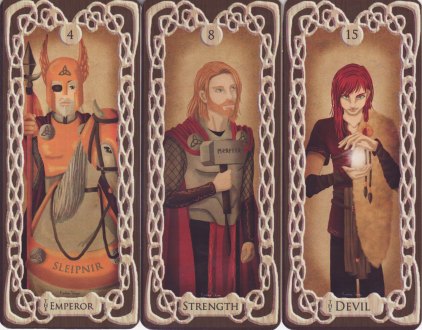
15 September 2012
I just bought a promotional item from 1978 for the consumer electrical/electronic product manufacturer AEG-Telefunken which had production facilities in Spain. The little booklet contains double page sections with a description of the meaning of the individual cards. The text for each closes with some information about AEG-Telefunken. It is a rather good version of the Tarot de Marseilles and comes in a fine quality two compartment presentation box.
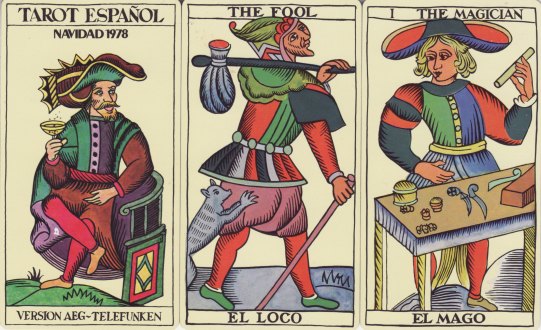
14 September 2012
Based on Lewis Carroll's Alice's Adventures in Wonderland, 1865, the Wonderland Tarot features most of the main characters, thus the Cheshire Cat is the Magician, Alice herself as the High Priestess, the Red Queen as the Empress, Caterpillar as the Hierophant, the White Knight as Strength, White Rabbit as Temperance, and so on. It is available through Etsy
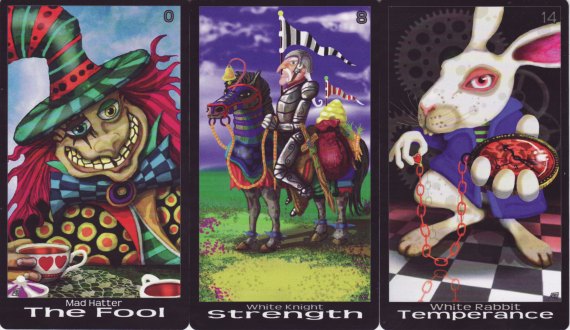
13 September 2012
Mexican decks are not that easy to find. I have only seven in my collection. So I was happy to find a copy of Taroth de los Bohemios Papus apparently issued as a companion to a Spanish edition of the book by Dr Moorne 'El supremo arte de echar las Cartas', Editora Mexicana, Mexico, 1975. The cards are in mint condition though the box certainly shows its age. I bought these from hollywoodkat on Ebay, a dealer who is good at finding rare items. As a bonus, she sends the cards wrapped up like a present. So it is always ones birthday when one buys items from the Hollywood Kat.
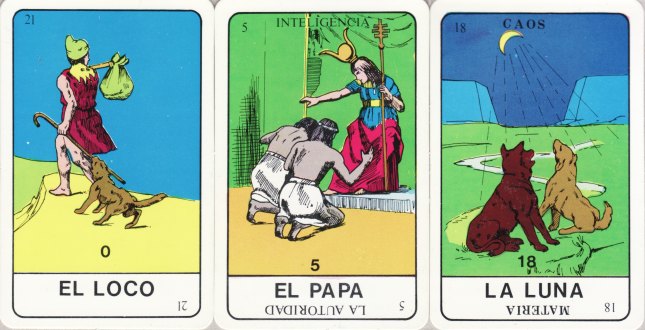
12 September 2012
I just bought an unusual tarot. Not that it had any amazing original designs, indeed, it was a version of the Fournier Spanish Tarot based on the Tarot Clasico of 1736. What makes this deck unique is the fact that it was designed for blind users. The cards have Braille dots spelling out the card titles in Spanish.
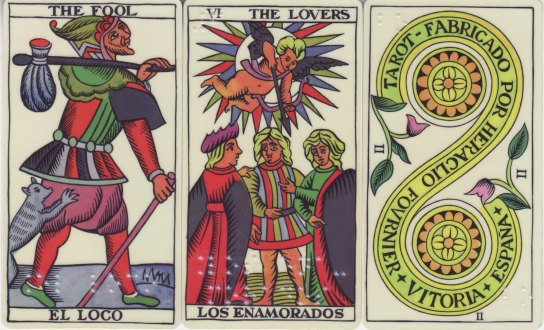
11 September 2012
The Pantoulas Tarot was the basis for an exhibition of digital collaged photographs July 2012 in the Tailor Made Cafe in Athens. Following the exhibition the artist, George Pantoulos, had these printed as a set of cards. His imagery is powerful, often visceral and skilfully realised. The deck is subtitled "A surrealistic view within the human soul". There is a focus on bird imagery. These are in a small edition and can be purchased through hellasgate.com/illustrationwordpress/?p=2515
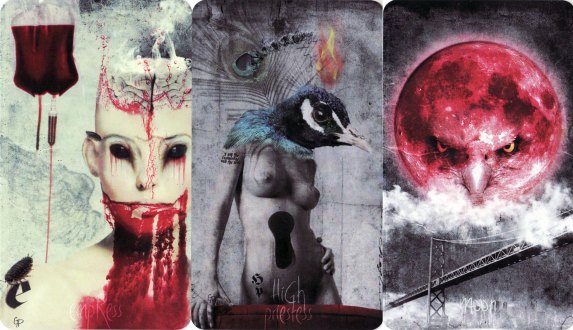
10 September 2012
I just bought a copy of the Elven Tarot by Karla Chan, who is a traditional artist with strong drawing skills, but likes to add backgrounds with Photoshop. These cards have their titles in an Elvish script. She has created a number of projects in steampunk style, and is also much engaged by Lewis Carroll's Alice imagery. For her World card she found a rather neat original image.
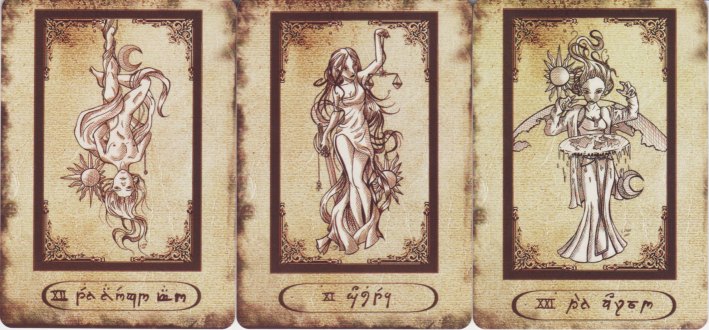
You can see more of her work on karlachan.sheezyart.com
10 September 2012
My return to publishing tarots has proved to have been very successful. My first in the new format, the Fialko Tarot, has now almost sold out, with only two copies remaining this morning. I am actively considering a number of other artists' designs and hope to make some announcements about new publications over the coming months.
9 September 2012
The Triomphes MMXII was conceived as an homage to the 17th Century Parisian tarot creator Jacques Vieville, with some of the artist Bertrand Saint-Guillain's friends (some of whom are tarot related) as models for some of the figures. Mary Greer appears as the High Priestess.
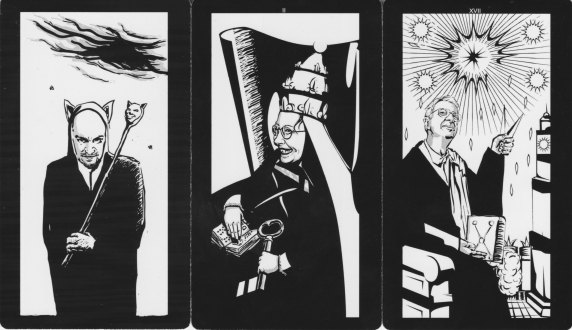
8 September 2012
Neon Genesis Evangelion is a long running Japanese manga and anime series initially created in 1995. It presents an apocalyptic mecha action story, revolving around the efforts of a paramilitary organization Nerv to fight hostile beings called Angels, using giant humanoids called Evangelions that are piloted by select teenagers. The Evangelion Nerv Tarot is a fan art deck.
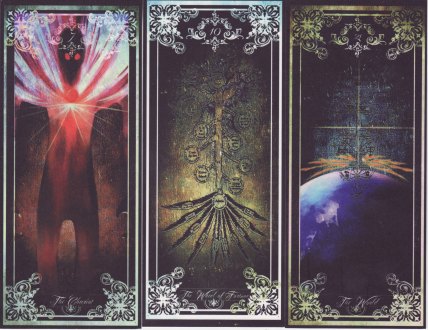
7 September 2012
When I recently bought the IB Tarot I was quite unsure what it was about. It turns out that IB (pronounced "Eeb" or "Eve" ) is a freeware horror adventure game by Kouri made in RPG Maker 2000 and available on Windows. A young girl named IB visits an art gallery with her parents. While observing the many exhibits, she suddenly realizes she is alone. And in her search for others, she finds things awry in the gallery... The game is focused on exploration and puzzle-solving. There are no battles, and it does not demand quick reflexes. This appears to be a self-published fan art deck.
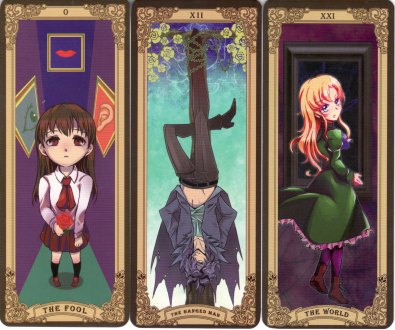
6 September 2012
Over the last few weeks I suddenly found myself buying a number of tarots. Among these is the Fabrication Tarot by Jessica Clayman who has also issued the rather fetching Twilight Rabbit Tarot. You can buy these through her website Twilight Rabbit Creations or her shop on Etsy.
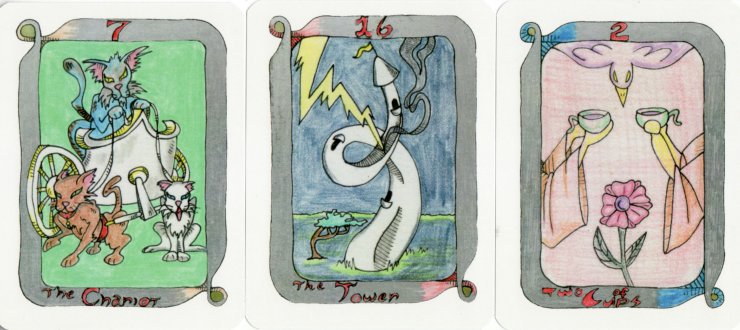
5 September 2012
The Web Tarot was originally designed to show at Converge 2011 a conference for web designers. It reworks the tarot archetypes into the concerns of website designers. Thus, though the cards are renamed, their tarot meaning remains obvious. So the Hermit becomes The Freelancer, The Wheel of Fortune is the Easter Egg (information hidden in computer code usually with some playful intention), The Devil is IE6 (Internet Explorer 6 was widely criticized by the industry for its security issues and lack of support for modern web standards) and so on.
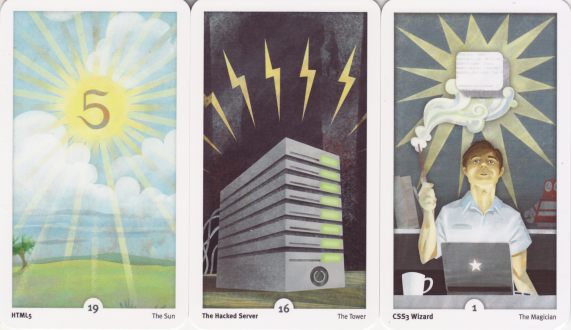
You can buy copies on unmatchedstyle.com/tarot
4 September 2012
My recent publication in my Art Tarot series, the Fialko Tarot, has sold very well, with after just a few days there are only 7 copies left to sell. This has impelled me to consider publishing more Art Tarots later this year. So I will now be looking for suitable material to continue the series.
31 August 2012
Two years ago I had to abandon publishing my Art Tarots as this project was threatened by people scanning decks and distributing them on the Internet, thus destroying my sales. I was not prepared to have my hard earned capital stripped from me by pirates.
Earlier this year, when I bought a new high quality printer, I discovered that it could print on substantial card. I made a few experiments with different types of card and found a glossy card that would pass through the printer okay. The image also fused right into the coating and I realised that this would remove the necessity for lamination, as the image would resist scuffing. Lamination was one of the big costs I had to bear when producing the Art Tarots. The materials were expensive and the time taken to laminate 100 copies of a deck was a large part of the costs. Thus I had to sell my decks at a high price just to break even.
The new method of production I have devised means that I can sell decks at half the price of the earlier decks.
I have also decided that 100 is far too large an edition. Instead I will only produce 50 copies. Also as the artist will get 10 copies and I will hold back a further 10 copies for my personal collection, this means that only 30 copies will be for sale. This should mean that the deck will sell out quickly, as there will be pressure on collectors to buy within the first month or so, and not hold back thinking I might reduce the price later.
So I have now printed and made up Art Tarot 24, The Fialko Tarot, and these are available immediately. I have also abandoned the custom made boxes, which were very expensive to have made, in favour of a transparent acetate box. These are good quality and not inexpensive but it has enabled me to keep the costs down as I no longer have to stick an image onto the lid of the box. I will not print the backs of the cards as this would mean higher costs. These are Art Tarots for collectors, and should not be seen as fortune telling decks - there are hundreds of mass market decks available for readers, and I am not supplying that market.
If sales of this deck are successful, I may be impelled to produce further items. Jeff Fialko's deck is a delight with wonderfully saturated colours. When he first sent me some scans I was immediately impressed by the strength of his drawing. It is a great tarot with which to launch, hopefully, a new phase of publishing.
20 August 2012
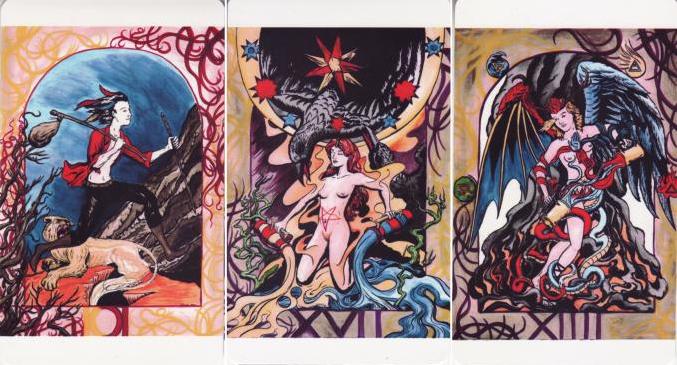
I have added another Japanese magazine gift tarot to my collection. This one was issued with the oddly named Frau magazine, a women's fashion and style magazine. It is collaged from twentieth century illustrations.
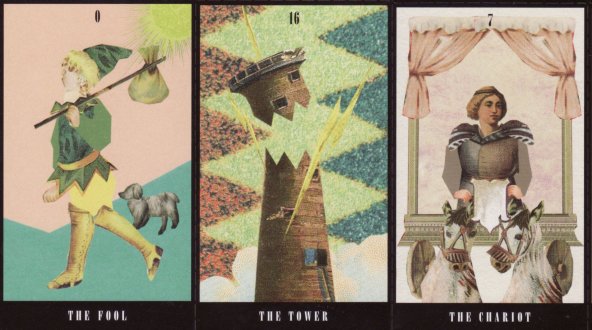
15 August 2012
It is not often that a tarot is original in two ways. The Trilateral Tarot by Mara Ann Thorson was created using sewn and appliqued patterned material. It is also triangular in shape. You can buy a copy of this limited editon deck from the website www.trilateraltarot.com
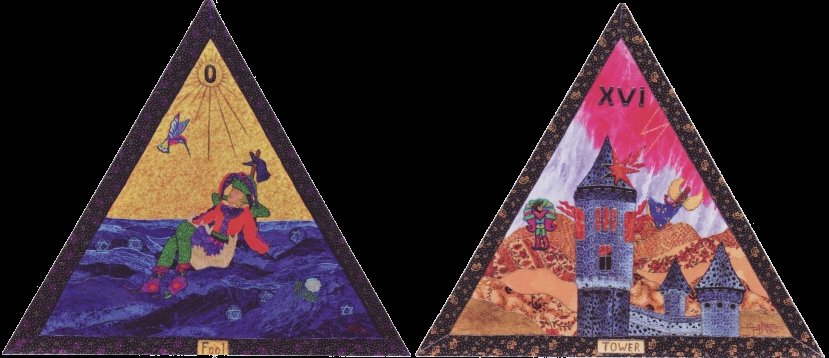
10 August 2012
I have just updated my Artwork of Modern Tarot database. I have managed to increase the items to 1000 and divided the single page, which was getting far too large, causing some people's browsers to struggle with it. This is now divided into three regions - Europe, the Americas, and the Far East - with entries being now sorted into countries. There are still many errors, typos etc and missing images, but these will be corrected as I continue to enter material. I have now removed the first implementation of this database, as it is superseded by the current one.
When I find the time, I will begin to restructure the tarot site to provide more resources on tarot art, as this is my main focus.
3 August 2012
I recently bought a book El tarot Profetico de Babilonia by Alba Arigos published by Editorial Keir in Buenos Aires, Argentina in 1991. This contained a series of 72 black and white illustrations of a tarot based on the Epic of Gilgamesh. It does not follow the full tarot structure as there does not appear to be any suits as such, but many of the first 22 cards link to the familiar tarot images. No doubt everything will be explained in the Spanish text. There are so many interesting things still to discover about modern tarot.
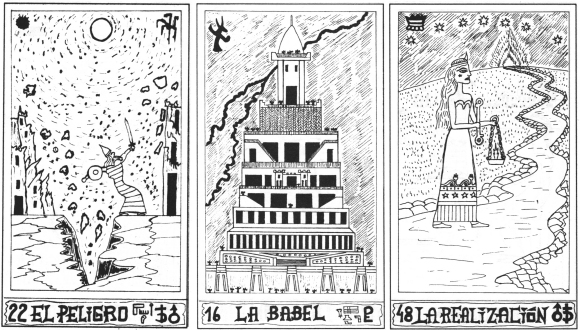
2 August 2012
After a long wait I have managed to find a copy of the Gemrod Taro. This is by the New Age guru Leo who was based in the UK in the early 1970s and known for the Tarot of Frown Strong which is very much sought after by collectors. The Frown Strong is dated to 1978. The Gemrod is an earlier deck first published in 1977 as illustrations in the strange allegorical novel Dear Dragon. The book is very difficult to obtain and consequently rather expensive, but I am happy to have it within my collection. The images do not appear to relate significantly to those of the Frown Strong. I have gathered some information on this strange guru figure going under the name of Leo, and I will, once I find the time, write this up for a page on my website.
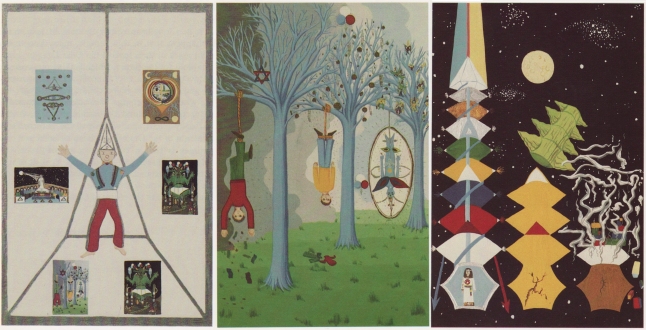
30 July 2012
I found this tarot sold through the Dollar Tree low price stores in the USA. It as apparently designed by Jon Stetson, an american charismatic celebrity psychic and the medium and spirtualist John Michael Hilford, but it seems likely that a graphics artist actually drew the images. The deck is printed in only three block colours yellow, red and black with half-toned block colours to add a grey and a buff colour. The images are simple but very direct and engaging, in cartoon or tattoo style. Although this has 78 card these are not the conventional set of Minors.
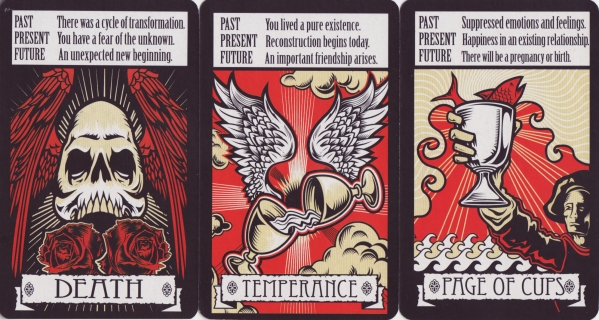
29 July 2012
As my database file is getting too large, I have decided, as an initial solution, to divide it into zones. I will have three - one for Europe, another for the Americas, and a third zone for the Far East. This will solve the problem for a few months until I think of a better solution. So I used up most of my Sunday afternoon, coding each entry page on my database with a zone code. I will implement this on the web page in a few weeks time when I upload the new entries I hope to add over the next week or so.
27 July 2012
I have now added just under two hundred items to my Art Tarot database. It now amounts to 900 tarots. I have added a few more descriptors in order that once I have added all the 2400 items in my collection, I will be able to extract various statistics concerning modern tarot art. I know that few people recognise the value of tarot art, but I am hoping that this database, once complete, will encourage people to look further into the artwork of modern tarot. Most tarot enthusiasts focus on tarot reading and such intangibles as to whether a particular deck gives good readings. It is my view that tarot designs when seen as a whole, document our modern culture, and for this reason I set myself the task of collecting sufficient examples to allow us to have such a vision. Up till now this has merely filled storage cases in my workshop, but I have decided that the time is now ripe to enable people to gain an overview of the role of tarot art in our times, thus I am setting aside most of the rest of this year to completing the database. What you see on this website is merely a kind of print out of the data, but this actually resides on my computer in a fully configurable database structure. Thus I can extract statistics - for example, it is easy to find how many black and white decks have been produced in France, or how many decks there are based on oil paintings, or how many Italian decks adopt the Marseilles order, and so on. All the decks listed will be those that were actually printed and thus made public. Kaplan's Encyclopedias of Tarot, include many designs that were never published and that to a great extent are only recorded in their pages. All the tarots in my database, are decks or books, which are physically in my collection. As to the future survival of my collection I am still uncertain.
For this update I have drawn primarily from the UK and French items. For the next update I hope to cover Italian material.
www.alchemywebsite.com/tarot/tarot_database.html
27 July 2012
Today a rather fine Spanish tarot arrived in the post. Unfortunately I cannot identify it, and there are no internal references to give any clue as to its origins. It is a majors only deck, in pen and watercolour. The titles are in Spanish, but it is not certain that it was published in Spain, as I could be from Spanish speaking South America or even Mexico. I have not seen these images before. If anyone can help identify this deck please get in touch.
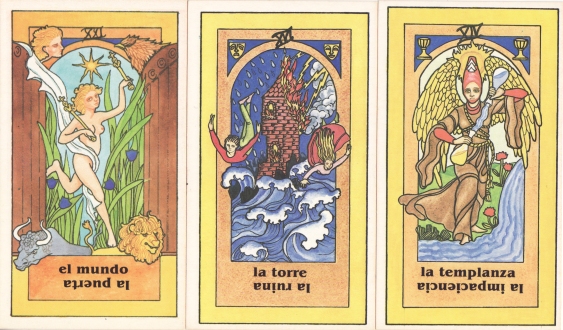
26 July 2012
When I first heard of the Affirmations for the Everyday Goddess I thought it was another oracle deck with no tarot connections. For some inexplicable reason some oracle deck designers create their deck with 22 cards with absolutely no tarot content. So I was delighted to find that my impression was erroneous, and that this deck was indeed a conventional tarot. The artwork is highly detailed and each card has a goddess figure as its focus. Some of these are wonderfully luminous and sharply depicted standing out from a background which is shifted just slightly out of focus. This effect enables one to clearly see the central figure and her associated imagery.
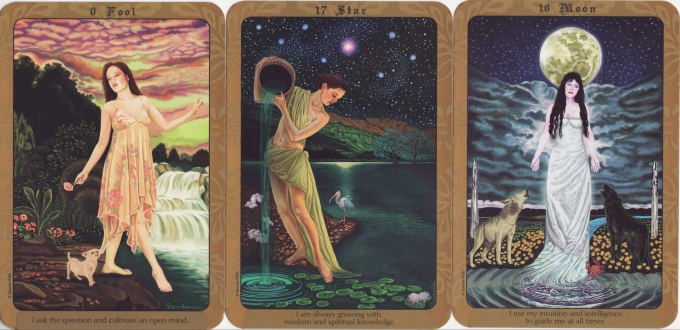
17 July 2012
People will know that I don't just collect decks of tarot cards but also tarot artwork contained in books. I recently obtained, courtesy of the author, a copy of a children's book entitled Nemorino & das Buendel des Narren (Nemorino and the Fool's Bundle) written by Gion Mathias Cavelty. The twenty two full page illustrations by Chrigel Farner present images from the Major arcana. It is easily available on amazon.de The artwork is a great delight.
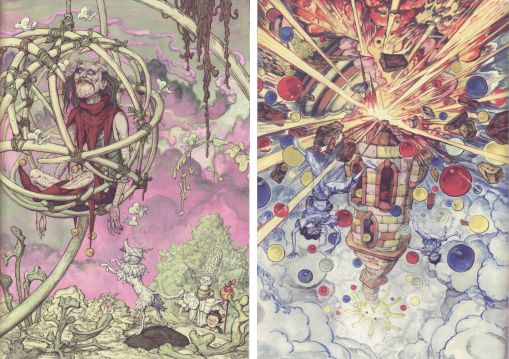
10 July 2012
Tarocca was a development of an earlier game Rocca Spiele. The title 'Rocca' derives from the Japanese word Rokkaku - hexagon. This was used to play a number of pattern matching games. This tarot form 'Tarocca' fusing the original game concept with tarot arose out of a meeting of the designers with the great Japanese tarot designer Ryuji Kagami.
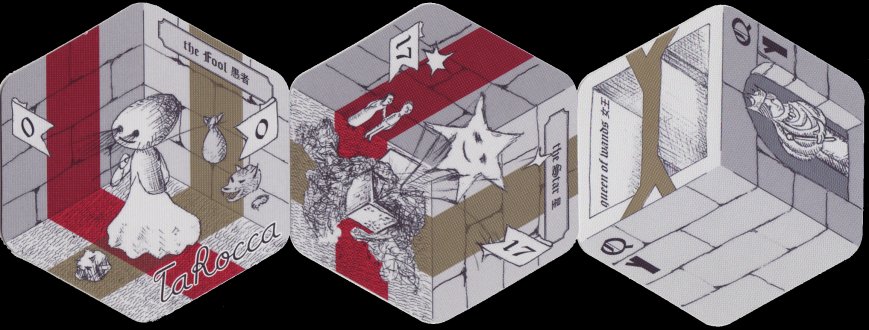
5 July 2012
Over the last two weeks I have added a large number of entries to my Database of Tarot Art. There are now over 700 items catalogued.
You can see this on this page www.alchemywebsite.com/tarot/tarot_database.html
The database will soon have to be restructured into subpages as the page now takes some time to load.
1 July 2012
I must be a bit crazy to buy obscure items such as this promotional deck for Snow Brand Flavorland Ice Cream. Its date is uncertain but likely to be before 2000 when the company merged with Nestle. I wonder if I am the only person outside of Japan to have a copy of this item!
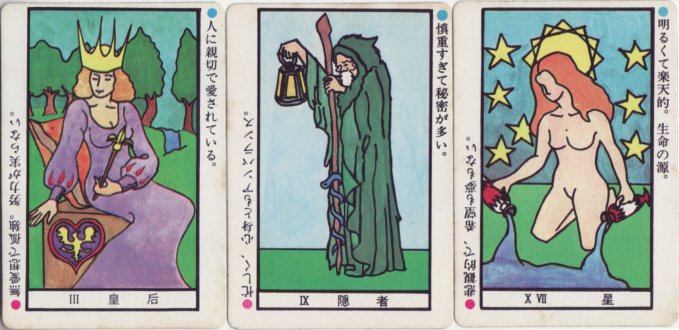
30 June 2012
The Women's Tarot published recently in Russia seems strangely titled as there does not appear to be a particular female slant to the imagery. There does not appear to have been any attempt by the artist or designer to address any women's issues.
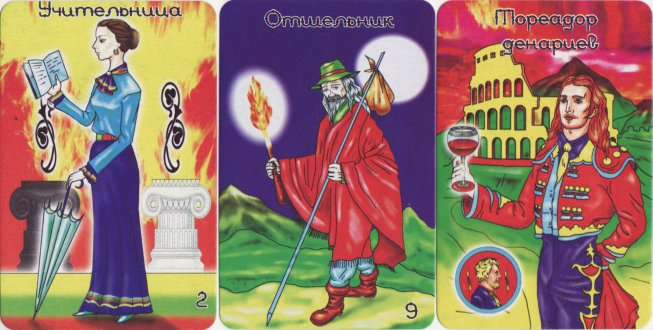
29 June 2012
Le Dernier Cri (the "final cry") is a Marseilles based collective of illustrators. They publish comic books, silk screen prints and various other items, some of a visceral and excoriating nature which are so challenging that many people are repelled by the strong imagery. They have just issued the Tarot de Mars by Quentin Faucompre. This group of primarily European artists seem to adopt the postmodern stance of subverting images in a playful though often penetrating way. For example, in the Magician, we see a rabbit-eared stage magician making himself appear out of a box. In Strength, a human headed lion places her head within the jaws of a lion headed human.
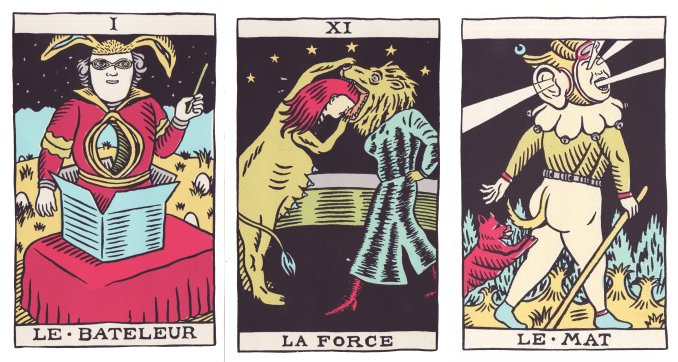
28 June 2012
Mei-chan no Shitsuji ("Mei-chan's Butler") is a Japanese manga series written and illustrated by Riko Miyagi. The manga was serialized in Shueisha's Margaret magazine. The manga has been adapted into a live-action Japanese television drama, which was broadcast on Fuji TV in 2009. This tarot entitled Holy Card Tarot based on the serialisation was a gift issued with Margaret Magazine.
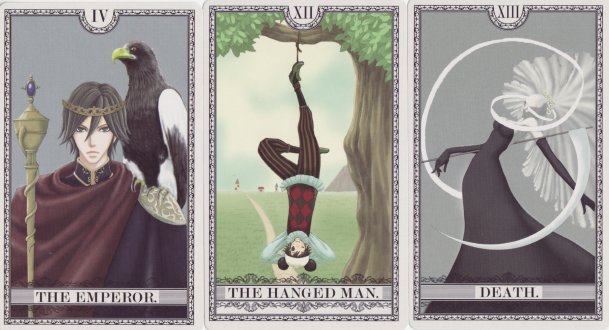
28 June 2012
A dealer in Los Angeles from whom I often buy obscure tarots, has today cleared up a little mystery for me. In my entry for May 2nd I mentioned a Russian Rider-Waite clone which I had bought but had no information on it. Now I know its title, the Sergey Loginov Tarot, I can find out some more about it and the artist.
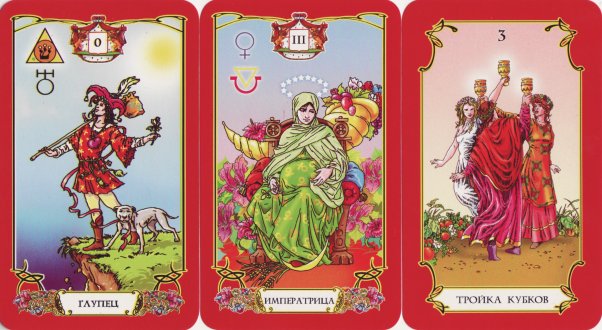
27 June 2012
I have just purchased a Japanese deck entitled the Alchemia Tarot Deck, The artwork for this deck is by Takaki one of the leading digital artists in Japan. Her style often involves ethereal forms, often winged. Despite the title this deck would seem to have little symbolic connection to alchemy, instead it is a rather beautiful Rider Waite clone. Supplied with a book, boxed in a sleeve.
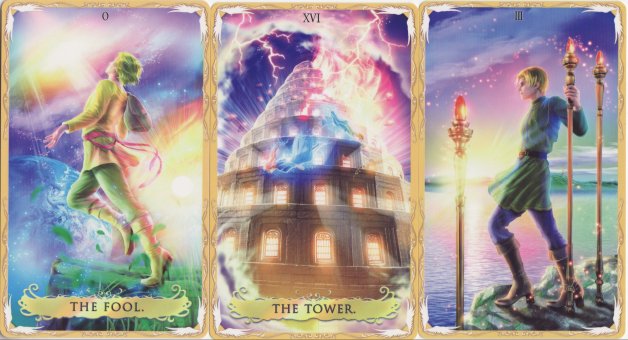
26 June 2012
I recently received the strangely titled Lunatic and Yuri Petrov Tarot. It turns out that this is a doujinshi or fan art deck and that 'Lunatic' and 'Yuri Petrov' are two of the main characters in Tiger and Bunny (Taiga Ando Bani) a 2011 Japanese anime television series produced by Sunrise under the direction of Keiichi Satou.
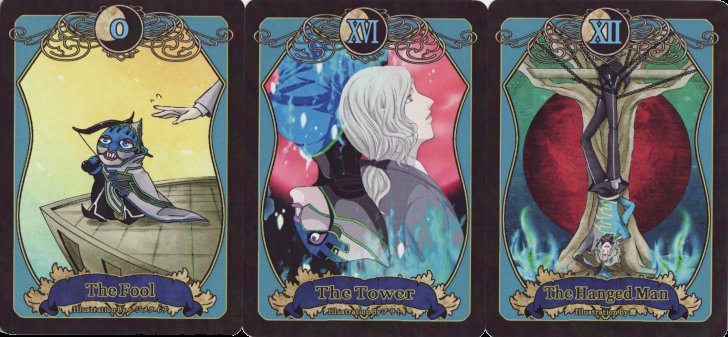
25 June 2012
I have now created a first version of a descriptive database of my own tarot collection. Initially I have entries for 558 items. Many of these are incomplete, lacking descriptions and images. These problems will gradually be addressed and new items added as I manage to find the time.
You can see this on this page www.alchemywebsite.com/tarot/tarot_database.html
Please note: all the text and research information is ©Adam McLean. It is my own intellectual property and I do not allow this to be copied and used by others.
This database represents years of collecting and hundreds upon hundreds of hours of my research, documentation, keyboarding and formatting the information I have gathered.
I want it to be a resource that might be of use to other collectors and tarot enthusiasts, but I don't want it lifted piecemeal and used by others.
25 June 2012
The Russian Tarot by Boris Monosov appears to have been designed in 1994, though I am unsure that it was printed at that time. In 2011 it was issued by the Russian publisher, Vektor, in a box as a full deck with a booklet.
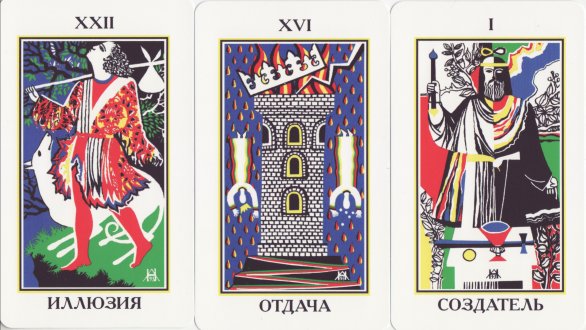
22 June 2012
Today I received a beautifully stylish Taiwanese tarot self-published by Kei. This has tall elongated cards and focusses entirely on the human figure, with no backgrounds and only small elements held by the figures to suggest the archetype of the particular arcana. Available from BabyDream
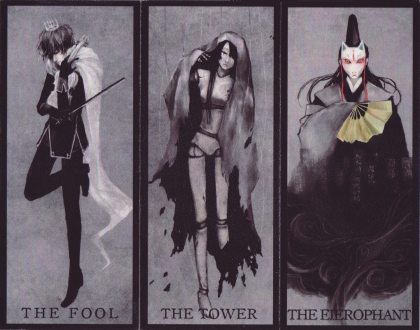
21 June 2012
Back in 2010 I began a project to create a database of modern published tarot decks using my own collection. I worked on this for a few months and managed to enter about 500 items. As the database grew in size I began to experience problems with the software I was using. After losing some data and having to rekey some entries, I eventually lost confidence in the software and its ability to do the task I required. I wanted to use a database which could easily output data as html formatted pages, so I could put this onto my website. Thus, sadly, this project foundered and languished neglected while I worked on other projects. I occasionally looked for better software, but did not find anything suitable. Today I found a new sofware package, thankfully inexpensive, which should be able to do the job. After a bit of a struggle I managed to import the records from my old database with only a few formatting and corrupted records. Some data could not be imported so will have to be hand entered. This is a bit laborious, but within three hours I had done about 100 of the 500 items. I hope to be able to work further on this in the next few days, so this phase should be completed sometime next week. Then there is the much more time consuming task of entering in the 1900 items from my collection still not in the database. It can take a half hour or more to describe the features of each deck. 1900 x 0.5 hours = 850 hours. Even being able to devote 10 hours a week to this means it will take about 85 weeks. So this will take a few years !!! and I will have added more tarots to the collection by then !
21 June 2012
In my entry here for 27 Mar 2012 I mentioned a tarot of owls that is in production in Italy. Fortuitously, another tarot featuring owls has come into my possession. This is Tierney's Delight tarot by Beth Seilonen, issued as an edition of 50 in May 2012. The 'Tierney' who appears to be delighted by owls is the psychic and tarot writer Tierney Sadler sticksandstonescircle.com/profile/TierneySadler You can buy a copy of this limited edition of 50 copies from Cat's Eye Art isis_eyes@hotmail.com
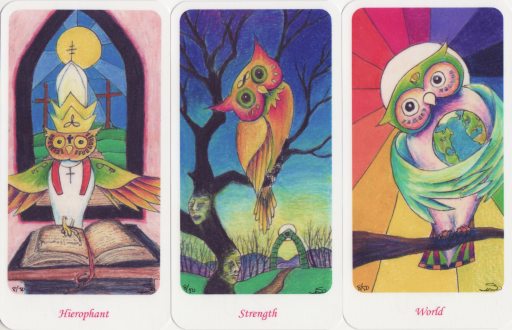
20 June 2012
Over the last few weeks I have had to devote much of my time to bookbinding and consequently I have built up a backlog of tarot items to post up here. I hope to begin to do this over the coming days. My personal collection now amounts to around 2400 tarots. I also have many hundreds of tarot designs in the form of scans, and a few pieces of original artwork. As far as I know it is umnmatched by any other current collection. Other collectors tend to buy items that especially interest them or resonate with their own mindset. When I began buying tarots I decided to try to build a collection that would document the tarot art of our time. Thus I just bought everything I could afford. Consequently, my collection is a comprehensive, approaching exhaustive, survey of the Tarot art of our time. I am becoming concerned about what should be done with this when I die. I would wish somehow to have this collection preserved intact as a resource for the study of this undervalued art medium that so clearly documents the culture of our age. At present, what would happen is that the collection would have to be sold off item by item and the funds then going to my relatives. It is not possible, in the present financial climate, to donate them to a University library or other such institution as they expect such donors to endow them with the funds to preserve and curate the collection. I have no such funds available, so I am struggling to find a solution to this problem. The easiest solution would be for someone to inject a large sum of money to set up my collection as a permanent Tarot Library or Museum. There may be other possibilities, but these are much more complex and seem difficult to achieve, so it seems most probable that on my death the collection will have to be broken up.
The last copy of the Lebanese Tarot was sold a few days ago. Seven decks have now sold out, but there are still copies left of other of my Art tarots.
26 May 2012
The Sacred Indian Tarot by Kiren Rai, not to be confused with the Sacred India Tarot, was produced in 2011. It is a majors only deck and comes in a strong thick cardboard box together with a 100 page book in English. This has been published by Om Books, based in the Uttar Pradesh region of India, but is widely available through the usual outlets, including Amazon. The artwork was created by a group of upcoming Indian artists some working within the Bengal style of painting while others appear to be collaged from symbols, images and icons from traditional Indian Philosophy, in many cases presented against various textured backgrounds.
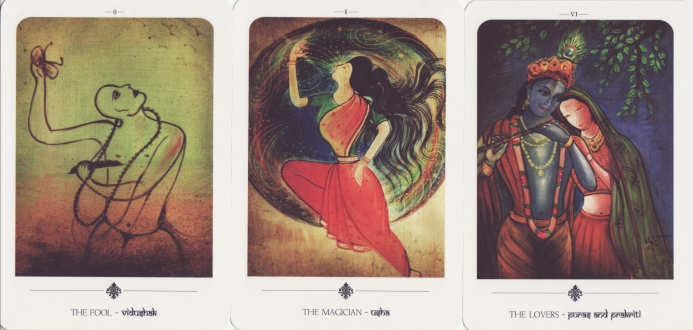
25 May 2012
Koiunreki magazine has included a tarot in its April 2012 issue. This was produced by Ryuichi Izuma with the illustrations by Emico. It is printed as the centrefold section on thick card and it is intended that the purchaser cuts out the cards. The artwork is in simple forms which are not separated by lines, as in the conventional pen drawn forms coloured in some way. This coupled with Emico's use of a muted pastel toned colour pallete gives these a harmonious feeling. These are likely to have been created digitally.
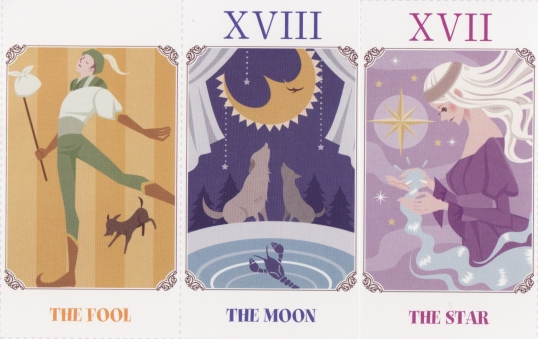
24 May 2012
I have recently acquired a rather fine Rider-Waite clone published in Taiwan by Bafun Books. The artwork was created by someone only identified as "Stephen" and it comes in a nice strong box with a 128 page fully illustrated book. These appear to be painted with pen drawn outlines, but such is the competance of digital artists that I would not be surprised if they were realised digitally. The imagery sticks close to the original
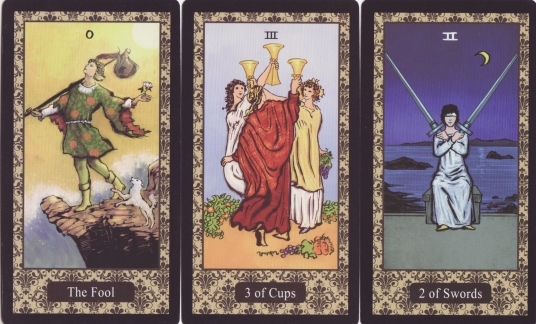
23 May 2012
In 1999 Michael Roman produced his Tarot 22, a majors only deck, issued as an edition limited to 300 copies. He has now augmented this with the minors to produce M.W. Roman's Magus Arts Tarot, this time as an edition of only 100 copies. The colours have printed somewhat more luminous (especially the green tones) than in the 1999 printing. You can buy copies through www.magusartstarot.com
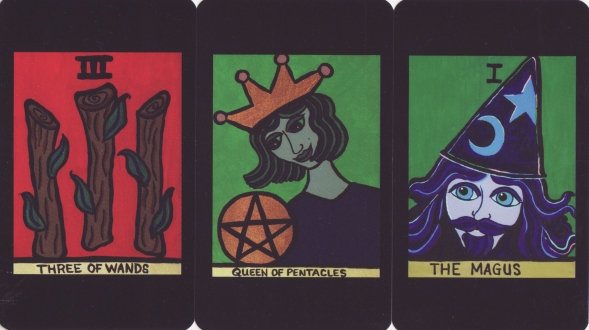
20 May 2012
I often come across tarots which I have never heard of before. The Tarot La Lluna created by Maria Montsant was issued in 2001. The artwork is in the form of paintings by Sergi Salvo in a rather cute style. There is no place of publication, but it is likely to be in Spain.
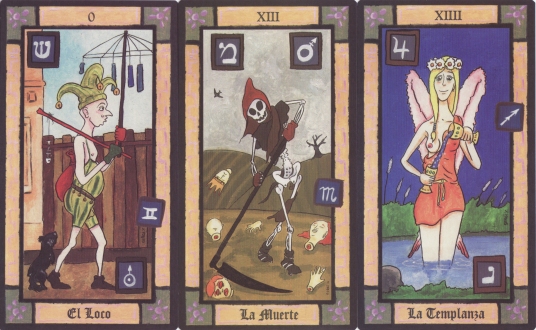
11 May 2012
The Stolen Child is a delightful pen and watercolour deck by Monica Knighton. The inspiration comes from the poem written 1896 by William Butler Yates with the theme of fairy spirits attempting to charm and lead children into their fairy realm. The first of the four stanzas including the chorus I show below. Knighton has sensitively and subtly translated his imagery into tarot forms, resisting the temptation to label each card with the arcana name. The edition is printed onto a quality textured matt paper in an edition of 500 signed and numbered.
Where dips the rocky highland
Of Sleuth Wood in the lake,
There lies a leafy island
Where flapping herons wake
The drowsy water rats;
There we've hid our faery vats,
Full of berrys
And of reddest stolen cherries.
Come away, O human child!
To the waters and the wild
With a faery, hand in hand,
For the world's more full of weeping than you can understand.
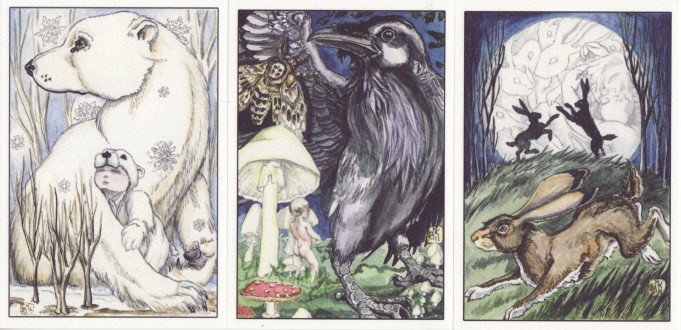
10 May 2012
Critical is a series of Japanese graphic novels. The recent issue of two of the volumes in the series included a promotional tarot deck. Often such decks are collaborative, but here the artwork (probably created entirely digitally) is by a single artist whom I have not been able to identify. The artwork often incorporates elaborate flowing forms emanating from the human figures or their clothing. The artist is a master of creating depth to these digital images. The Tower, though merely a series of spikey pinacles set in a misty landscape, has a wonderful sense of depth and perspective.
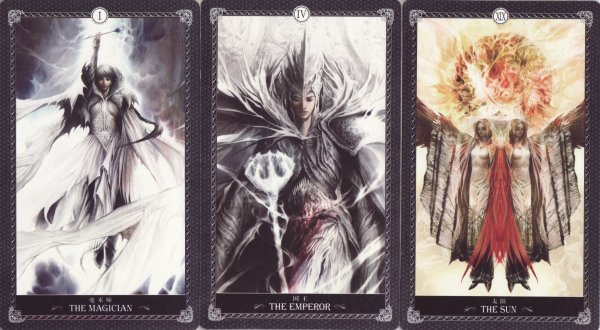
9 May 2012
The Clover Tarot by Nika Berne is published in Latvia and dated 2010. It is a full deck of 78 cards with emblematic pips and English card titles and comes in a box with a detailed book in English of 104 pages. It is essentially a Rider Waite clone, but with the imagery freshly revisited and reworked. Nika Berne works in watercolour, coloured pencil and pen line. She has re-envisioned the imagery rather than merely copied or translated it into her style. Thus, for example, her Moon and the Three of Cups, provide a fresh idea of these established images while retaining the underlying conception. This is a rather fine deck, which will probably not be seen by many collectors. It deserves wider exposure. Kudos to the Latvian publisher who had the courage and foresight to issue the deck. You can buy these from www.taro.lv/ru/taro_clover
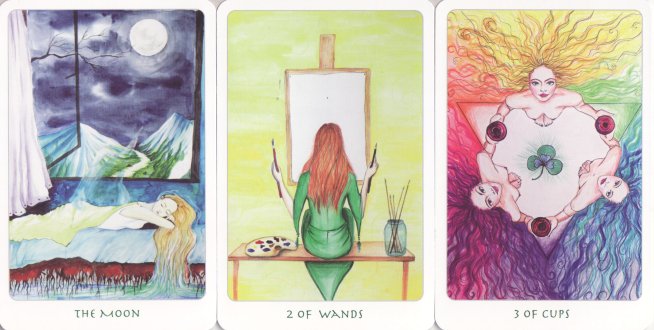
7 May 2012
Now, a tarot entitled Devil May Cry may seem a strange name, however, it turns out that this is the name of series of computer games. It is a series of five interrelated extreme combat games, first issued on the Playstation 2 in 2001, then later on the Playstation 3 and the Xbox360. The tarot deck would appear to be a doujinshi or fan art collaborative deck. The arcana depict scenes with one of the characters from the deck. As the high-definition remaster of the earlier titles was released for PlayStation 3 and Xbox 360 in 2012, this deck was possibly created by some fans in response to that.
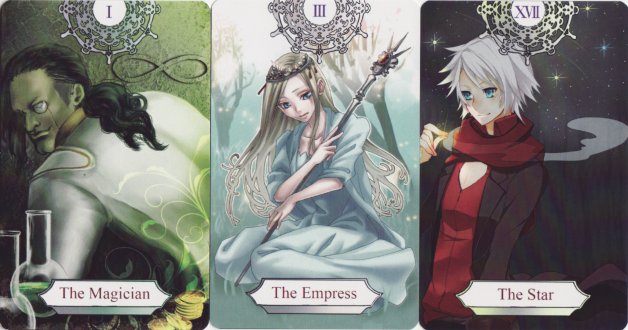
6 May 2012
Recently we have had a spate of Vampire and Zombie themed tarots. The latest from the world of the undead is the Dracula Tarot from Australia. This tarot was created by Vicky Vladic, with the artwork by established illustrator Anna Gerraty, who works in mixed mediums of watercolour, pencil, inks, acrylic and oil paints. You can see more detail and buy a copy of the deck and the associated book on the website vsomethingesoterics.com
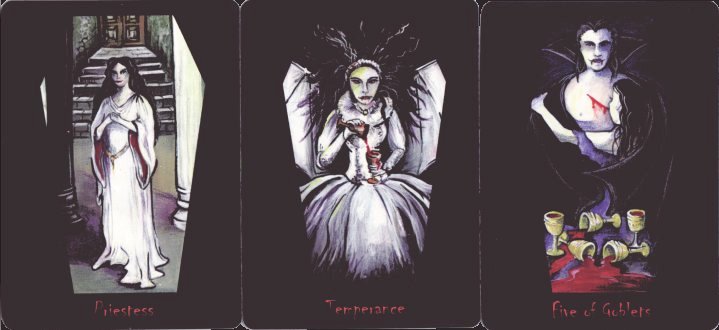
4 May 2012
A few days ago I discovered Le Tarot de Sète created by the artist d'Hervé DiRosa in 2004. DiRosa is a well known French painter, sculptor and animator. His work has been featured by many prestigious institutions worldwide, including in The Netherlands, Paris, Mexico, and New York. He was commissioned to execute numerous public frescoes and murals in Italy, France, Japan, and Mexico, and founded the International Museum of Modest Art, in Sète, France. His style is a form of bold, in-your-face Pop Art, filled with humour and excitement and his passion for kitsch or what he termed "Art Modeste". His cartoon caricature forms much influenced grafitti art. He was part of the Figuration Libre (Free figuration), a French art movement of the 1980s. I have been lucky to have been able to buy one of the signed edition of 100 copies, which was issued in a rather fine box with an illustrated descriptive book. The tarot designs were originally created as silkscreens on canvas for an exhibition in Montpellier in April 2004. Presumably the printed deck and book were issued as promotional merchandise associated with this exhibition. He often adopts the strange convention of representing faces with multiple eyes set vertically.
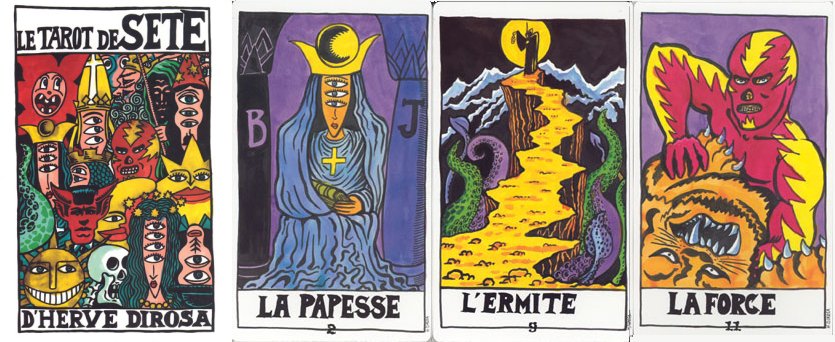
2 May 2012
I just bought a rather fine Russian Rider-Waite clone. I am not sure of the date or place of publication. The deck is simply entitled 'Tarot'. The colouring is digital, though the line drawing may have been created originally in pen.
1 May 2012
The Gaian Tarot by Joanna Powell Colbert was long in the making and much anticipated until it was issued in a limited edition in 2010. It has now found its way into the Llewellyn stable. Llewellyn have chosen to print it as standard sized cards rather than the somewhat larger formats of the limited edition, however the strength of the artwork is still very apparent. Colbert used the medium of coloured pencil, but with an intricate method for establishing the underlying drawings. It is very informative to see her method of working which she has documented on her web site. Her device of allowing part of the image to step outside the frame of the drawing is a masterful idea.
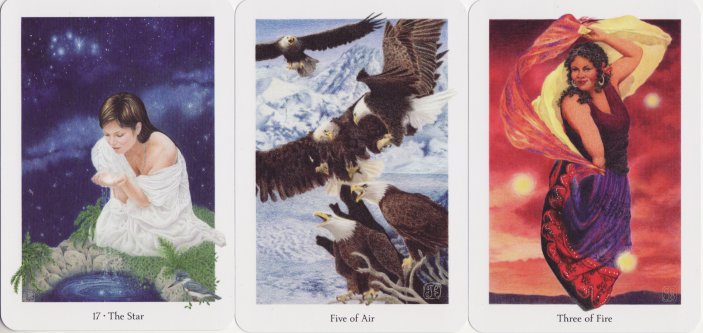
30 April 2012
The Honey Patch Tarot is a fan art deck created by Hotch Potch Patch collective organised by Yuki. It was created in 2008, and the references on the Internet appear to be dated to, at the latest 2009, so it seems possible that this project has now ceased production. The cards seem to have been printed on a quality giclee printer. The artwork is distinguished by having fine clear lines and subtle shading and tones. I assume the title refers to some children's manga series. It comes in an acetate envelope with a printed sheet identifying the individual artists, plus a printed card with the box for one to cut out and assemble.
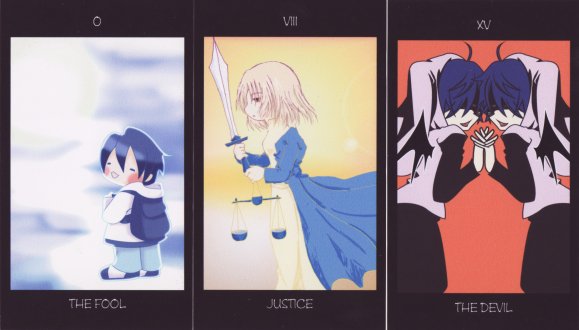
29 April 2012
The Azure Arcana is a book and deck set issued in association with the Japanese Role playing game Legend of Heroes Ao no kiseki (Trails in the Sky). This game began in 1989 as the Dragon Slayer : The Legend of Heroes and over the decade has been upgraded and reissued many times on various game platforms. I do not have any grasp of the characters and situations explored in this latest game, but playing it is aided by drawing from a set of tarot cards. Each of the cards bears the name of one of the main characters in the game - thus Strength is Wald Wales, Judgement is Mariabell Crois, and The World is KeA. The artwork, conventional manga but well executed, is by a number of different graphic artists who hold close to the same integrated style.
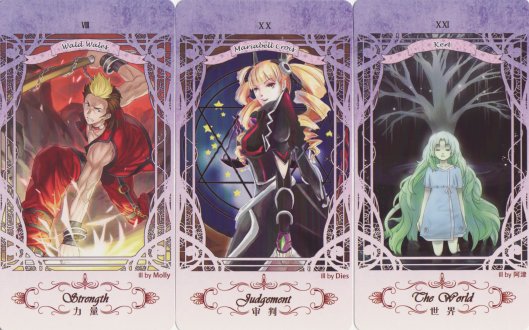
28 April 2012
The Tarot "Droga" (the road or way) is a new Polish deck of 78 cards by Barbara Marzena Mirewicz-Czumaczenko. This deck is different in two ways. Firstly, it was originally created as hand-made fired glazed clay tablets, which were then engraved by scratching out lines and painted. This far as I know this medium has not been used before in tarot. Secondly, the Major Arcana have a road running through all the cards, with branches into dead ends, a crossroads, even a roundabout. This means that one can arrange the cards in various ways to present a narrative journey through the arcana. A similar thing has been done before with Eric Provoost's Minotaur Tarot, where the cards could be laid out on a table to present a unified panorama. The Tarot "Droga" which is beautifully printed on thick stock is available from www.otostrona.pl/tarot-droga.pl/ This is a must-have deck for collectors of European tarots.
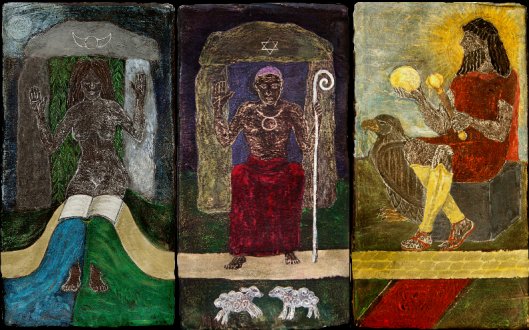
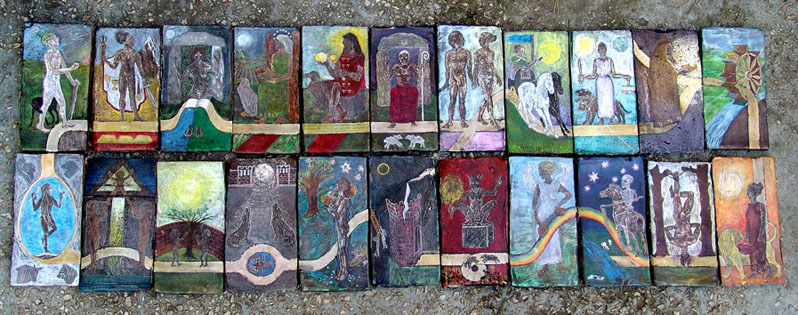
27 April 2012
Today I had a depressing phone call from someone wanting to purchase full sets of scans of tarot cards from me. I explained that this was not possible, and that he would have to get permission direct from the artist. He said that there were many sites on the Internet where you could download full 78 card decks, and that Yahoo had a site encouraging this. When I pointed out that all modern tarot decks were still under copyright and that many sites were consequently illegally distributing artists intellectual property, he just put the phone down on me. Another pirate. What cheek he had to contact me. I had to abandon my tarot publishing venture after some people distributed scans of my tarots on the Internet, which impacted on sales of those decks. After that, I could not justify investing my hard earned capital and my valuable time in publishing tarots. I subsequently abandoned my Art Tarot series after number 23, two years ago. Such people do not fully realise that they have created an environment that entirely subverts small scale publishers. I would probably have issued a further five or six decks by now, but these will not see publication and are lost to the tarot community.
27 April 2012
The Sacred India Tarot book and deck set is a collaboration between the Indian writer Rohit Arya and the British artist Jane Adams brought together by the Mumbai publisher Gautam Sachdiva. It was a long time in preparation but the resulting deck is a great delight. Jane Adams works with mixed media, here it is mostly coloured pencil for the light details with some more dense medium for the darker colours and backgrounds. The publisher sees this tarot as a synthesis of two mystical and meditational streams - tarot and Indian mythology. The accompanying book is not merely a guide to using the deck for readings but provides much information on the background of the Indian gods and goddess forms. Though published in India, it is easy to buy the deck and book set direct from the publisher on Amazon.com. I receieved mine within a week of placing the order.
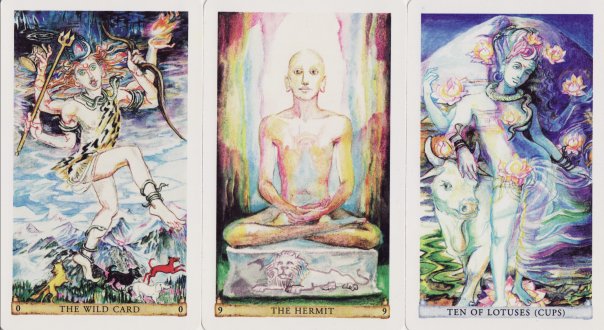
26 April 2012
The Incidental Tarot was created by Holly DeFount in 2011 and published in the last few months. The designs in coloured pencil are well crafted and, through her grasp of colour balance, deliciously luminous. She has renamed and reworked the ideas behind some of the major arcana, thus, for example, the Devil is altered to Chimaera, the Tower to Phoenix. Her suits are named Arrows, Rose, Quills and Oaks. The pips, though not emblematic, are nicely realised. You can see and buy her tarot from TheIncidentalTarot.com and see more of her artwork on RavenandRoseArts.com
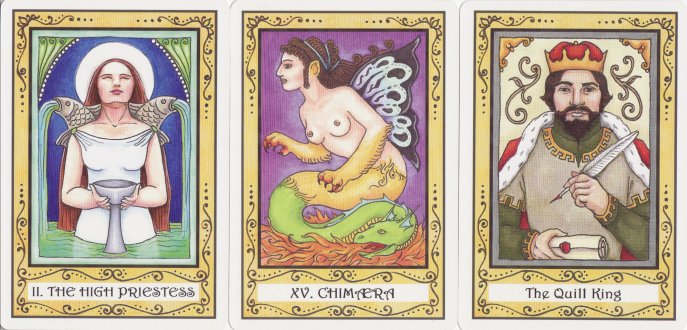
25 April 2012
U.S. Games has now issued a new tarot by Paulina Cassidy, the Joie de Vivre Tarot. Many people were very impressed by her Paulina Tarot and this new work follows on in the same style. Her pen and watercolour is exceptional and she creates very engaging forms. These are not merely woven out of decorative ideas, but each card seems to present a little dramatic scene for one to ponder upon. There are so many details to explore in each card.
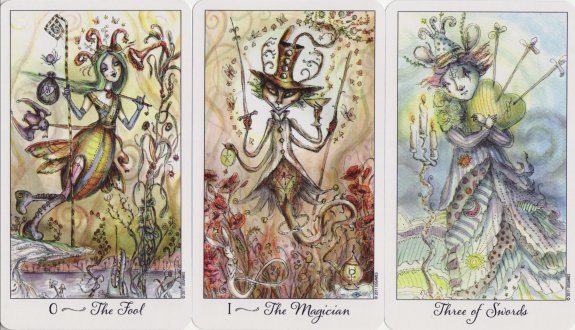
24 April 2012
Le Tarot des Tailleurs de Pierre (the Tarot of the Stonemasons) is a beautifully produced deck and book in a box published by the well known esoteric publisher Guy Trédaniel in 2011. The artwork is by Hughes Gartner and the book text and design by Jean-Michel Mathonière. The symbolism of the imagery explores various aspects of the stonemason's craft - carved statuary, architectural features, the working tools and the underlying geometry of the craft. The artwork apprears to be digital mimicing pen and watercolour. The cards are beautifully finished using gold leaf on the edges, which one rarely sees nowadays. It is a 78 card deck. The pip cards are not emblematised.
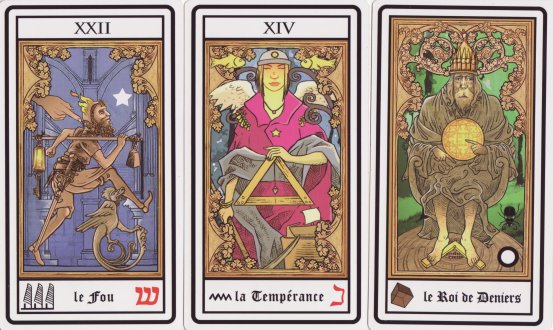
23 April 2012
The Deck of Heroes Tarot by Richard Shadowfox is the latest offering from Schiffer Books. I suppose the idea behind the deck design is coherent and relevant, but I just cannot find myself able to accept the human figures created using software similar to Poser. These just leave me entirely detached from the artwork. In some cards where the figures are sufficiently shrouded in dark shadow one can forgive the Poser forms, but when they are fully lit they look terrible. They just don't give my brain the signal that these are human beings, instead their frozen, expressionless gaze and stiff, awkward postures, never raise them above mannequins or clothing store dress dummies. I cannot understand how a good quality publisher such as Schiffer Books could have let this one through their editorial meetings.
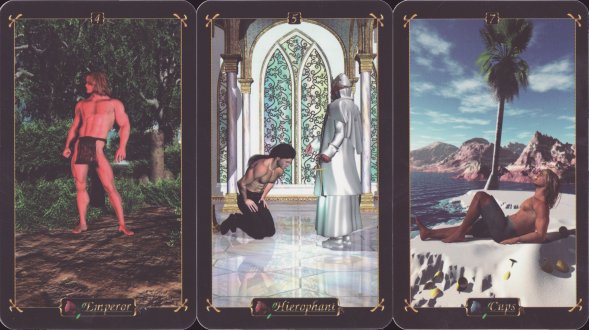
22 April 2012
The Super Tarot published in Taiwan in 2005 is a little decks of cards that comes in a large box also containing a small book. The cards are in the more elongated format often favoured by the Chinese as this shape resonates with the traditional cards in China. There is, I suspect, some narrative underlying the choice of imagery, but as I do not read Chinese this remains opaque to me. The Hierophant has a image of the Potala Palace in Lhasa, Tibet, while The Chariot strangely depicts a female figure running across treetops while a male runs on the ground below. It is intriguing and mystifying and it is likely that I will never know the story behind this, but it is a good tarot to have for my collection - one needs a few enigmas !
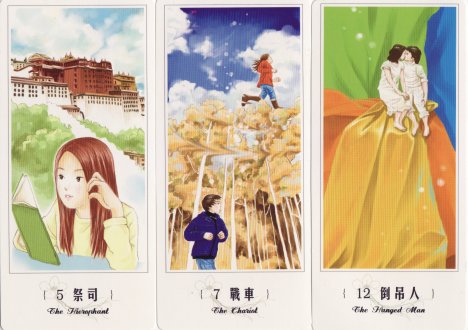
21 April 2012
Antonio Possenti I Tarocchi is a series of coloured drawings currently on exhibition at the Vallardi Galleria d'Art in Sarzana in North West Italy. The artwork in coloured pencil on card, with either some washes of oil or watercolour or perhaps the use or watercolour pencils, is delightfully engaging and humorous. I particularly enjoyed the Hanged Man whose face is inverted the right way up. Once cannot get a good impression from the small images I have scanned in, but once you have the cards themselves you will be able to see all the little subtle touches of humour. You can buy copies direct from the gallery www.vallardi.org and these are not at all expensive. Though the edition is 1000 my copy is numbered 460, so it may be these are selling fast to visitors to the gallery.
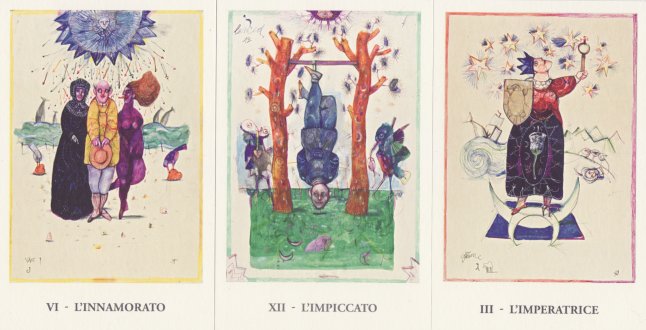
20 April 2012
The Secret of Kabbalah Tarot are round cards, supplied as press-outs printed on thick stock in the back of a book by Shukei Kuyougi published in Japan in 2011. Collectors of round cards will definitely want a copy of this and the dealer Baby Dream on Ebay can supply copies. The artwork is traditional, though spoiled a little for me by the rather heavy handed use of a graphics filter to create a textured weave to mimic oil painting on canvas, however, it still remains a "must have" item for collectors.
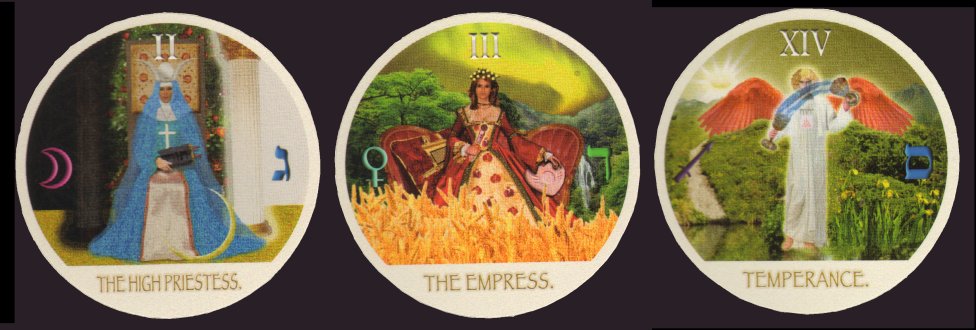
19 April 2012
The Toriko Tarot is a self published collaborative fan art deck based on the Japanese manga series written and illustrated by Mitsutoshi Shimabukuro. The artwork is more creative than the usual run of manga art decks which can be a bit "samey", derivative and imitative. I particularly liked the World with its complex drawing of, amongst other things, the turtle supporting the world encircled by the ouroboros. It is rather amusing that each image is presented as a table place-setting with fork and knife on the left and right.
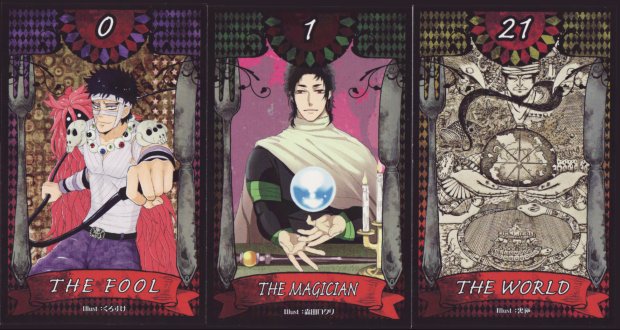
18 April 2012
When I first began seriously collecting tarot I managed to buy a rather wonderful Japanese art deck by Takashi Kitami, a well known painter and illustrator. The tarot images he exhibited in January 2005 at the Span Gallery in Tokyo, were issued as free gift in a Japanese magazine. I have now acquired an earlier tarot by Takashi Kitami, in much the same style, which was issued as a free gift in the Moe magazine for September 1992. The style is immediately recognisable through the small headed figures with elongated necks, placed within a surreal landscape.
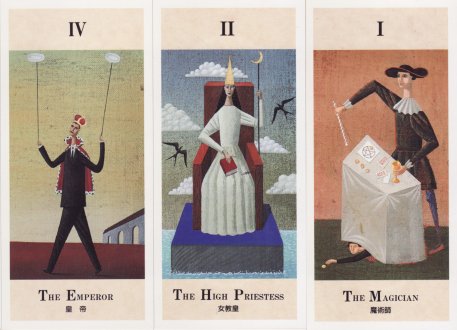
17 April 2012
Etsy.com was established in 2005 to provide an online site where small scale independent artists and craftworkers could sell their productions. It is a good source for obscure tarots, indeed I bought a copy of the Incidental Tarot from Etsy earlier today. I don't often venture far from the tarot section, but when I do I find a mass of artwork, some excellent, but some embarassingly naive. A year or so back, April Winchell one of the Etsy members set up a website Regretsy.com that took an irreverent and humorous view of some of the Etsy productions. This website became a focus for a number of artists and in 2011 Wendy Sheridan set up a project to create an artist collective tarot, the Regretsy Tarot. The 78 card deck takes an ironic and playful glance, parodying the sort of material presented on Etsy and similar outlets, but avoiding descending into cruel and inappropriate targetting. It presents a deliciously light and frothy view of this material through the artwork of 25 artists in the Regretsy collective. You can buy a copy from caboosterkit.com
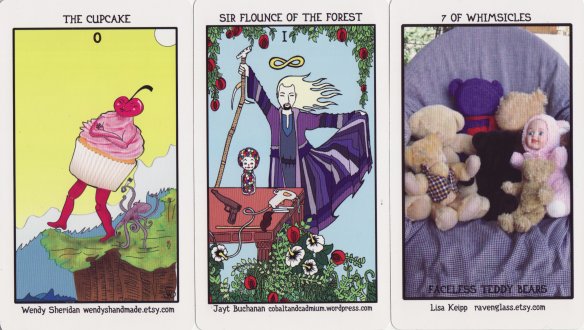
One of my fellow collectors has pointed out to me that "Sir Flounce of the Forest" is wearing a coat by one of the top Etsy sellers, a former Grateful Dead follower named katwise. She sells tutorials on how to make these coats, and there's a very funny short video. I expect many of the images have a fascinating backstory. This whole deck is obviously a bit of a in-joke appreciated much by Etsy members and purchasers.
16 April 2012
A few weeks ago I managed to obtain a copy of an early Japanese tarot from 1978, the Love Tarot of Yoshiko Minegishi. This was issued as a pull out and cut up section in a Japanese magazine. Luckily I have the uncut printed sheet. Tarots issued in Japanese magazines as free gifts rapidly disappear and become impossible to source. This one from thirty years ago is almost completely unknown. The colours of the printing remain pristine and vibrant, so it must have been stored away from light.
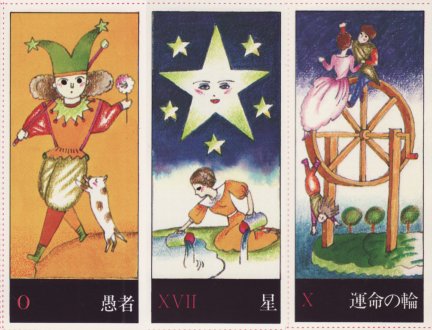
15 April 2012
Modern tarots often bear strange titles. I recently received the Silent Tarot, created by Esmeralda Rupp-Spangle, and just published. Its artwork does not immediately give me a clue as to the title. It has been created through collaging old photographs, stills from old films, bits of advertising posters, old engravings, paintings and other illustrations. Most of the images are "framed" or incorporated into decorative borders. The cards are large so one can appreciate the artwork. You can see more details and buy a copy from silentcitadel.tumblr.com/
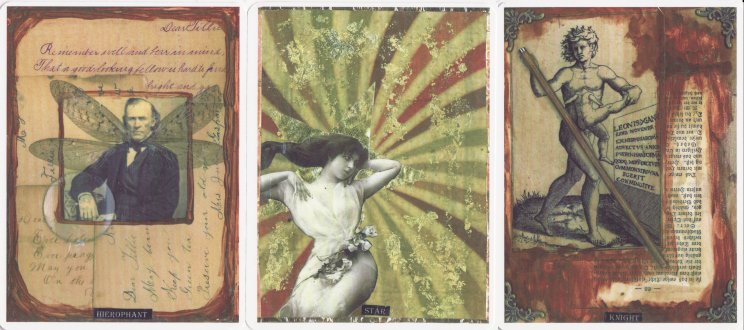
11 April 2012
Some years ago I discovered some artworks by the artist Suzanne Treister which incorporated alchemical emblematic imagery. I posted two examples of this onto my alchemy website for the 16th December 2008. It was good to find recently that she had produced a full tarot deck in the same style, The Hexen 2.0 tarot published by Black Dog Publishing in London. The artwork is pen drawing coloured with watercolour. The style harks back to the graphics of 1960s hippy subculture magazines, especially the stylised typography. Many of the cards are devoted to the constellation of ideas around a particular individual. Thus The Fool is Aldous Huxley, The Magician Timothy Leary, The Emperor is Diogenes of Sinope, Five of Chalices to H.P. Lovecraft, Four of Pentacles is Tim Berners-Lee, Seven of Wands is Alan Turing, and so on. Other cards are associated with social movements and ideas, thus Wheel of Fortune is Cybernetics, The Moon is Transhumanism, Two of Chalices the Summer of Love, Two of Pentacles the Intercloud, Queen of Pentacles is associated with Electronic Surveillance, etc. Most cards incorporate substantial areas of text, so there is a deal of reading necessary to penetrate the linked idea set that Treister is exploring in this postmodern tarot. There are many emblematic references to images from alchemical engravings and woodcuts. The deck is widely available on Amazon and other outlets. Hexen 2.0 is a exhibition currently at the Science Museum in London (7 March - 1 May 2012) I quote from the publicity material which you can see in full on on the Science Museum website
HEXEN 2.0 charts the coming together of diverse physical and social sciences in the framework of post-Second-World-War US governmental and military imperatives. It investigates the development of cybernetics, the history of the internet, the rise of 'Web 2.0' and mass intelligence gathering and the interconnected histories of the counterculture, and explores the implications of new systems of societal manipulation and the development of a 'control society' alongside historical and current responses to advances in technology.
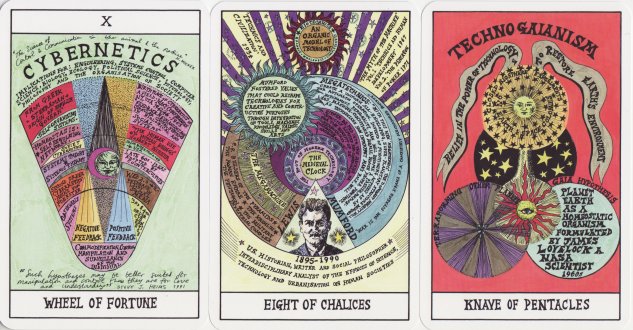
10 April 2012
The EntroalPercorso ("into the path") tarot was created by the Italian sculptor Martino Barbieri (1948-2009). Sadly he died of cancer before completing the images. His good friend Morena Poltronieri of the Museo dei Tarocchi in Italy was able to complete the tarot designs. Martino Barbieri had finished arcana 1 to 16 in 2005 and Morena Poltronieri created the missing six based on his sketches and style. It seems that these drawings were originally intended to be realised as sculptures. They depict imaginative machines usually with a handle and various cranks, which supposedly turn various components of the device and these often have surreal symbols, sylised fish, birds, candles, locks, pictorial images on a roller, flowers and so on. One supposes that these represent various aspects of human life that can be accessed through cranking on the appropriate machine. The link to the traditional acana symbolism may on first glance seem a bit distant, but once one thinks more deeply and enters into the style and sculptural language of the piece the associations become obvious. The deck, limited to only 50 copies, comes in a hand decorated wooden box and includes a blown glass wand. Only a few copies are left of the edition and they can be purchased direct from www.museodeitarocchi.net
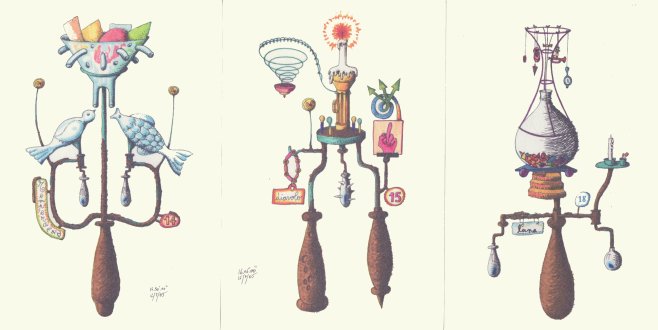
9 April 2012
The artwork on many recent manga decks can often disappoint, however, the Tarot Enie deck (2011) created by Maya Takamura is a fine example of what can be achieved in the style. Her drawing is impeccable and her sense for harmonising colour tones is delightful. The 22 cards are printed quite large and on quality thick card. The print surface is varnished with a soft matt varnish. The small illustrations below do not do the deck justice. It comes in a strong large shelf box, with an internal compartment for the cards. You can see more of her work on her website maya.vc/top.html
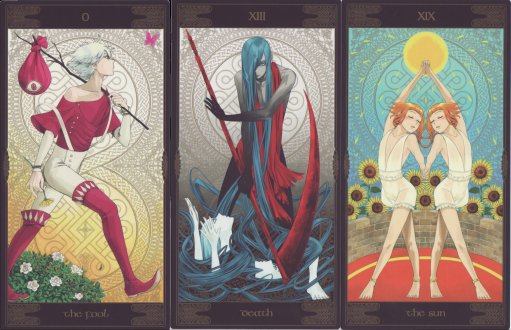
8 April 2012
The Touhou Project Tarot was self-published in 2010 in Hong Kong. It is a privately produced doujinshi based on the popular Japanese Touhou Project shoot-them-up game. The tarot is issued privately by an unidentified artist who appears to be a member of the Urbs Nox (City of Night) collective. The artwork incorporates circular graphic diagrams that draw on magical circles, astrological diagrams and similar esoteric and pseudo-scientific forms.

7 April 2012
The Watcher Angel Tarot published by www.spiralfirestudio.com was created by Jackie Williams with the little white book written by Michelle Belanger. The artwork is in a water based medium without harsh pen outlines. For the backgrounds Williams often adopts methods of texturing the washes of colour, probably using sponging and complex layering. This produces a subtle complement to the foreground figures, which do not so much stand out from the background but seem in many cases to emerge from it - a rather fine production.
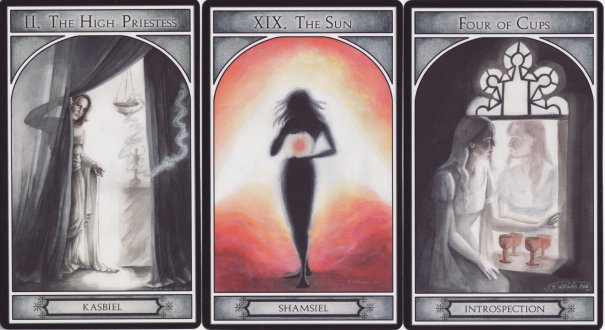
6 April 2012
The Australian artist Jordan Clarke has produced a 22 card collaged deck. I can do no better than quote her description of herself and her work
Fascinated by all things dark, whimsical and vintage her work is characterized by a collision of Victorian vignettes, rockabilly pin-ups, religious iconography, tattooing, 20th century circus and fairground lore, and a slight obsession with El Dia De Los Muertos.You can see details of her work on www.theartofjordan.com
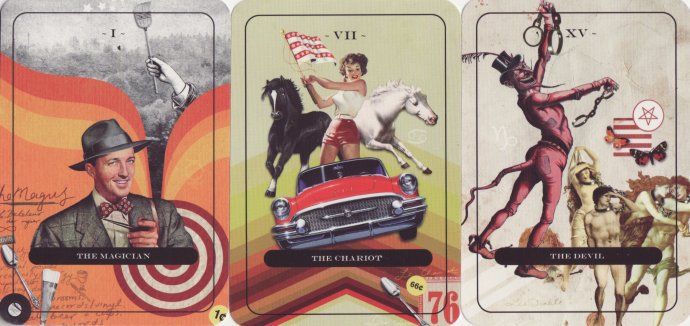
5 April 2012
The Holy Card Tarot is a collaged deck assembled by Patty Gallagher in the USA. It draws on some religious paintings of old masters together with some more recent illustrative material from catholic pamphets. The creator of the deck claims it is a "discovery of the common origin of spiritual themes and an opportunity to create a more inclusive religious symbolism of the West", but it seems too aggressively Catholic to achieve that aim. You can see more details and buy a copy from www.holycardtarot.com It comes with an explanatory book on DVD in a rather fine hard black box.
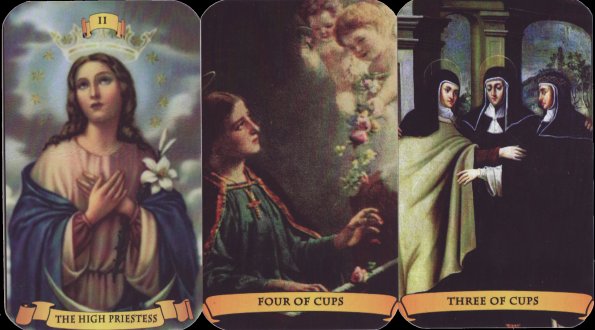
4 April 2012
The All Bears Tarot is a delightful piece of whimsy with a bear theme, created by Lynnette Monrean (tarotlyn on the Aeclectic Tarot site). It is a collaged deck using photographs of brown bears, grizzlies, pandas, polar bears and other bears. In creating the full deck of 78 cards tarotlyn had the help of many other Aeclectic Tarot members. You can see more of the cards and buy copies of the deck from www.beartarot.com
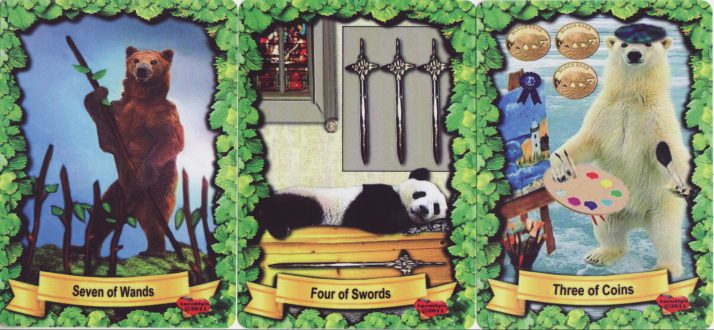
3 April 2012
I try to keep up with all the new tarots that are being produced, but I also like to add some of the earlier tarots that are missing from my collection when the opportunity presents itself. So I was happy recently to be offered a copy of Le Tarot Sacerdotal. This was, apparently, first created in 1951 ! and issued as part of a book Les Mystères Initiatiques. Some time later, these designs were modified and printed as a deck of 22 cards. It is consequently among the earliest of modern tarot decks. There may be some Art Deco influence upon the artwork.
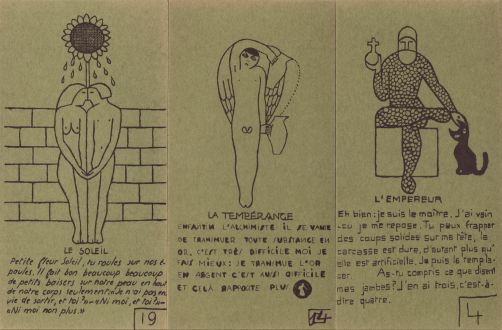
2 April 2012
The Dante Tarot is the latest issue of the prolific Russian tarot designer Vera Sklyarova. It was published at Moscow in 2011. You will have to know your Dante in order to grasp the imagery. Sklyarova provides a key in the paperback book which comes with the deck, but as few of us can read Russian, we will have to go back to the text itself. Thus card 52 (here on the right) corresponds to some verses in Canto IX of the Inferno when Virgil guides Dante through the Fifth Circle of Hell and the City of Dis.
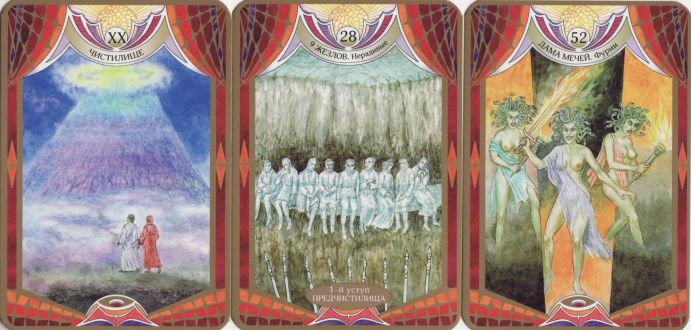
And more he said, but I hold it not in mind because my eye had wholly attracted me toward the high tower with the ruddy summit, where in an instant were uprisen suddenly three infernal furies, stained with blood, who had the limbs of women and their action, and were girt with greenest hydras. Little serpents and cerastes they had for hair, wherewith their savage brows were bound.
And he, who well knew the handmaids of the queen of the eternal lamentation, said to me, "Behold the fell Erinnyes; this is Megaera on the left side, she who weeps on the right is Alecto, Tisiphone is in the middle," and therewith he was silent.
With her nails each was tearing her breast, they beat themselves with their hands, and cried out so loud that I pressed close to the Poet through dread. "Let Medusa come, so we will make him of stone," they all said, looking down. "Ill was it we avenged not on Theseus his assault."
"Turn thy back, and keep thy sight closed, for if the Gorgon show herself, and thou shouldest see her, no return upward would there ever be." Thus said the Master, and he himself turned me, and did not so trust to my hands that with his own he did not also blindfold me.
1 April 2012
The Golden Dawn Temple Tarot produced by Nick Farrell and Harry Wendrich is intended as an aid to meditation within the Golden Dawn magical system. Thus the cards are printed very large, being A5 8.5 x 5.75 inches (215 x 146 mm) in size. The designs incorporate much of the Golden Dawn system of correspondences as well as drawing on the instructions provided in the Order of the Golden Dawn on the design of tarot images. Here Farrell and Wendrich have created densely coloured images using the various complementary colour systems in the Golden Dawn. There have been other Golden Dawn tarots working with much the same material, and this deck is well conceived with the structure of the images deeply thought out. It is obvious that here the artist Harry Wendrich has worked closely with Nick Farrell. The deck comes with a book providing some background material as well as a series of meditative exercises. You can buy copies and see more of Harry Wendrich's artwork on wendricharthouse.com
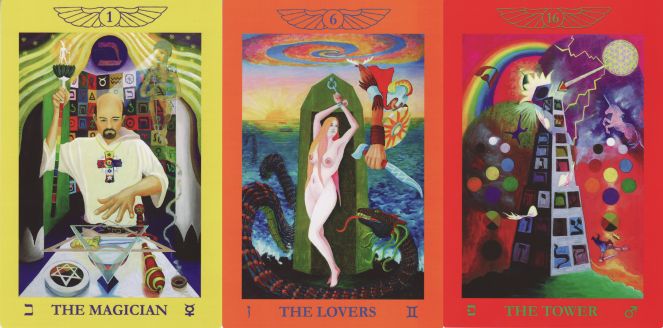
31 Mar 2012
The Hive Gallery in Los Angeles has encouraged collaborative exhibitions on the theme of tarot. They have recently issued the third in their series. The artwork is excellent though entirely individual to the contributor. There seems to be no attempt to integrate the artwork or link it with some theme. It is a good showcase for some East Coast artists work.
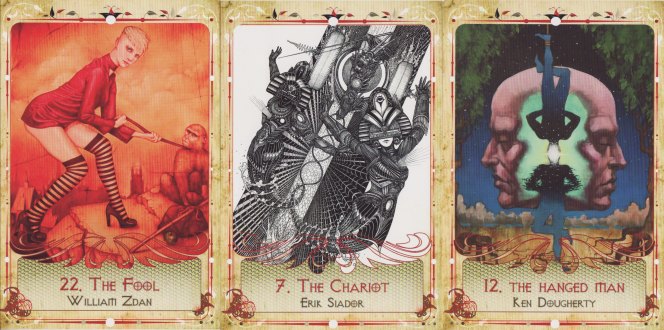
30 Mar 2012
I managed to obtain a copy of an old Celtic style tarot created in 1983 by Dominique Bergeron who went under the name of Bluenver. According to Kaplan's Encyclopedia, this Tarot Divinatoire was issued in a both a black and white version and a coloured one. I have the black and white version. The artwork is inspired primarily by the Celtic knot form figures often depicted in medieval manuscripts. This must be among the earliest of the now many 'Celtic' tarots.
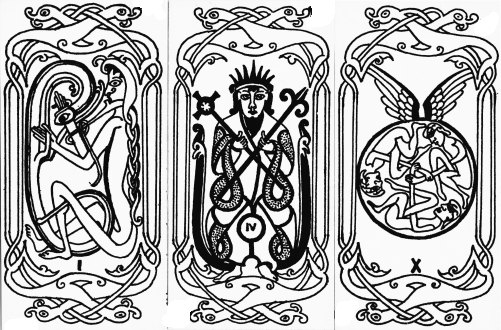
29 Mar 2012
The Tarocchi Psicologici is a book and deck set issued in Italy in 2011. The 78 card deck was created by Susanna Viale, a well known Italian artist. She works primarily in oils. She has a rather good appreciation of colour harmonies and the interplay of light and darkness. Her imagery holds close to the traditional tarot archetypes though seen through her own particular stylistic twists.
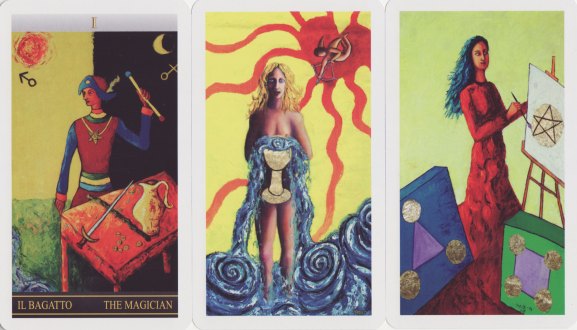
28 Mar 2012
The Ancient Scroll Tarot 2011 sold in Russia and the Ukraine was created by N. Klisheva and I. Kutepov. This is a 78 card deck in standard format. The rather fine line drawings in pencil or pen are presented against a textured background in the form of a wall with cracked plaster and the tones are shifted towards sepia or burnt sienna to produce an attractive antiqued effect.
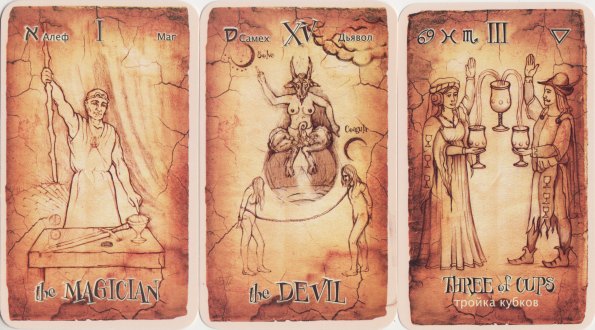
27 Mar 2012
I Tarocchi di Ferrara is the latest issue from the Museo dei Tarocchi. The artwork is by Mariarita Frazzoni and the edition is of 30 signed and numbered copies only. These are printed onto large cards about 9 by 6 inches (230 by 160 mm) so one can see all the details in the art. Mariarita Frazzoni is a well known illustrator of children's books in Italy. The paintings for this tarot apparently use mixed media including pastels, inks and watercolor to create different effects. This allows the artist to avoid harsh pen line for the foreground figures and thus the details stand out from, yet are integrated into, the flowing watercoloured backgrounds. Mariarita Frazzoni was the creator of another tarot Abracadabra - Le Streghe Giocano a Carte in 2006 also published by the Museo dei Tarocchi - you can see details at their web site www.museodeitarocchi.net I also believe she has produced designs for a rather beautiful tarot of owls.
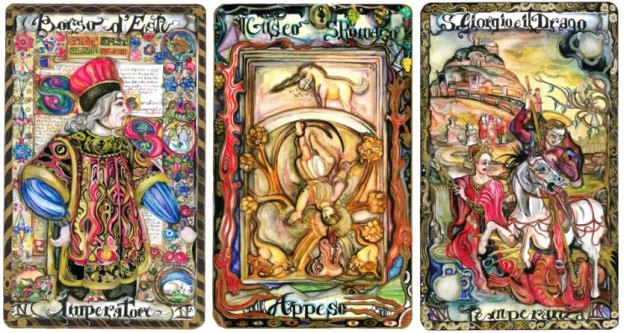
26 Mar 2012
Iowan's Tarot was created by Iowan Stone-Flowers primarily out of a concern to have African American imagery incorporated into a tarot deck. Having lived for fifteen years in Brooklyn and now in Georgia, her imagery ties together urban and rural America. This full deck of 78 cards has the suits named as Staves, Gourds, Spears and Cowries, and the 22 majors though entirely renamed nevertheless remain recognisable as the familiar tarot arcana. You can find details on her web site iowantarotonline.com
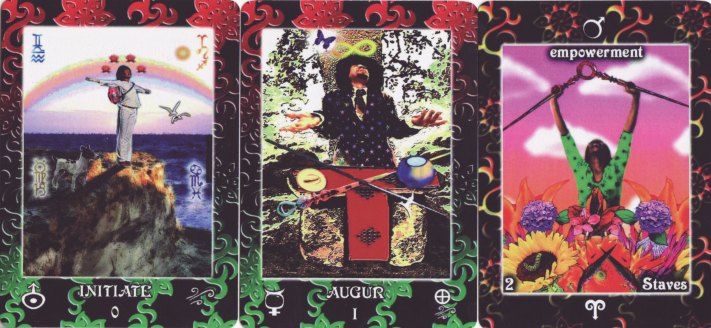
25 Mar 2012
Il Tarocco del Fabbrini was published in 2010 by the International Tobacco Agency as a promotional item. This one of the leading Italian companies for Tobacco products, smoking accessories and Tobacconists' services and is headed by Pietro Fabbrini, company founder and chairman, and Marco Fabbrini, (CEO). The tarot is beautifully printed and comes in a strong card box. The imagery reflects Venetian life and draws on a number of classic tarots - the Tarot of Marseilles, the Trevigiani and the Tarocchino of Bologna - the pip cards are thus not emblematic. The artwork is by Federica Busetto in very fine pen drawings subtly coloured with watercolour.
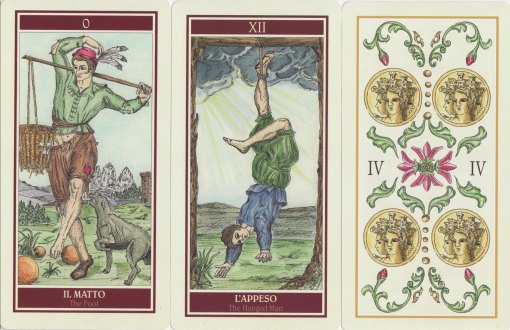
24 Mar 2012
Awaken is the latest tarot from Beth Seilonen. It is created in watercolour using some masking techniques with coloured pencil. This is a small edition of only 13 copies. Beth is based in Maine and has a website where you can see much of her output. www.catseyeart.com She is one of the most prolific tarot artists ever !
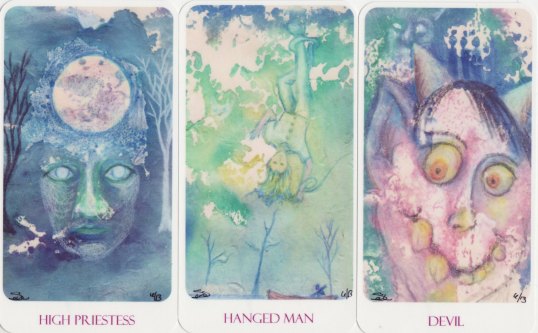
23 Mar 2012
I have now made up the final 40 copies of the Quantum Tarot and Taro of Ithell Colquhoun.
A number of my Art Tarots are close to selling out:-
Marie-Claude Purro 12 copies only left at present
Alchemical Wedding 10 copies only left at present
Corneal Edema 15 copies only left at present
Lebanese 4 copies only left at present
Fortuna's Wheel 15 copies left at present
The following are completely sold out:-
Alchemical Emblems
Tarot of the Sidhe
Aleph
Phantomwise
Arto
Diary of a Broken Soul
23 Mar 2012
The Rosetta Tarot created by M.M. Meleen as a traditional 78 card "Thoth" deck, reflecting Aleister Crowley's reworking of tarot. What is fascinating to those interested in tarot artwork is the media the artist has adopted. Thus the Majors are entirely created as acrylic paintings 3.25 by 4.75 inches. The suit of Wands (element of Fire and wood) are in coloured pencil with acrylic. The swords (air) were in drypoint etching technique printed from a plate then coloured with acrylic. Cups, being water, used watercolour, water based inks and acrylic. Disks (earth) used oil pigments and acrylics. The overall effect is a deeply saturated, intense, colour pallette. This was issued in 2011 in an edition of 777 signed and numbered copies. You can see details and buy a copy of the deck on www.rosettatarot.com There is also a companion book available The Book of Seshet.
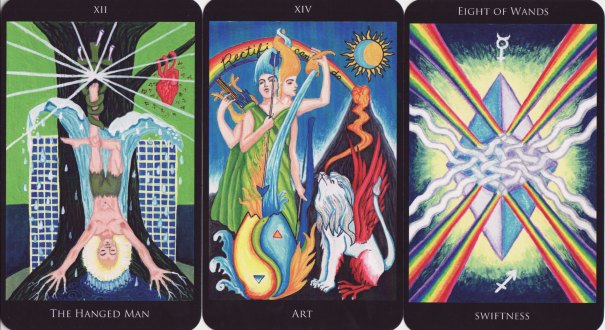
22 Mar 2012
I Tarocchi della Cattedrale by Federico Manicardi is inspired by some of the stonecarvings in the Duomo or Cathedral in Modena. Manicardi adopts the sylistic device of small headed figures with sculptural clothing.
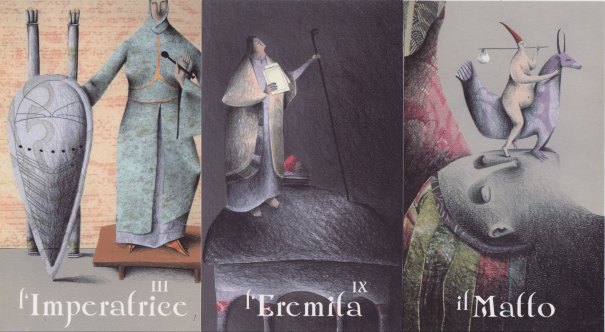
21 Mar 2012
The Black Fantasy Tarot by Angela Xu is a delightful deck drawn in ball point pen. Using ball point rather than a rotring or knibbed pen creates a more diffused line which is a rather interesting effect. She has created a blog about her deck blackfantasytarot.wordpress.com. In this she explains some of her imagery "There are no human figures in the full set of 78 cards only animals, most of the majors are mythical or fantastic, while most of the minors are real animals that symbolise the card meaning in popular culture or in their behaviour."

20 Mar 2012
For some weird reason zombies have returned to haunt the media. Even I cannot escape coming across televison series, trailers for films and books on the zombie theme. So it was not long before they appeared in a tarot. So yesterday the Zombie Apocalypse Tarot arrived through my letter box. This is quite gruesome and so well over the top that it might well disturb the sensitive souls among us. I am one of those people who likes to see how an art work was created so I find myself not so much stirred up by the imagery as curious as to how the makeup was made. I don't know who created the makeup and photographs for this but they are top quality and doubtless professionally done. I expect this is connected with the Zombie Apocalypse movie, but am unlikely to be sufficiently drawn to go to this movie in order to see if this tarot was created as a spin off from it. I don't think I actually enjoy the artwork but I can appreciate its integrity. You can see more of the cards at zombiecardgame.tumblr.com
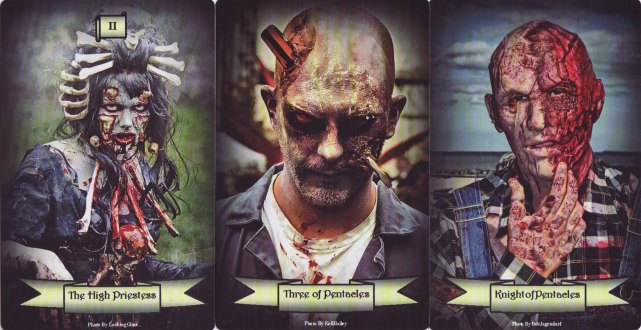
19 Mar 2012
I was recently able to obtain a copy of the wonderful Tarot of Alexander Daniloff. He is a Russian artist and illustrator presently based in Italy and he produced a series of tarot designs for an exhibition last year. Along with the exhibition the images were printed up in the form of decks of cards. Apparently he was not entirely satisfied with the printing, perhaps he felt the small format did not do full justice to the details on the larger originals, but to my eye these cards are a great delight. You can see more of his artwork on www.daniloff-art.it/ Daniloff seems to have entirely embraced the rich tradition of Italian art and his work references many early Italian painters, their format, subject matter and styles.
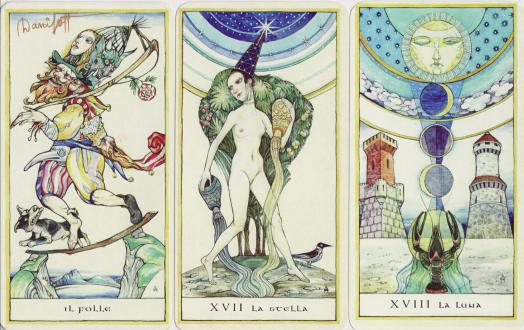
18 Mar 2012
The Tarot House, a full 78 card deck, has just been issued by Mother and Daughter team, Tricia and Jenny. You can see all the cards and buy copies from www.thetarothouse.com The artwork appears to be in gouache.
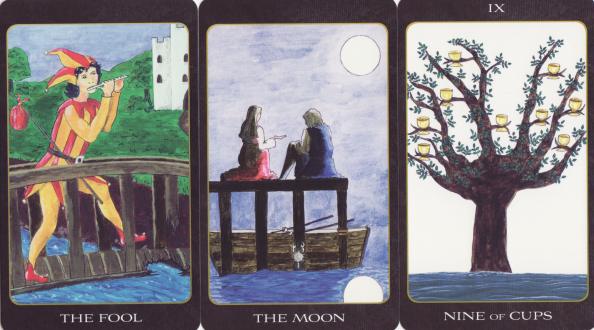
16 Mar 2012
Some years ago Francisco J. Campos produced designs for a tarot deck based on my coloured alchemical emblems. I was so delighted by this that I published it as the first in my Art Tarot series. I came to realise that he had produced such a wide range of tarot card designs, and I was hoping that I would eventually print and publish some of his other work. This was not to be as my tarot publishing came to an abrupt end. Last year I heard that his Vaudeville Tarot Majors only deck was to be issued with a book of poems by Lena Ruth Stefanovic, under the title Devil, an unauthorized biography, by the same publisher (OKF, Cetinje, Montenegro) in Montenegro that published Emily Carding's Tarot of Black Mountain in association with a novel. The 22 tarot majors are printed on thick card inserted at the end of the book.
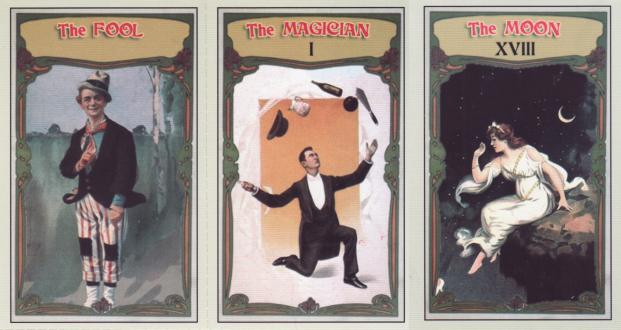
15 Mar 2012
The recently released Mabinogi Tarot is a collaborative self-published Japanese manga deck, which owes more to Harry Potter than to Welsh mythology. The designer Erin-Art released six cards at a time, over four issues. It seems that this is a doujinshi or fan art deck based on the Korean multiplayer online role-playing game Mabinogi, which is very popular in Japan. The artwork is of very fine quality.
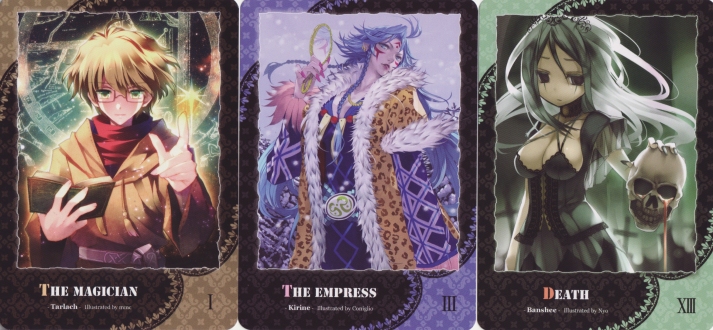
14 Mar 2012
Over the last month I have obtained a number of wonderful tarots, but have not found the time to enter them onto this weblog. I will try to do this over the next few weeks.
Among these is Une rêverie sur le Tarot de Gérard de Nerval. Gérard de Nerval was an early 19th century French poet and translator, an important member of the Romantic movement. In the early 20th century his writings, especially stressing the importance of dream imagery, captured the interest of Andre Breton and thus came to influence the Surrealists. This tarot celebrating de Nerval, was created by Walter Unfer and were formed from collaged 19th century steelplate engravings. Being an art deck the cards are large enough to show the considerable detail. The collaging is so well done that the different graphic elements fuse together and become entirely integrated. Walter Unfer must have spent so much time working out how to bring these graphic elements together to make such a coherent whole. These do remind me of Max Ernst's graphic novel Une semaine de bonté (A Week of Kindness) published in 1934 which drew on similar graphic material. The Tarot de Gérard de Nerval is published as an edition of 100 signed and numbered copies by www.tarot-palestrina.com The small scans shown here do not do justice to the complexity and sharpness of detail of the images.
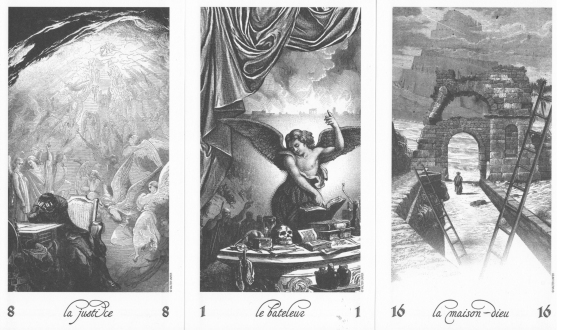
10 Feb 2012
I remember seeing Debra M. Givin's paintings a few years ago, so it was a great delight to find that she had managed to get these published by US Games Systems under the title Cat's Eye Tarot. These paintings are skilfully executed and based on her close observation of cats and their mannerisms.
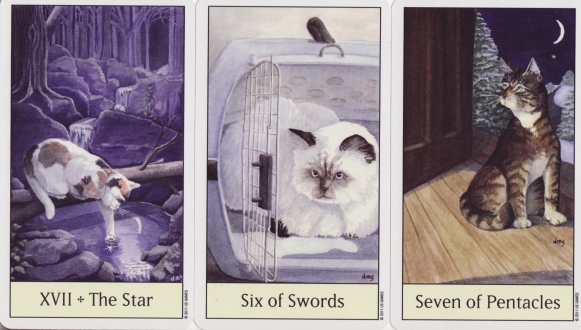
9 Feb 2012
The Tarot Maximo was created in 2011 by Anthony Max as personal project, taking just over 6 months to complete. It consists of posed photographs and acrylic paintings reflecting tarot ideas which have been collaged with other elements and graphically manipulated in a digital graphics program called ArtRage. The 78 cards have no titles or numbers. You can see details on his blog tarotmaximo.blogspot.com
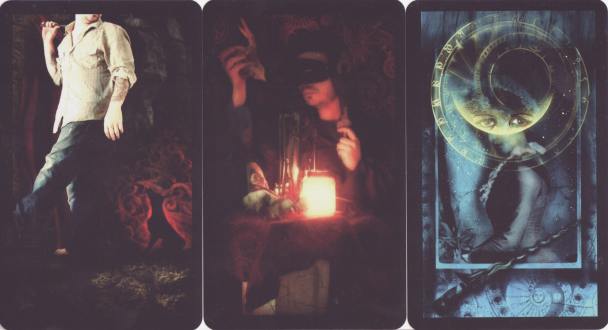
8 Feb 2012
Guido Gillabel in Belgium has recently issued a limited edition deck of only 22 copies, descriptively entitled Playing with Pamela's and Edward's tarot project. This is printed in silver grey ink on matt black card. For each of the card designs Guido Gillabel has taken small areas of the line drawings behind the Pamela Colman Smith - Arthur Edward Waite Majors and creatively reworked these into new images.
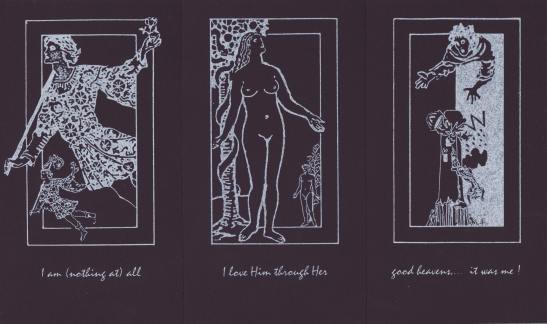
7 Feb 2012
The Love Tarot produced by Waku Waku Mail is a Japanese promotional tarot for WakuWaku-communications. The card images which are naked and semi-naked long limbed women in teasing postures were apparently created by a graphic artist named Comaki.
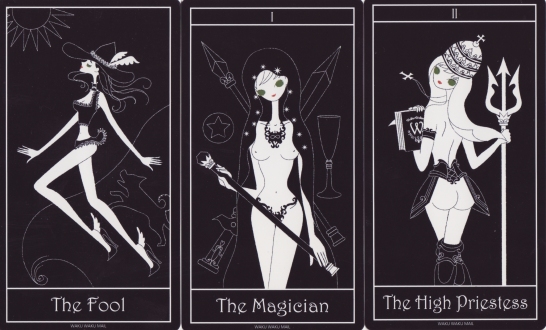
4 Feb 2012
Nakisha, the creator of the delightful TaRat and Rabbit Tarots, has now produced a further animal themed tarot, the Blue Dog Rose. This is a full 78 card deck with suits corresponding to one of dogs (wands), cats (swords), rodents (pentacles) and birds (cups). I do like painted tarots and her classic pen and watercolour drawings are delightful. "Nakisha" is the working name of the Seattle based artist Elsje VanderHoeven who has a website devoted to her tarot decks www.nakisha.com/nakishas_tarots.htm. On her blog she does say that she is working on a new more complicated tarot deck, so we will all be looking out for that.
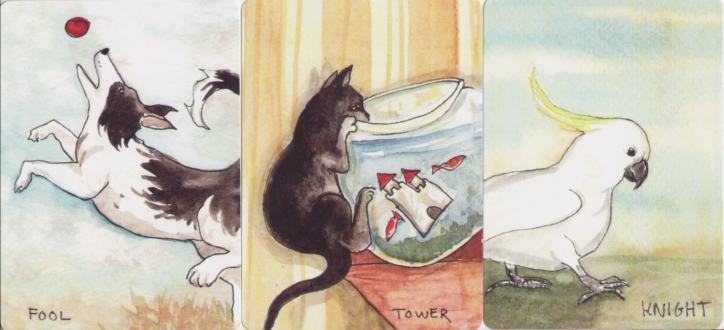
3 Feb 2012
The delightfully named Useless Tarot produced by Poppen-Do in 2010 is another transparent tarot. The 'cards' are very small only 2 inches (50mm) high. For the most part they are collaged pieces from engravings. They are sold in a matchbox, which also contains a little white book, with some keywords. I can find out no further information about this humorous Japanese artist.
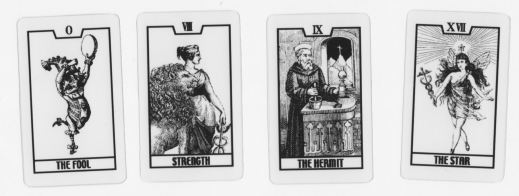
2 Feb 2012
The Kappa Sigure Tarot is a self-published deck from Japan by Gre (Kappa Sigure). The artwork is in pencil and ink with some airbrushed or spray pigment to texture some of the cards. You can see some of her other artwork through this page.
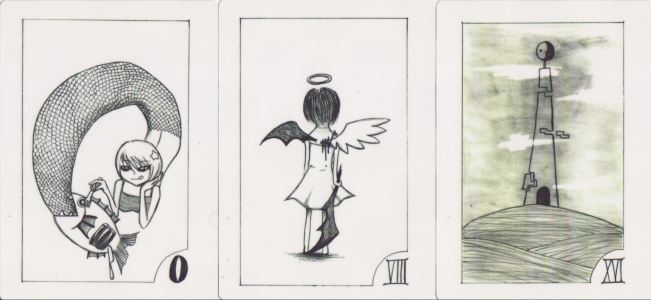
1 Feb 2012
I recently obtained a copy of the luxury edition of Ryuji Kagami's original tarot Astrology of Love. This came in a rather fine box and includes a faux leather pouch somewhat in the style of those issued by the Morinaga Hi-Crown Chocolate company in the 1990s. The artwork for this deck is by Aki Horiuchi who must have worked under the direction of Ryuji Kagami who has conceived and designed many interesting tarots over the last decades. This is a rather fine Rider Waite clone. The artwork appears to be in acrylics in a stylised naive format.
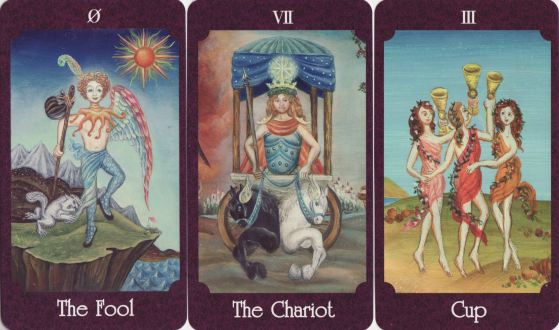
31 Jan 2012
A week or so ago I received a copy of Les Tarot des Femmes Erotiques composed from vintage early 20th century erotic photographs, choses to reflect tarot imagery. This is published in the USA by the witches beautyhistorymagic.com You can see rather full descriptions of their production at www.vintageeroticatarot.com Here are The cards corresponding to The Hierophant, The Moon and the Ten of Swords.
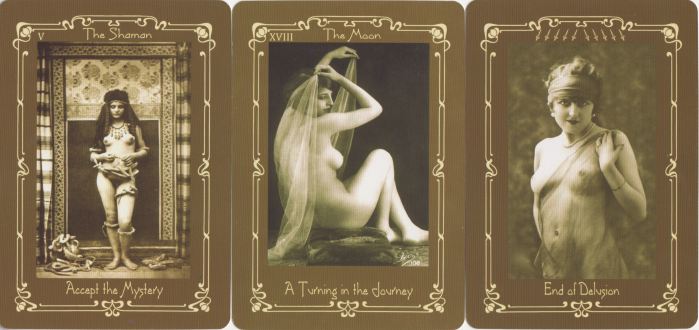
30 Jan 2012
I have now printed, laminated and made up the final 40 copies of the Ithell Colquhoun Taro and these are now on sale again. I do have a few advance orders so anyone wanting to buy a copy of this strange and creative tarot deck made by well known English surrealist painter and occultist, please place an order soon before the remainder are sold.
29 Jan 2012
The Tarot Card Alice book and deck issued in Korea in December 2011 uses the original illustrations of Tenniel to Alice in Wonderland and Through the Looking Glass. These have been subtly and sensitively redrawn and coloured without overwhelming the underlying drawings. At first glance one would think the colouring was through watercolour, but on close inspection this appears to have been done digitally in watercolour style. I found this to be a rather fine production and a worthy new addition to my growing Korean section.
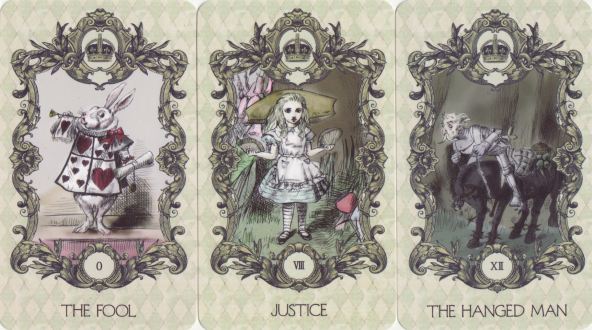
28 Jan 2012
I recently managed to obtain a copy (no 16) of the limited edition of 18 copies of the Rampo X Tarot created in pen and ink by the Japanese artist Sawsin Kondo. The artwork is quite astounding and I am pleased to have it in my collection.
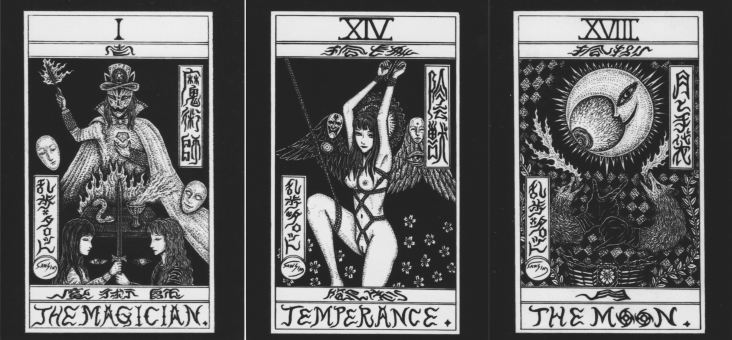
12 Jan 2012
A few days ago I received El tarot de la Bruja Moderna. This Tarot of the modern witches is not that by Antonella Plantano and Laura Tuan issued by Lo Scarabeo, but an unidentified Spanish deck with entirely different graphics. There is no publisher, artist or date on the printed box. The slightly angular forms of the figures seems quite familiar to me, but I cannot remember if I have seen these before. The "witchcraft" element in the artwork is entirely minimal.
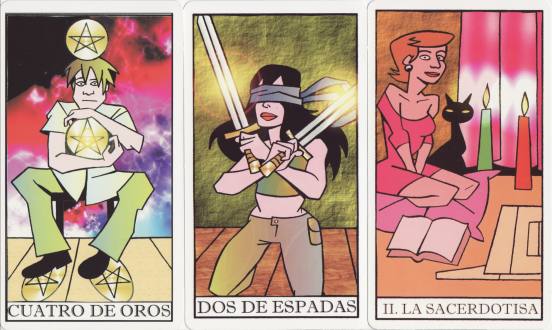
29 Dec 2011
The American Obscura Tarot by Misha Huntting takes a discordant and gothic perspective on american society and weaves this into a dark tarot deck. This is a full 78 card deck. You can buy a copy and see Misha's considerable body of artwork on her website at theartofmishahuntting.weebly.com
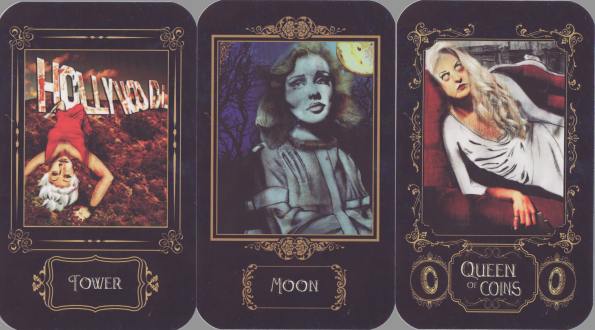
15 Dec 2011
Schiffer Books has issued a number of fine tarots in the last two years or so. Today I received the Secret Language of Birds Tarot. This was conceived by the writer Adele Nozedar and the artwork in the form of acrylic paintings was created by Linda Sutton. The full 78 card deck comes in a large box with a 200 page book describing and contextualising the deck. The cards are in a large format with minimal border which allows the art work to be seen in detail. The original paintings must be astounding as Linda Sutton has used gold leaf on many of them which she then overpaints. I expect she will make more money from selling her art work than from the royalties on the tarot deck. Some of her tarot painting were on exhibition at the Piers Feetham Gallery in London in September/October 2011 see www.piersfeethamgallery.com. They are not especially expensive so perhaps some tarot collectors might buy some of her pieces.
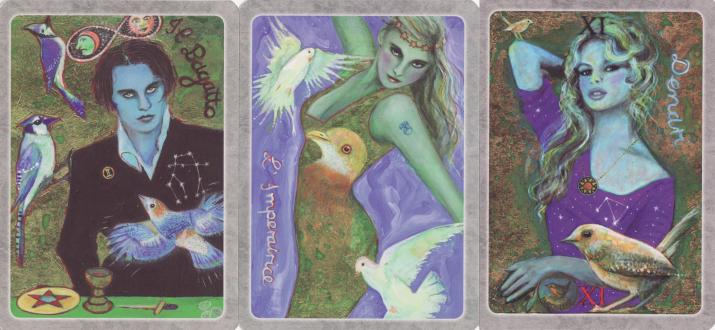
13 Dec 2011
Today a rather fine Rider-Waite clone from Romania arrived in the post. The artist has stuck closely to the original designs but redrawn these. This seems to have been done in a computer graphics program rather than using paint and paper. The outlines of forms are in a fine reddish brown line which reduces the contrast and thus softens the imagery. The style is thus light and fresh, contrasting with the coloured woodcut style of the originals.
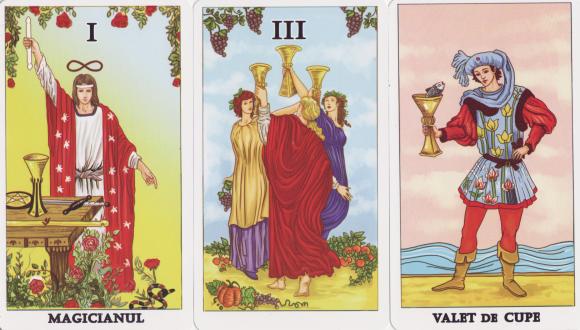
 8 Dec 2011
I cannot be the only one who was astounded when seeing illustrations of some black and white images of Tarot designs in Decker and Dummett's History of the Occult Tarot. These designs were created by Wilfrid Pippett and J.B. Trinick around 1921-23 in collaboration with A.E. Waite. This may have been intended for use within Waite's Rosicrucian inspired order.
Shortly after the book was released, I tried to find the sources for these images, hoping to find a complete set and perhaps even issue it in my Art Tarot series. I was not successful in these endeavours.
So I was delighted to hear, earlier this year, that Marcus Katz had discovered almost a complete set of coloured images of these designs. Then his colleague Tali Goodwin managed to discover the original drawings and some prints based on these. Thus they now had a complete set of the designs over three formats.
Marcus and Tali have now published these in a large format book, Abiding in the Sanctuary: The Waite-Trinick Tarot. A Christian Mystical Tarot (1917-23). In this each of the pieces is reproduced full page, and they provide interpretative material as well as the historical background to the cards and their creators.
This book is available through Blurb.Com. The print quality is excellent. I see these images as one of the earliest of the art tarots. It is wonderful that a full set of the desgins has survived and that Katz and Goodwin have been able to make these available to us. The book can be bought from www.blurb.com/bookstore/detail/2702755 where you can see a preview.
28 Nov 2011
I have been very busy recently on my publications so have rather neglected my tarot weblog. However, tarots are still arriving and I hope to be able to catch up over the next few weeks. Among these is a rather fine large format book, not too expensive, with a delightful set of 78 tarot designs by Francesco Clemente. This was issued as part of his recent exhibition Francesco Clemente: The Tarot at the Uffizi Gallery, Florence, Italy from September 9, 2011 to November 6, 2011. The images are essentially portraits of his friends in New York who include Salman Rushdie, Jasper Johns, Kiki Smith, Philip Glass and Scarlett Johansson. You can see some details on this page.
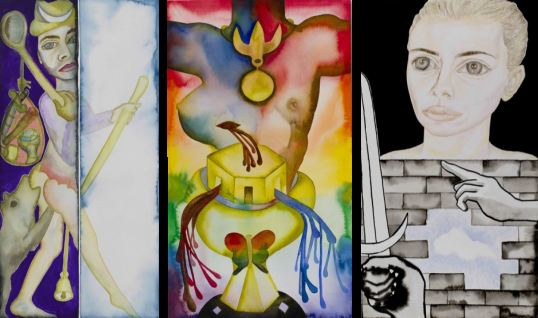
7 Nov 2011
Tarot collectors are usually a bit obsessive, but I suspect only the true hardcore collectors will be driven to buy a copy of the Melthelm Abstract Tarot. This is a self-published tarot from Japan, by an artist working in an abstract art mode. Tarot is, of course, an emblematic form and though a number of tarot artists have tried to push far into abstraction, for the most part they retain some emblematic content. Thus Wifried Teschler's Energetic Tarot of 1986, with its minimalist abstract forms, still seems to present a narrative, or at least one fnds oneself drawn to reading this into the artwork. The Taro of Ithell Colquhoun, though abstract, has a underlying esoteric system, which once grasped, enables one to see her images as refecting particular tarot archetypes. The Melthelm Abstract Tarot is totally uncompromising. One struggles to find any link of the artwork into the conventional tarot imagery. One might expect to find, say with the Lovers card, some division into two areas reflecting the two lovers, but this is not what we find. This tarot seems entirely opaque. It will be well worth collecting, as it is such an obscure item. I would expect that only a few copies will be sold and the artist will cease publishing them quite quickly. So it is likely that they will become very rare and unobtainable. The dealer Baby Dream has a small batch of these for sale.
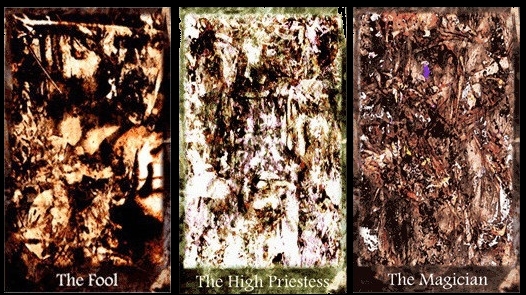
1 Nov 2011
I have recently obtained from Japan the rather strangely named tarot deck Tiger Card Ultora : Fate/Tiger colosseum UPPER. Decoding this was not too difficult, courtesy of Wikipedia. Fate/Tiger colosseum UPPER is a 3D fighting game for one of the Playstation game machines. It was released in 2008. The tarot, which appears to be an official release, came with a printed set of rules for a card game, a folder for displaying the cards and a folding out stand up display figure. The artwork is very fine quality manga, and the delightful Moon card especially entranced me.
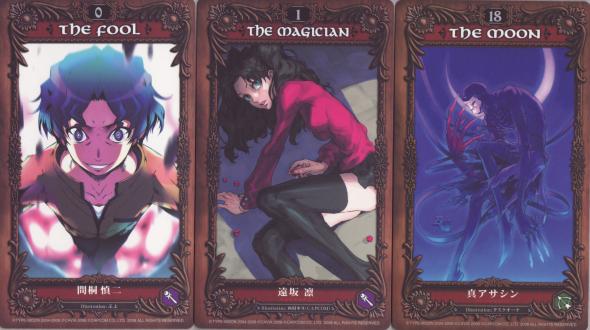
27 Oct 2011
Beth Seilonen is the most prolific creator of published tarots. She deserves a place in the Guinness Book of Records. I have most of her limited edition tarots in my collection, but I seem to have missed her Winter and the Crow tarot which she produced in January of this year. So I was delighted to be able to buy one of the few remaining copies. For this tarot she uses the medium of coloured pencil on a woven textured paper. The Crow makes its appearance of a number of tarots - Crow Tarot (Debra Klopp-Kersey) and Crow's Magick Tarot (Londa Marks) come immediately to mind.
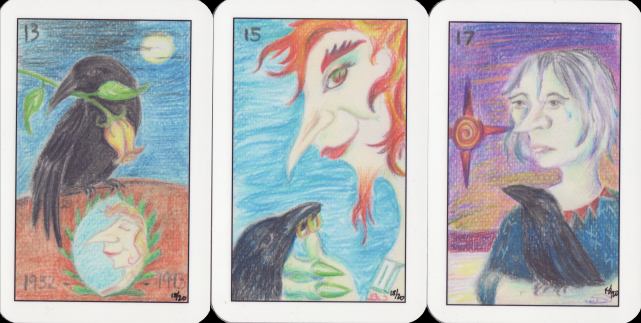
Beth has just had one of her tarots Tarot Leaves published by Schiffer Books which will be easy available through the usual distributors.
26 Oct 2011
The Tarot of the Holy Light by Christine Payne-Towler and Michael Dowers draws on alchemical and other emblematic material found in woodcuts and engravings in early books on alchemy and mystical matters. These have been redrawn, coloured and collaged using Photoshop to create the imagery for each of the cards. I found it really interesting to identify the source of all the components, however, one does not need to be familiar with the original source material to appreciate their intriguing and delightful artwork. I loved the Tower with its use of an alchemical furnace from one of the alchemical engravings in the well known Mutus Liber. The artwork could be seen as being similar to that of Robert Place's Alchemical Tarot though he redraws the images in a lean modern style while Christine Payne-Towler and Michael Dowers create a more dense gathering of symbolism into each card image. It is certainly a deck that will fascinate and intrigue the viewer. It is issued in a fine solid box. You can buy copies from this website www.tarotuniversity.com/2011/09/tarot-of-the-holy-light-deck.html though I expect if will be widely distributed and sold through many outlets.
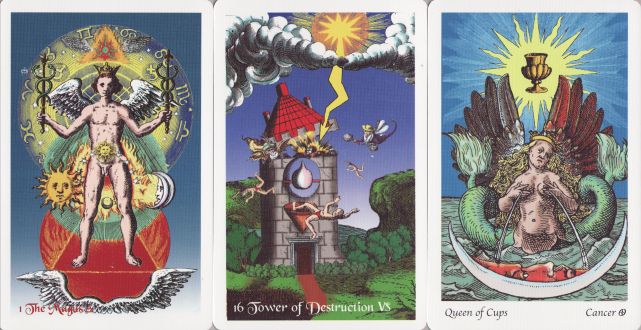
25 Oct 2011
The Quel Tarot by Kelley Kolberg has recently been issued. This is a 22 card Majors only deck in an edition limited to 100 copies. It comes in a rather fine wooden box. I understand that the creator is currently working on a full set of minors, so we might expect a full 78 card deck eventually to appear. The artwork uses photographs which have been modified in a computer graphics program to produce impressionistic effects. You can buy copies from Kelley Kolberg's web site www.metarotiscapes.net/Quel/Quel.html where you can see some more cards and some details about the deck.
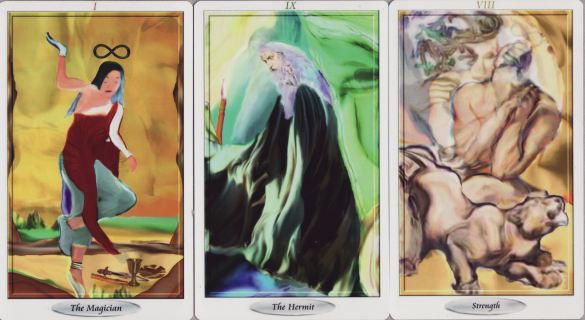
13 Oct 2011
I often collect tarot cards issued with magazines. I find these especially interesting because they often reflect trends in culture rather than pure tarot concerns. Also these tarots, being given away for free, are often thrown away and consequently difficult to source even a few months after the magazine was issued. I recently bought Das Entscheidungstarot (Decision tarot) issued by the German fashion magazine Amica. The packaging records the illustrator as Roya, but does not indicate a date for the issuing of the tarot.
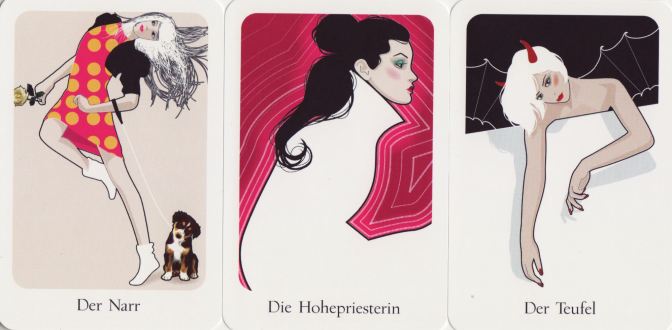
2 Oct 2011
A few days ago I obtained a copy of the Eroteme fashion tarot cards created by Oleg Mitrofanov. This is conceived of as biannual publication of a tarot deck, which "aims to expand the borders of fashion by introducing style, beauty and decadence into specific and often forgotten branches of cretative arts". This first issue uses the theme of opera. Each of the photographs of models posing in wonderful costumes, often with stage like makeup, are collaged with other graphic elements to present a tableaux related to a scene from a classic opera which in turn reflects the tarot imagery. It is quite a tour de force. This is a tarot which all serious collectors should try to acquire. It is not inexpensive, but the edition is very small (30 copies) and as the cards will be collected also by people in the fashion industry it will probably sell out quite rapidly. You can see more of the cards on www.olegmitrofanov.com from where you can buy them direct.
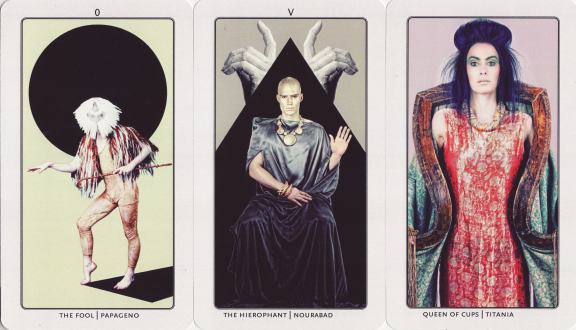
13 Sep 2011
Tarot 90 is a collective tarot produced by 22 separate artists for an exhibition organised by the Galleria Benot in Cadiz and the Galeria Akelarre in Marbella. The exhibition seems to have been designed by Juan Candon. I am not sure about the date on the exhibition which issued this tarot. The group of artists is known as Colectivo de Arte 90 whch seems to have been established in 1990. A number of the artworks are signed and dated '2000' and it may be the exhibition was in 2001. The artwork adheres closely to the tarot archetypes.
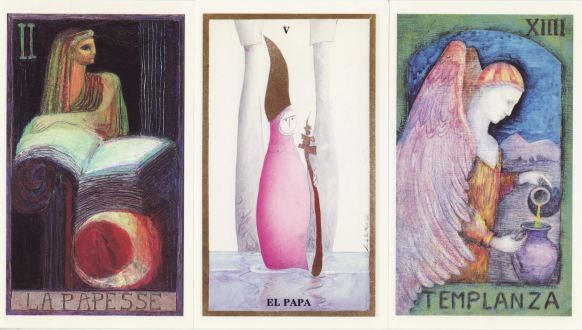
2 Sep 2011
The grim reaper is a familiar image for the Death card in tarot decks. Now Beth Seilonen, has created an entire Major Arcana using this idea, Grimmy's Transitional Arcana. As always Beth Seilonen, generously for us collectors, limits her edition to only 20 copies. I was able to buy number 7. As always Beth's subtle humour lies behind the images. Beth must be the most prolific published tarot artist of all time with nearly 60 titles. F.J Campos has also created many deck designs, but, sadly, almost none have been published.
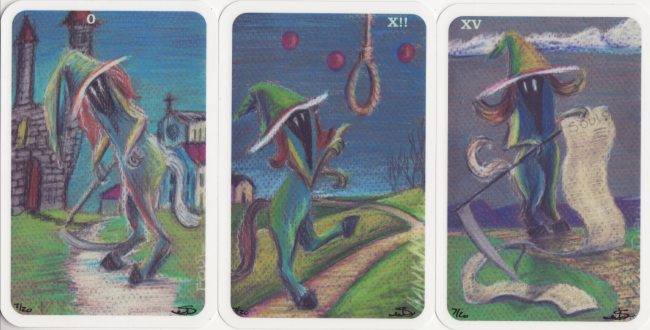
31 Aug 2011
The Tarot de Madrid was produced in 1984. It consists of a series of photographs primarily of the heads of various models, whose faces have been painted to suggest the tarot arcana. It is a neat idea and well realised.
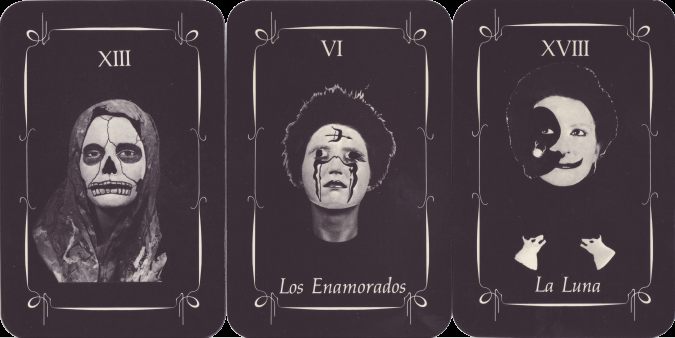
30 Aug 2011
The iTongo book and deck was created by Robyn-Anne Pollard of Cape Town in South Africa. The Major Arcana are based on South African mythology and legends, while the Minor Arcana present tableaux of tribal history spanning the period (c.1700 - 1850). The artwork was created by Chantal Fielding who works in oils as well as acrylics. You can buy a copy through www.africantarot.com There is a video on Youtube, just search for iTongo.
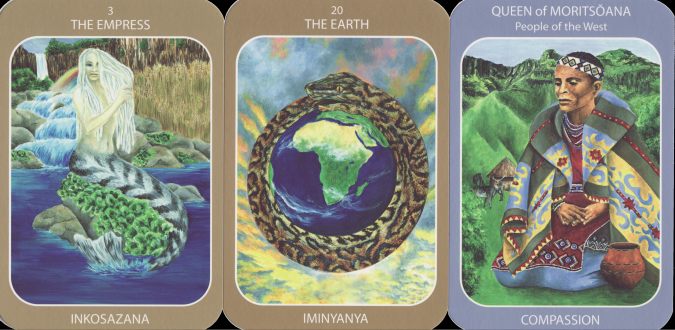
25 Aug 2011
Here is a bit of amusement with a sting in its tail. Today I received an email from someone wanting me to value
a tarot deck for them. Now I don't provide valuations. You can see I even put a note about that at
the head of this weblog. This is for a number of reasons. Firstly, I am not a professional
valuer. If I were a tarot dealer selling secondhand tarot decks, then I would have this expertise,
but I am not. Secondly, it is not possible to value decks unseen. Condition is important. Thirdly,
I don't know for what purpose such a valuation would be used. Someone might want use what I say
to push up an auction price. As I am quite well known in the tarot collecting community, someone
could well use what I say for their own purposes. I would have no control over how this person chose
to use any valuation I gave. So I don't give valuations !
So I wrote back to this person saying "Sorry I cannot provide valuations. This depends so much
on a correct identification of the edition and its condition." This person immediately replied
"Hi Adam sorry to be a pain, here are a couple of pics, trying to find anything about Tarot Cards
is so hard as most dealers go ohh Tarot Cards, it seams they can talk about the every day
playing card but Tarot ohh. If I'm asking to much, Thank you for your time,
I was quite surprised that this person did not seem to take no for an answer so to make the
situation crystal clear I replied "To reiterate. I do not give valuations."
To this I received this amusing though rather annoying message :
"What a drip To reiterate what a drip thanks 4 ur help, I will make sure I dont have a nice helpfulI often receive such unpleasant mails from people. I am sure this applies to many others who
word to say about a person that has the knowlage but not willing to part with it and is in the
public domain ie www, not a good advertising realy, all I asked for was advive that would have
taken the same amount of time and letters in a email, and less thought, I pray that in a life time,
u would ask me for advice, I would part with my knowlage to improve some1's day, you must be
so great. regards *******
P.S. Be more concerned about ur character than ur reputation....
b'coz ur character is who u are
and ur reputation is what other think of u..."
work publicly on the Internet. I have a thick skin and, indeed, found this missive rather amusing
which is why I decided to share it on my weblog. Their P.S. is especially amusing as it is self-referential.
Anyone writing such an email is obviously revealing a little bit too much of their character.
But there is a serious side to this. People, such as myself, who give their time to trying to promote
interest in some subject, do not deserve to be treated like this. A sensitive, caring individual, without
a carapace hardened by years of dealing with difficult individuals, might well just be driven to abandon
sharing their information by means of their website and all of us would be the losers. People who are so
selfish and unthinking as to write such a response in reply to a straightforward email, diminish and may
ultimately destroy Internet communication. Why should I bother even to reply to people who write to me
requesting my assistance, if I may have to face reading an unpleasant insulting reply such as this?
24 Aug 2011
Yesterday I received the Raven's Fool Tarot. I bought the special edition limited to 22 decks (I have number 17). This came with a beautiful pine box on the top of which the artist, Vicky DeFrancesco, has painted the image of a Raven. The full 78 card deck of almost square cards has some delightful artwork exploring the theme of the Raven. You can buy a copy direct from the artist at www.ravensfool.com
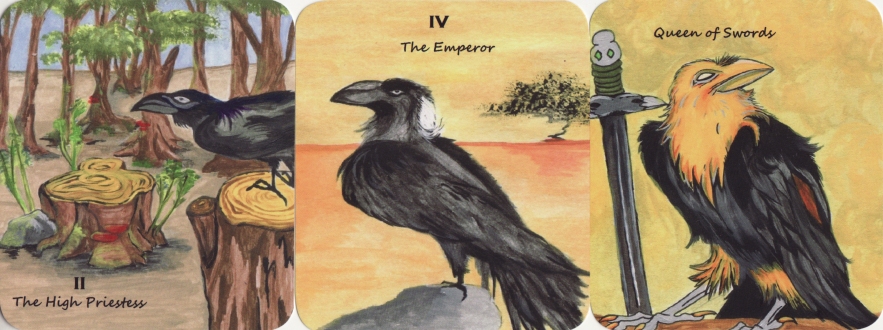
Over the last few weeks I have received a number of wonderful tarots, but have not managed to find the time to update this weblog, having been working on improving the layout and navigation of my interlocked series of web sites as well as on my publishing activities. Among these tarots I now have the Year of the Rabbit Tarot from Taiwan, a self-published deck limited to 300 copies. There are a number of Rabbit tarots, I can immediately recall three, the Twilight Rabbit Tarot, the Usatarot from Japan and Nakisha's Rabbit Tarot. This year, 2011, is the year of the Rabbit in the Chinese astrological calendar. I think you will agree that the art work for the Year of the Rabbit tarot is really neat.
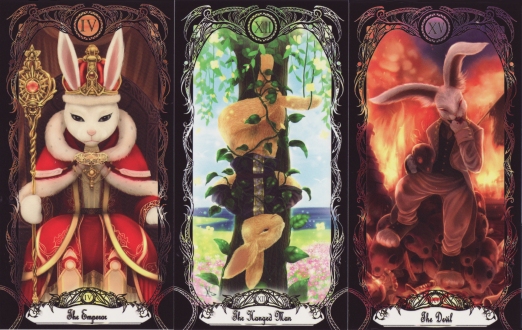
2 Aug 2011
The Surrealist Tarot by Ari Bach is a wonderful series of 78 pencil drawings created over the summer of 2010. This full deck is published by Tarotsmith Divination and is available at a modest price through their web site surrealist.tarotsmith.net. The cards are quite small and I hope that Ari Bach might be persuaded to make some of his drawings available at a larger size so we can appreciate his graphic skills. I see he has some of his other material on DeviantArt. As with most surreal stylised tarots, there is a playful aspect to the imagery, a typical example of this toying with ideas and images being seen in the Eight of Cups.
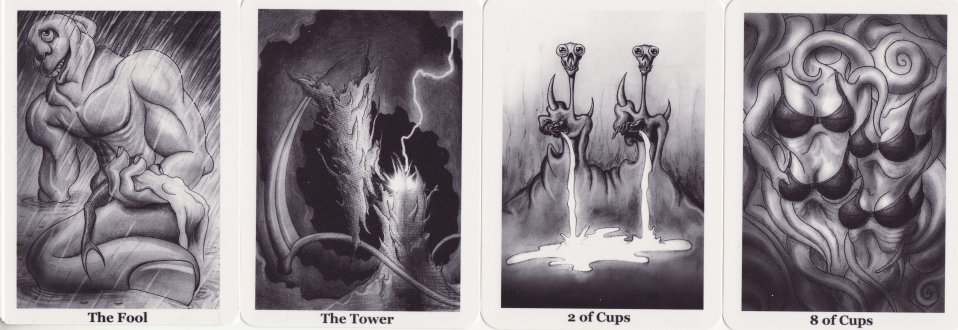
1 Aug 2011
Afew years ago I managed to buy a copy of The Sinister Tarot by Christos Beest. This was an edition limited to 40 copies issued by the O.N.A. (Order of the Nine Angles) magical order and published in 2007. This was a deck of 20 cards with a clear tarot structure. Although not a secret, I eventually discovered that the creator of this deck was a talented musician and painter from the UK named Richard Moult. Now in collaboration with the Black Glyph Society, apparently located in Australia, he has augmented hs deck by adding the courts and other cards to produce the Emanations deck of 64 cards. I show three cards. The first was in the original Sinister Tarot, the other two were added in the Emanations.
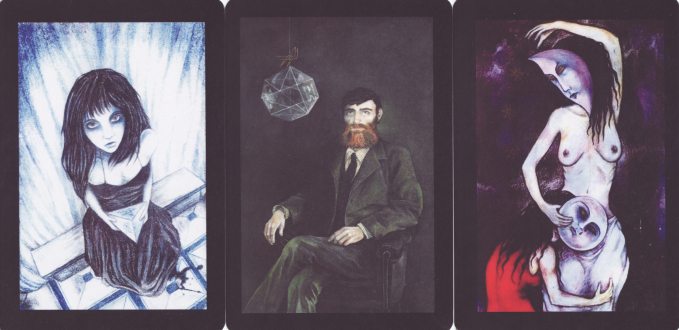
27 July 2011
Fournier in Spain has issued the Alchemy TM1977 England Tarot. This is a full 78 card deck and uses the artwork developed by the Alchemy Gothic company in the UK which produces goth and steampunk fashion accessories, posters etc. Some of the Major arcana artwork uses that produced as posters. The image for the Hierophant is well known as is that for The World (their current Versus Doctrinus poster).
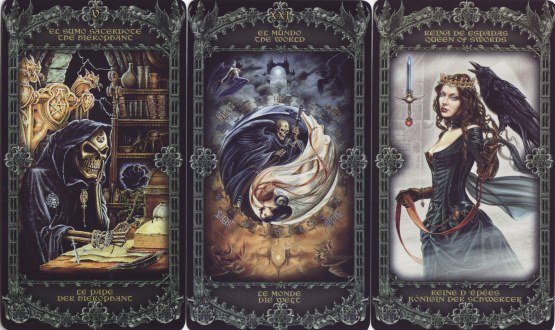
21 July 2011
Pat Smith, who created the video of my Art of Japanese Tarot has now been able to upload the full length version to YouTube. Youtube used to restrict videos in size and length.
13 July 2011
The third penguin themed deck I now have is the Penguin Parade Tarot by Robyn Tisch Hollister. This was issued in an edition of 50 copies. These are small cards which come in an interesting folding box. It is a full 78 card deck. The suits are Shells, Stones, Feathers and Sticks. The original artwork would appear to be in watercolour.
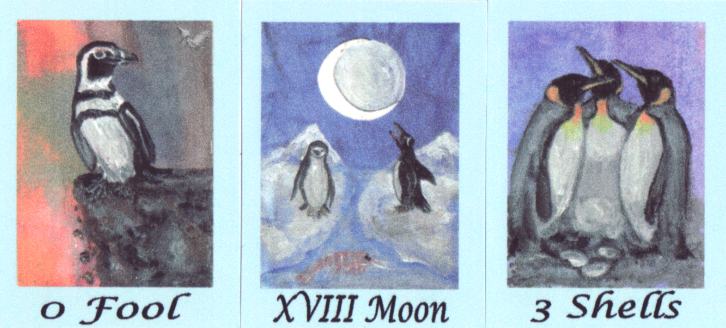
12 July 2011
I only rarely buy a "Tarot" deck which has no discernable tarot structure. I am rather conservative in my collecting habits and I keep my collection tightly focussed on decks with the familiar 22 majors and minors. If I were to add non tarot "oracles" I fear there would be no clear boundary to collecting. Very occasionally I make an exception, either because the artwork is important or the concept is significant in some way. I recently was drawn to purchase the Jung Tarot issued as a gift in the Japanese Misty magazine, No 6 , June 2011. The concept is by the prolific conceptualiser of tarot Ryuji Kagami with the artwork by Maggie Hyde. There are 22 cards but they do not seem to relate directly to the tarot archetypes - instead the imagery reflects Jungian ideas - Inner Shadow, Outer Shadow, Dark Anima, Light Anima, Self, Synchronicity, and so on. A nice idea, not tarot but still worth a place in my collection.
11 July 2011
The Dark Tantra Tarot has just been issued in the UK as an edition of 50 copies. The artwork is by Ruth Ramsden in collaboration with Mark Ramsden and is a synthesis of eroticism, fetishism and tantric spirituality. The pen drawings which are the basis of the designs were printed in two colours, dense black with thick lines and grey thin lines, whch gives a very interesting effect. You can see more details on their web site The limited edition Major arcana of 22 cards have four extra "Mistress" cards, presumably from a proposed Minor arcana.
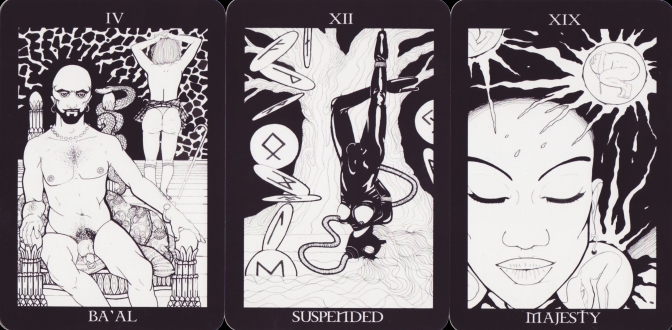
9 July 2011
Are penguins the new cats? Well I now have three tarot decks on a penguin theme. They have a bit to go to catch up with their feline friends but they are moving in the right direction, along with rabbits, frogs and foxes.
The latest Penguin Tarot is Japanese in origin. I believe it was created in 2010. I am not sure penguins in clothes work that well.
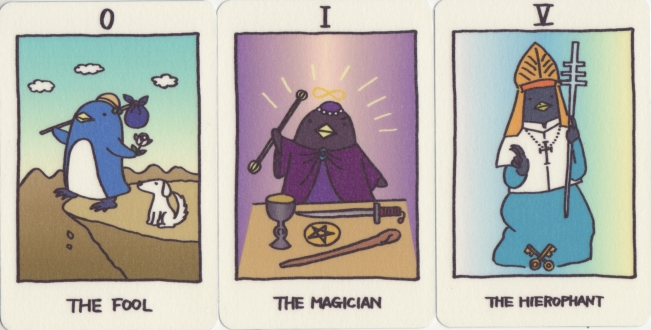
8 July 2011
A few years ago Bethalynne Bajema produced the delightful Sepia Stains tarot. She has now issued another wonderfully stylish deck, the Black Ibis Tarot. The designs begin with posed photographs which are modified in Photoshop or some similar computer graphics program building up a complex of textured layers. Each has a clear foreground figure set against a distant backdrop, often of gothic buildings. The backgrounds are desaturated and toned towards Bethalynne's preferred sepia. The figures are given a further gothic feel through the style of their headpieces. These are well worth collecting along with the Sepia Stains, and you can buy copies through her website. You can also see some of her remarkable artwork on www.ettadiem.com
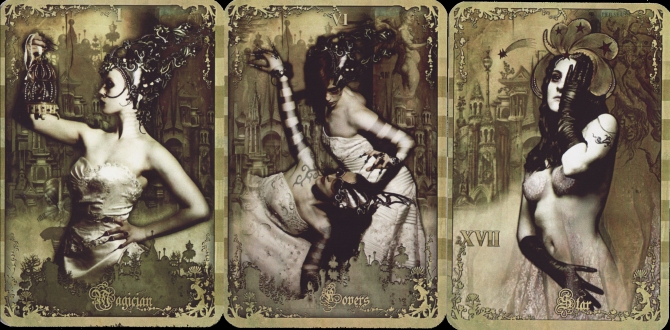
6 July 2011
The Tarot Medytacyjny - Poznaj Siebie (Get to know yourself Tarot) is a new Polish deck from Dariusz Cecuda, the creator of the Soul Mandala Tarot. This is a modified photographic tarot incorporating posed photographs, collaged images and the familiar layering of textures. It is a full 78 card deck with primarily unemblematic pip cards.
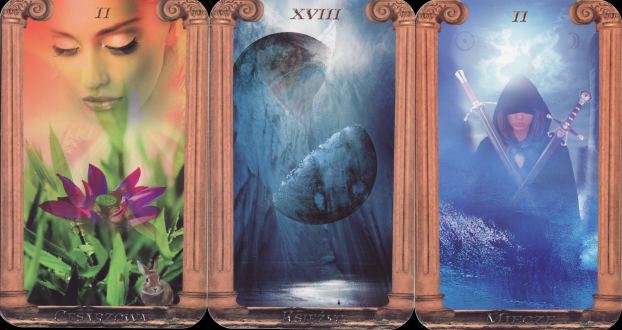
5 July 2011
I recently found a Czech tarot that I had not previously hear of. It is the Poselství Tarotu, published in Prague in 2004 and 2009, and is a full deck of 78 cards with emblematic pips. The designs are by Dagmar Lukuvková. The deck comes in a box with a substantial book by Renata Herber. I found the Tower card expecially engaging.
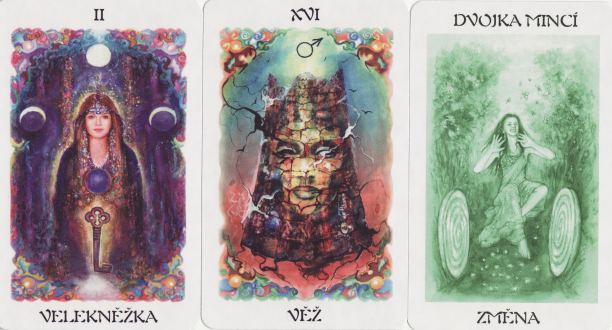
27 June 2011
Yet another cat themed tarot has appeared. This one is from Maria van Bruggen in Belgium. As with most cat tarots, this one is full of humour. You can see Maria's wide range of cat themed artwork on www.zazzle.com/cat_alogue
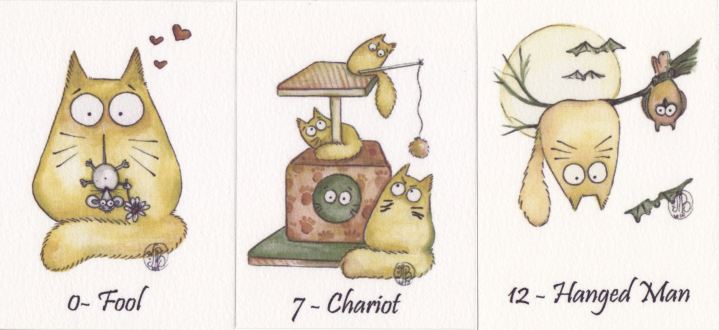
14 June 2011
The Hawaiian Aloha Tarot was, strangely, published in Japan this year, with a substantial descriptive book in Japanese. It is a full deck of 78 large cards. The artwork is in pen line coloured with watercolour. The artist is only identified by the name "Honey", though the artwork is signed "Ai". Some of the designs are original takes on the imagery. The minors are non standard. In the book each card is given a Hawaiian name - thus "Makani" wind, "Lomilomi" massage, "Kapa" Hawaiian cloth, "Humuhumunukunukuapua'a" the reef triggerfish (official fish of Hawaii), and so on. The deck comes in a strong cardboard box.
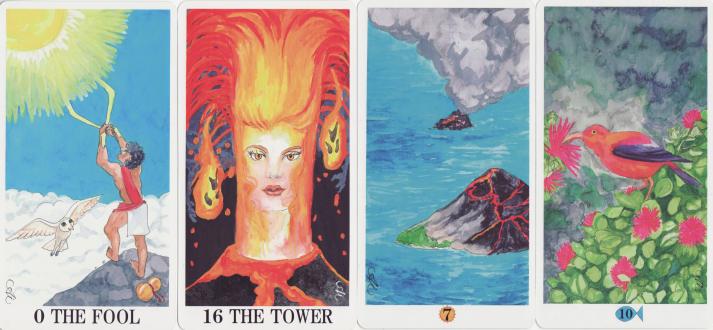
12 June 2011
I already have two tarots included as gifts in editions of the Spanish magazine Super Pop, so it was rather delightful to have the opportunity to buy another. This has some rather good quality artwork by A. Cortijos.
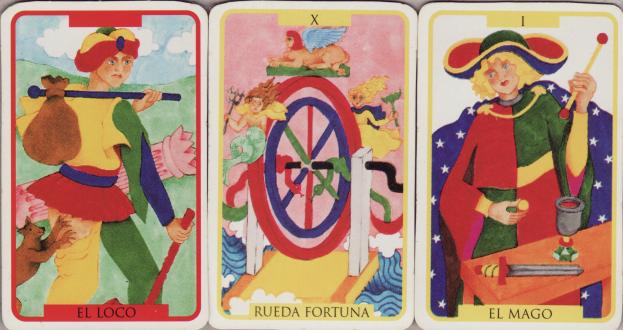
11 June 2011
I recently received a copy of a new version of the classic mid-18th century Nicolas Conver printing of the tarot of Marseilles. This has been skillfully redrawn and recoloured by Tadahiro Onuma of the ISIS organisation in Japan. The artwork adds modelling to the flat forms of the original, bringing the Conver up to date and yet preserving the style and forms of the original. It is a sensitive reworking, deeply respectful of the Tarot of Marseilles tradition. It should soon be available outside Japan.
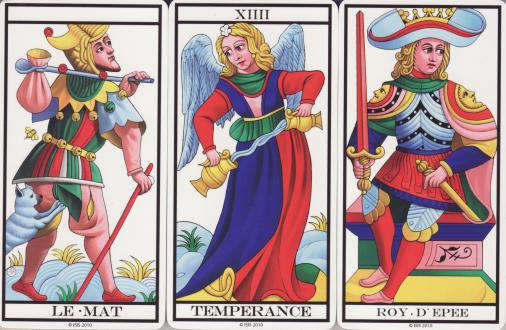
6 June 2011
The Tarot Galego or Galician tarot was created by Manuel Aneiros and Xosé Vizoso (who created the artwork). Galicia is a province in Northwestern Spain, and it has its own distinctive language, related to Portuguese. The Tarot Galego was published at A Coruña in 1992. The deck has 52 cards, the first 22 being the familiar major arcana, while 23-52 are a non-standard minor arcana not arranged in suits, but individually titled. The names are in Galician. This is a really interesting find. The figures are depicted in "peasant" style.
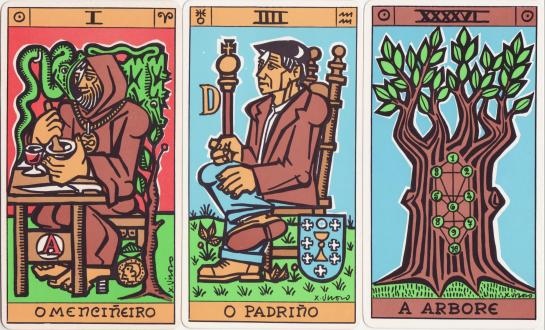
3 June 2011
A week ago I ordered a copy of the Tarocchi Politici from their distributor in Italy. It arrived in a massive box full of bulky packaging material. I searched for ages amongst the chopped up paper and eventually found a small box with the cards. This tarot was created in 2008 by F.G. Allenby as a series of pen drawings coloured with watercolours. Each card is a caricature of some Italian politician who is satirically placed in the tarot archetype. I am afraid I dont have sufficient knowledge of Italian politics in 2008, but I expect most Italians would immediately recognise the particular politician and the point of the satire. There are a number of satirical Italian tarots pointed at political and social aspects.
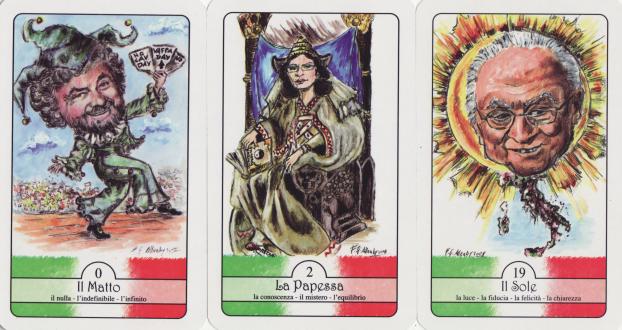
2 June 2011
I do have quite an extensive collection of cat themed tarots. I have now added to this perhaps the earliest cat tarot, produced in Japan in 1983. This is the Tarot Card for Lovers issued as a deck and book in the familiar slip case in which early Japanese tarots were published. The colours are very bright and the artwork is in pen line with coloured pencil. The images look so familiar to me that I suspect the artwork may have been reused or copied in some later tarot, but I just cannot recall which one.
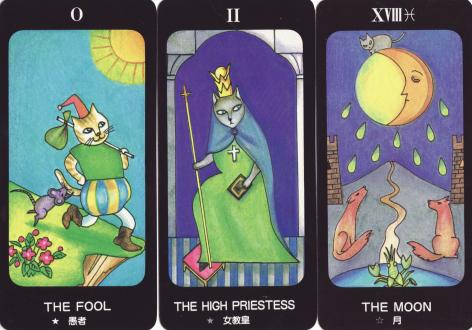
1 June 2011
There are a number of tarots inspired by H.P. Lovecraft's invented magical book written by the "Mad Arab" Abdul Alhazred. I just obtained the Tarot Necronómico issued with a book by J. Fernando Pérez-Vigo at Madrid in 1992.
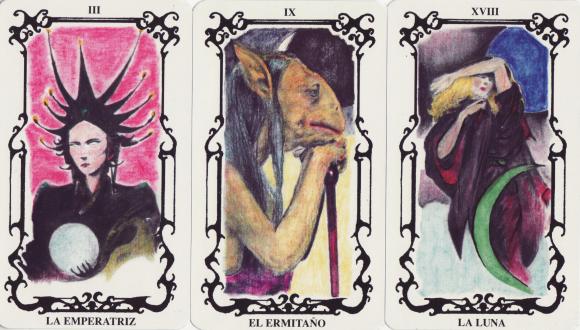
31 May 2011
I still have a pile of tarots to bring to your attention through this weblog, but my time is limited by other commitements. I recently received the Tarocchi Futurismo created by Osvaldo Menegazzi. In this he celebrates the art movement of the early decades of the 20th Century, Italian Futurism, created by Filippo Tommaso Marinetti. A number of artists were linked to this movement. Menegazzi draws on the paintings and graphics of Marinetti and Giacomo Balla with their bold and jarring shapes mixed with fragmented typography.
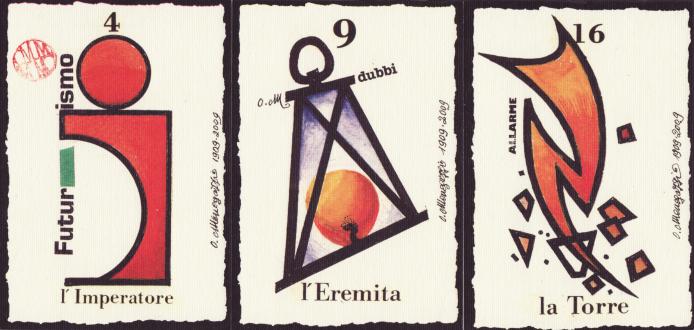
Here are two examples of Futurism
I have over forty Russian tarots so I was very pleased to receive another through the courtesy of a fellow tarot enthusiast in Moscow. This is the Tarot of the Twelve Rays by Isset Kotelnikova and Max Kim in 2010. It is a full 78 card deck with standard pip cards without emblems, and quite conventional Court cards. The artwork for the Majors is rather well done, with some interesting colour and light effects, and appear to be digitally realised rather than painted with pigments. The figures seem rather cold and remote. Isset Kotelnikova runs a tarot school, the Gates of Isis, based on the system of Papus. You can see more cards on their web site taro.isset.ru
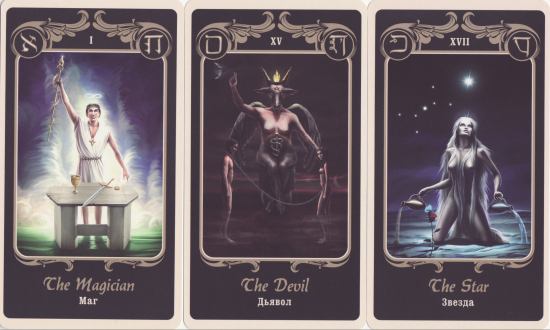
18 May 2011
I recently received some tarots issued with the Femme Actuelle magazine some years ago. One of these, entitled Le Tarot du Cosmos, turns out to be a small version of Le Tarot de l'Ange Liberté which was a series of remarkable paintings by Myrrha based on poems of Victor Hugo. Seeing these again I wanted to search out some more information about the artist, and I found a web page in French which gives quite a clear picture of Myrrha. These artworks are rather impressive pieces and I noticed that three of them quote symbolically from the 16th century alchemical manuscript Splendor Solis, which shows, as part of its sequence of images, a series of symbolic events taking place in flasks. Myrrha reworks these into card 12, 13 and 15.
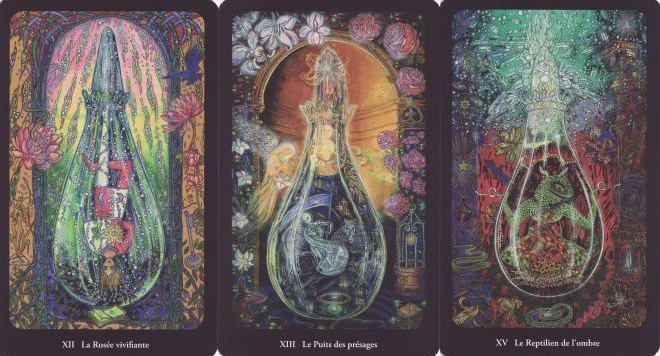
17 May 2011
I have recently bought a considerable number of tarots some of which I will post up here in the coming days. I was very gladdened to be able to obtain a tarot from the Canary Islands. This is the Tarot del Universo issued with a book by José María Doria apparently in 1989 at Santa Cruz de Tenerife. The artwork by Rafael Trelles is surreal with quite astounding and original images.
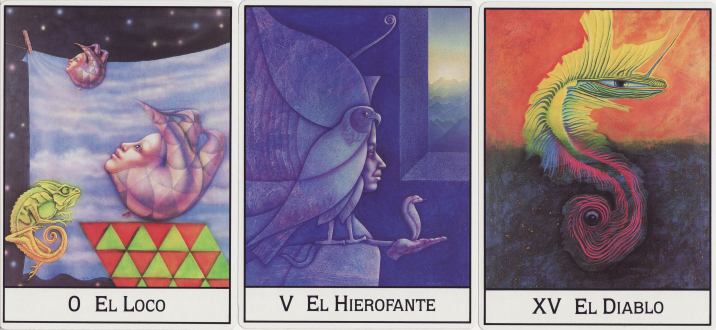
11 May 2011
I finally got round to buying a copy of the Wild Wood Tarot by Mark Ryan and John Matthews. It had been out for a few months but a mass market tarot such as this will be around for some years, so I had not rushed to buy it. I am so glad I did. The artwork by Will Worthington is marvellous. He has already produced fine artwork for other tarots and sets of oracle cards, but in this deck he truly surpasses all his previous work. Each design is meticulously draw in fine pen line then coloured with water based colour. He applies many layers of different, though related, colours to build up a texture, depth of tone and saturation to key areas of the images. His rendering of birds and animals is a delight. Compared with some other mass market decks whose artwork is flat and dead, here each image is alive and its visual space full of life. Just look at his depiction of water below the Kingfisher. The original paintings would be well worth collecting if ever they came onto the market.
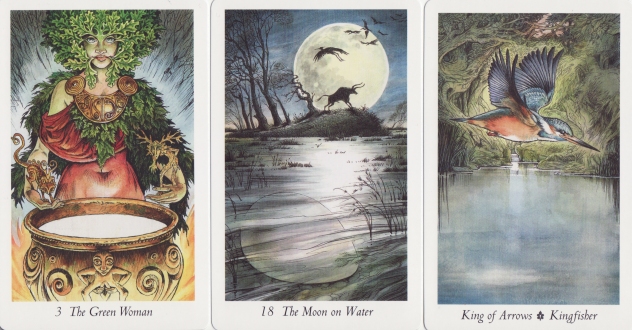
10 May 2011
I recently bought a Spanish tarot entitled Tharhots 1313. This is a conventional 22 card tarot which is provided with an extra set of 22 cards with short text cues to the meanings of the cards. The artwork is naive, and it appears to be by an untrained artist rather than someone attempting to mimic that style. They are simple line drawings in pen which have been coloured, with no modelling, using coloured pencil.
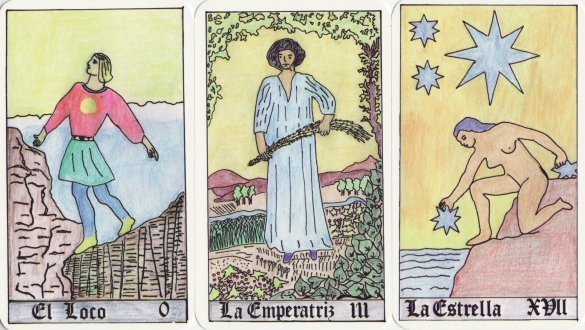
9 May 2011
Beth Seilonen's latest tarot is called Awareness. She tells me it arose out of a feeling she had recently of being caught up in the fog of life. In this tarot she explores a new style. Many of her tarots are clearly delineated and speak immediately to us. For this deck the tarot forms are more submerged in layers of textured watercolour, like a film or fog. A very interesting approach. It is issued as a very small edition of only 12. Buy one soon.
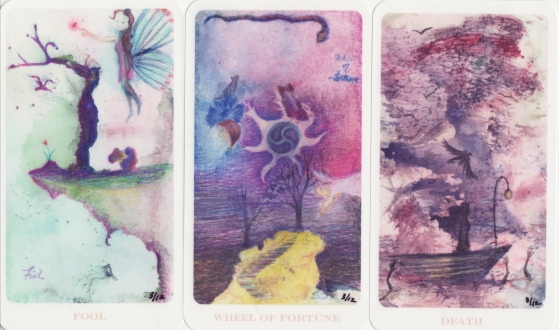
4 May 2011
It was foxes a few days ago, now its rabbits and hopefully in a few weeks it will be even more penguins. The Canadian artist illustrator Jessica Clayman has now produced the Twilight Rabbit Tarot, which she sells through Etsy and on her website www.twilightrabbit.com, is a full 78 card deck, with emblematic pips, which do not follow the Pamela Colman Smith images. Here the four suits are rabbit oriented, Clover, Passions, Carrots and Stone. The cards have a stylised frame and the artwork is digitally created with the outlines perhaps drawn first in pen.
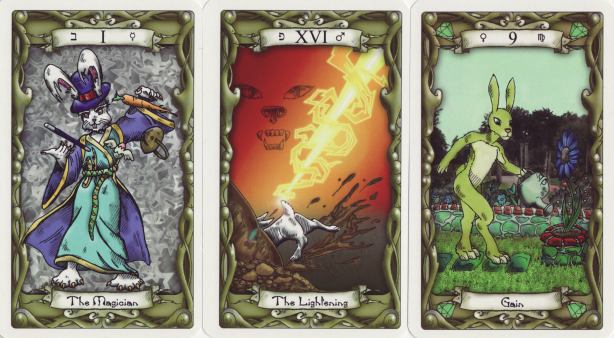
3 May 2011
Djinn is series of French graphic novels written by Jean Dufaux and illustrated by the Spanish artist Ana Miralles. The 10th volume in the Djinn series, entitled Le Pavillon des Plaisirs includes a set of tarot majors by Ana Miralles. Each card reflects one of the characters in the novel.
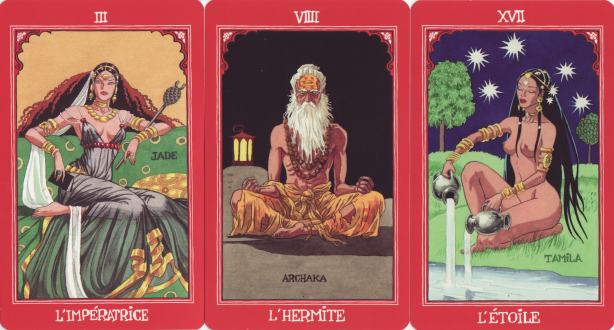
30 April 2011
Bafun Books in Taiwan have issued this year the Love Tarot as cut out cards in a book for the childrens market written by Stephen Lee. The artwork is by a woman artist who uses the nickname Pinpei. She uses coloured pencil on a rough textured paper which gives a grainy effect to large areas of colour.
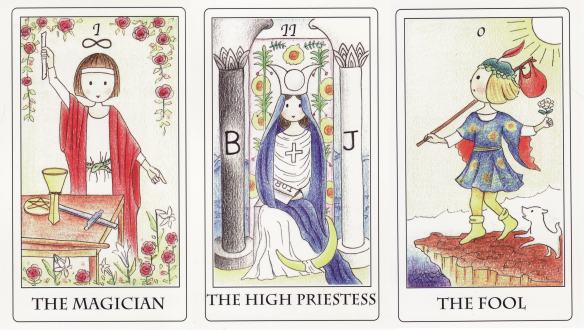
29 April 2011
I recently obtained a copy of the Fox Tarot by Mary Hoy, sold through her Cageddreams.com. Mary Hoy works primarily in the digital medium. This is a full 78 card deck, professionally printed and supplied in a transparent plastic box. The minors do not copy the Pamela Colman Smith imagery. Mary Hoy produces some wonderfully cute depictions. Strength is particularly amusing, with a fox stroking a rabbit (in place of the usual lion) entirely inverting reality.
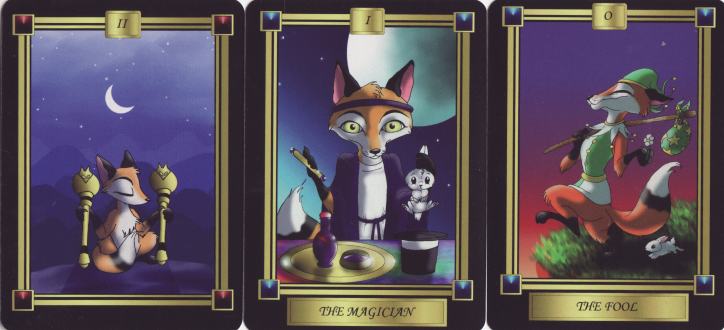
28 April 2011
Ryuji Kagami is a well known author of books on astrology and fortune telling. He has been involved in the design of a number of tarot decks. I recently bought a copy of a magazine from 2004 published by Shogakuka, which contains a cut out gift tarot entitled One Oracle or the Good Luck Tarot. The artwork though simple presents a stylish set of designs, somewhat similar to that os the Soulful Tarot, 2005 which he designed in collaboration with Yoshitaka Yasumatsu. This One Oracle tarot was a little bit more expensive as it is by a well known tarot designer and was intact inside a seven year old magazine.
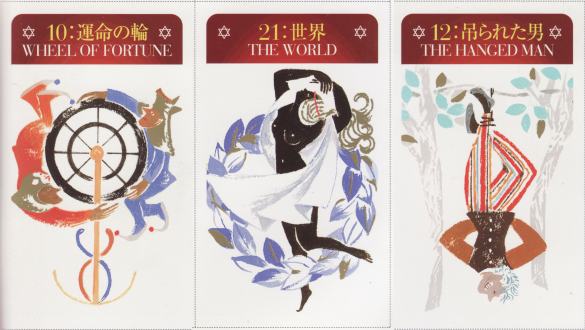
26 April 2011
The Mirror Tarot by Himoko Rose is included in the Misty magazine of February 2011. It is a push out deck which comes in a plastic bag inserted into the magazine. Now I wonder how many of these will go missing ! The designs are rather fine.
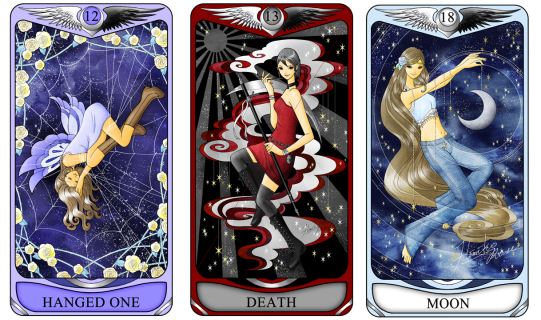
25 April 2011
The Spider Tarot by Lua is included in Arte Miss Fortune Telling magazine issued in 2011.
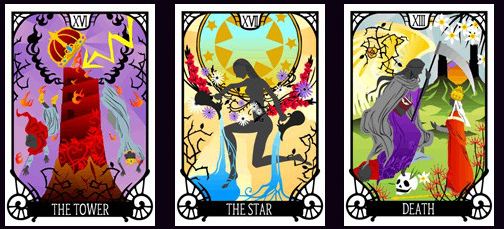
24 April 2011
I am often made aware that many of my fellow tarot collectors think me rather silly to collect the given away or gift tarots included as promotions in some Japanese magazines. I suppose some must look down on these productions and see them as insignificant. Well, I take a contrary view. Some of the artwork is of very high quality. As far as collectability is concerned, I would suggest that, if in a few years time, you want to acquire one of these tarots you will have great difficulties in sourcing a copy. You might, possibly, eventually find a copy of the magazine, but will the tarot deck still be included? They are, after all, meant to be detatched and used as cards. Recently I bought four such magazines which include tarots.

Here are examples of the card designs by Moira Yuuki from the Chakra Magazine No.4., 2011.
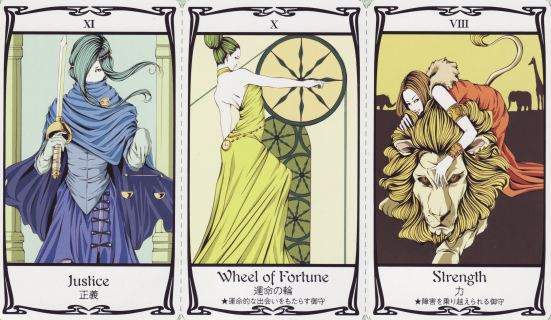
21 April 2011
The Kitchen Tarot is a rather amusing, inexpensive and well-produced 22 card tarot deck created by Susan Shie, who works in collage, painting and digital art. The originals for these card designs were very large, being from 3 to 8 feet in height. The cards have names reflecting kitchen imagery, though the designs incorporate the original tarot arcana. Thus, The Magician is named "Salt and Pepper", The Lovers "Cream and Sugar" and The World is "Potluck. The imagery on the cards is very detailed so one continually finds new references and subtle humour. The small book that is included in the strong card box was written by Dennis Fairchild, the author of many books on the subject of divination.
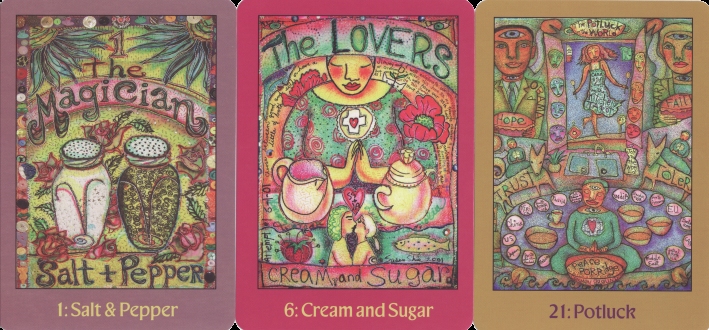
13 April 2011
I have just obtained a rather obscure tarot deck, the Fetish Tarot. This was produced in Berlin, though I am still uncertain as to the date it was created. It is a full 78 card deck of posed photographs by the art photographer Reinhard Haberberger. A small group of models are posed in various fetish situations to illustrate aspects of the tarot imagery. This deck was produced for Realm of Steel, a company in Germany selling handmade steel cuffs. The photographs are rather dark in tone and have been manipulated through Photoshop or some other software to add a top layer with a texture to make them look like old abraded photographs. The majors are in the usual tarot of Marseilles fashion while the suits are various fetish devices, cuffs, cords, whips and scalpels.
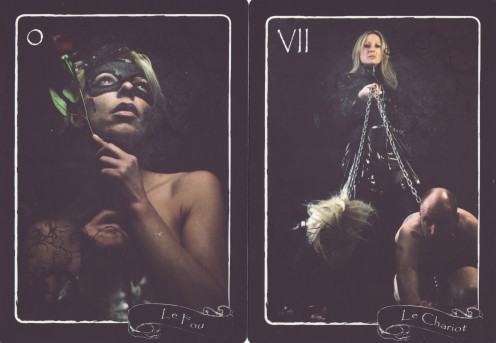
12 April 2011
Durarara is a Japanese light novel series written by Ryohgo Narita, which was adaptated into an anime which began airing in Japan in 2010. The series is about a dullahan working as an underworld courier in Ikebukuro, Japan, an internet-based anonymous gang called Dollars, and the chaos that unfolds around the most dangerous people in Ikebukuro. The heroine of the series, also known as "The Black Biker" or "The Headless Rider", is a dullahan from Ireland who came to Japan looking for her stolen head. Presumably she is the figure seen on the Death card. A game based on the series for the PlayStation Portable was also released in 2010. A Taiwanese fan of Durarara has now self-published a tarot based on the characters from this series. Each card, strangely, has "keep out" police style tape across the images. I have no ideas why this is so, but it may be this is referenced in the manga or anime. It comes in a rather fine quality black velvet pouch. I got my copy from the dealer Baby Dream, who sells these on Ebay at the moment.
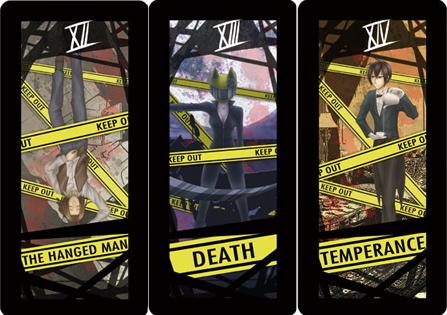
10 April 2011
Yesterday the Tarot de los Antiguos (The Ancient Tarot) arrrived in the post. It was created by the Spanish artist Miguel Angel Lopez Melgarajo and published in 2010 by one of the leading esoteric publishers in Spain, based in Barcelona. Born in 1960, Melgarajo had a series of spiritual experiences between 1984-87 which coloured and influenced his artwork. For his Tarot de los Antiguos he took the standard 22 major arcana and added a further 14 to make a grand total of 36 cards. The extra cards are a series of abstract ideas - The Mask, Love, the Cross of Another, Conscience, Power, Freedom, Mystical Revolution, Transcendence, Imagination, Will, Faith, Silence, The Form, The End - The Beginning. Melgarajo is known for his life drawing, so many of the figures in these cards are wonderful nudes.
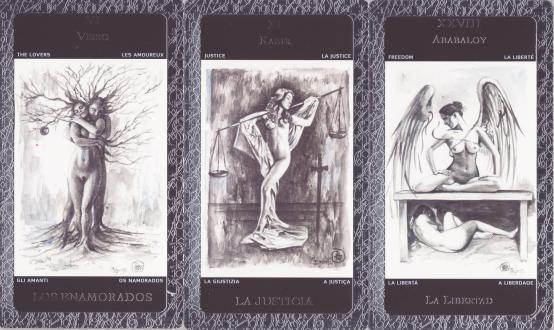
8 April 2011
Lynyrd Narciso is a prolific creator of tarot decks based in the Philippines. He is always exploring new styles, new themes and ways of expressing tarot imagery. I have twelve of his decks including the recently issued Tarot of the Curious East. He has produced this in an edition limited to 50 copies. For this deck he had adopted the unfamiliar landscape format, which allows him to explore the imagery in a new way. One day his limited edition decks will be very collectable. This deck appears only to be available through the Tarot Garden store.
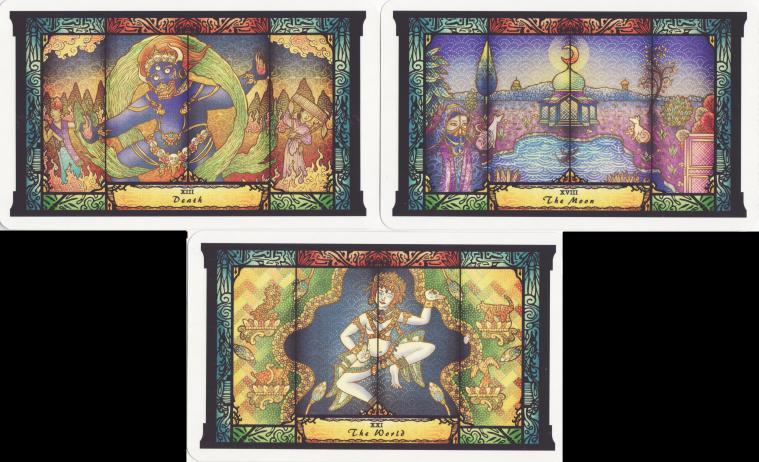
7 April 2011
There are many Rider-Waite clones. This rather fine version by Osel, a full 78 card deck, is included as cut out cards in a book issued by Easy Quick publishers of Taiwan in 2011.
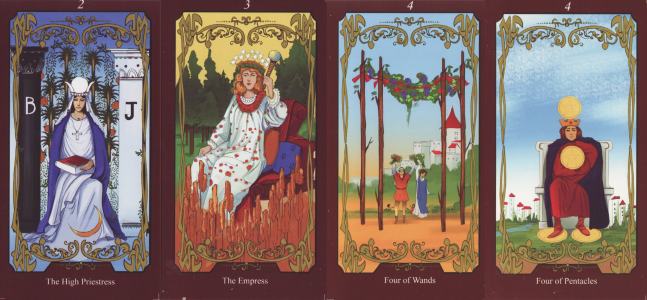
6 April 2011
A few days ago I bought a set of tarot designs printed for a book cover Im Haus der Gefiederten Schlange ("In the House of the Feathered Snake") by Frederick Hetman, published in 1990. The artwork is by Tilman Michalski. I was much impressed by the image for the Star which shows a polyhedron called a stellated icosidodecahedron, thus playing with the word as well as the image. I quickly realised that some of the artwork was very similar to that in Madru das Baumtarot published as a set of cards in 2000. This was also by Hetman and Michalski. Not all the images correspond but there is some obvious re-use of elements of the composition in many cards.
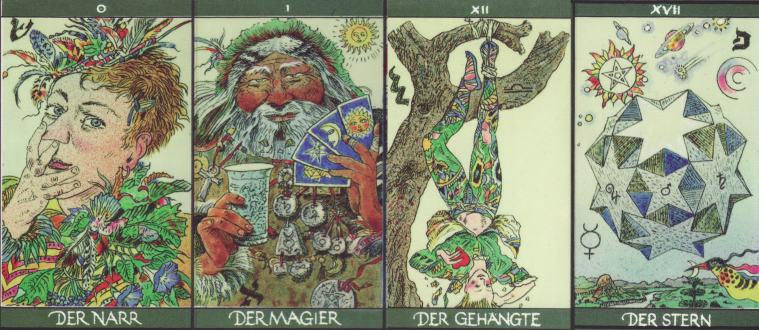
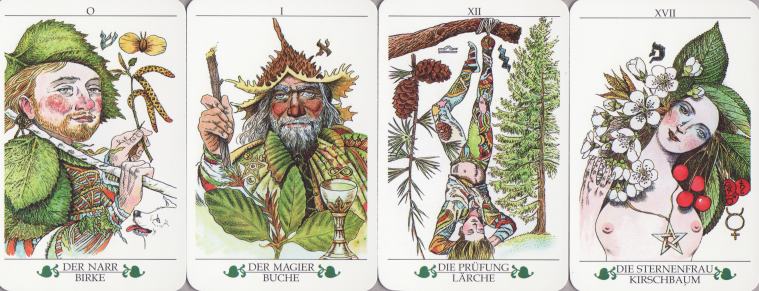
5 April 2011
I have a small number of Mexican tarots. This has now increased to eight items with my recent acquisition of the Tarot Santero, published with a book by Ediciones Fenix in 2010. This is obviously a deck whose symbolism incorporates ideas and imagery from Santeria, the Carribean religion derived from West Africa magical traditions. There are now a number such decks going under the name of Santeria, Voudoo, Lukumi, Orisha among others. This deck of 24 cards connects closely to the conventional tarot. For example Oshun is the High Priestess, Obatala is the Emperor and so on.
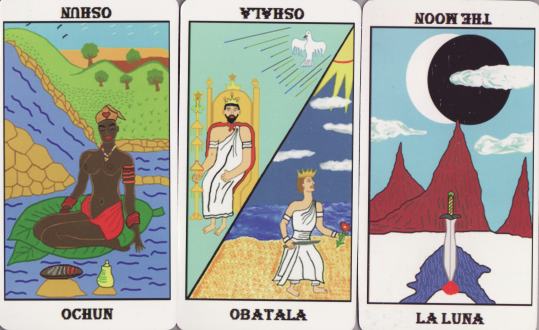
4 April 2011
I have just updated my tarot collection listing. I currently have 2168 tarots, with more in the post! I have bought some really interesting items recently, but as I have been producing some books, I have not had time to put some entries up here on the weblog. I hope to find time to remedy this in the next few days.
22 March 2011
I have been looking for a particular Polish tarot for some years. Though not particularly rare, I found it difficult to source a copy. Two turned up on Ebay auctions a few years ago but I was never successful at the bidding. This is the Tarot Karty Ktore Wroza by Jan Witold Suliga. The designs are printed in a stapled booklet and it seems intended that one manually cut them out as cards. A month or so ago a fellow tarot collector based in Poland found me a copy and has very kindly presented it to me as a gift. The card designs are by Jan Opalinski an artist known for his strength in drawing. The tarot mind behind the designs was Jan Witold Suliga, a key figure in modern Polish tarot.
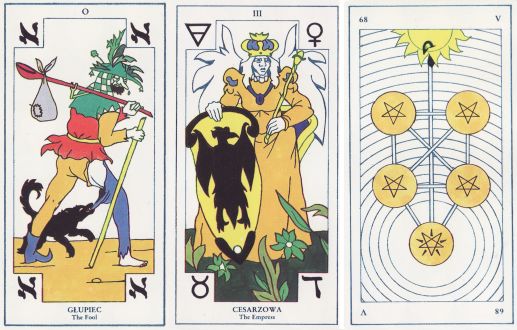
21 March 2011
Sad Story is a rather fine Korean tarot. The artwork is by Kwon Shina and apparently first appeared in a comic book in 2000. It seems the designs were issued as a tarot deck in 2007. The cards have no titles or numbers but are immediately recognisable. The little white booklet is entirely in Korean so I am unable to find out much about the deck. Korean tarots are much undercollected and ignored, though there are many wonderful items issued there. They don't last long in print, so one must collect them as soon as they come available.
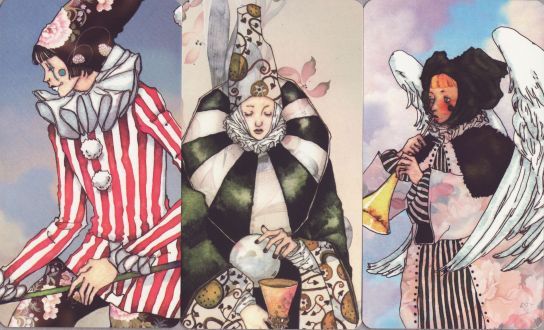
17 March 2011
There are a number of tarots issued in Thailand. I try to buy anything that comes available, so I recently obtained the Pai Thai Payakorn Tarot created by Narudol Wijitranon and published Samnakpimbookdimon in 2010. This is a Rider Waite clone localised with Thai imagery. It is created with fine pen lines coloured with pencil. The colours are deeply saturated creating vibrant imagery. It is available at the moment through a store on Ebay
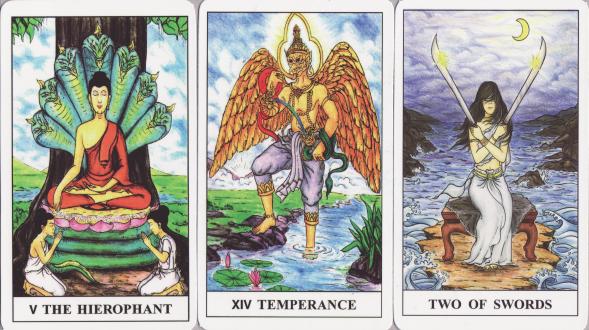
2 March 2011
I have been very busy over the last month or so with publishing books. I have been able to produce an art book of some of my coloured alchemical engravings. You can see this on my art weblog. This is not to say that my tarot collecting has ceased, indeed, I have continued to add some interesting items and have a batch of tarots on its way to me from Taiwan at the moment. So watch this space. Today, I will show the Hive Tarot which a colleague in Los Angeles managed to obtain for me. This was based on a collaborative art project by the Hive Gallery. These are big cards created to show the artwork and not intended necessarily for use as a working tarot deck. It was produced as a small edition of 100 copies, so it will be well worth collecting. The artwork is creative and playful, and some images are quite astounding.
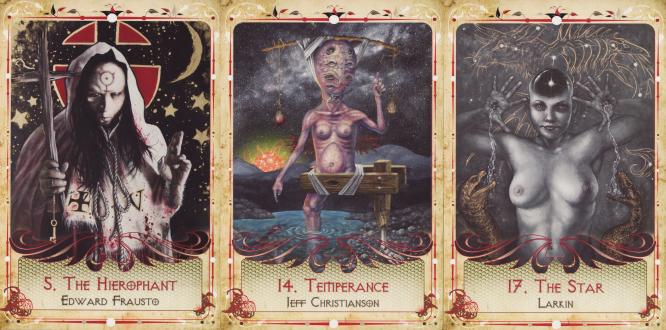
9 February 2011
Yesterday I received an amazing art tarot in the form of 22 etchings. This was created by the Colombian artist Catalina Cabrera in 2000. It is in the form of an edition of 75 numbered in normal numbers and five special issues with Roman numerals. There are still a few copies left of this edition for sale. The distributor is the art dealer Juan Carlos Tovar jct_@hotmail.com. You can see the complete set of images on a website here. It comes in a strong solid box with each engraving being interleaved with tissue. This is the only tarot I have from Colombia. It will be an essential addition to any collection of South Amercian tarots.
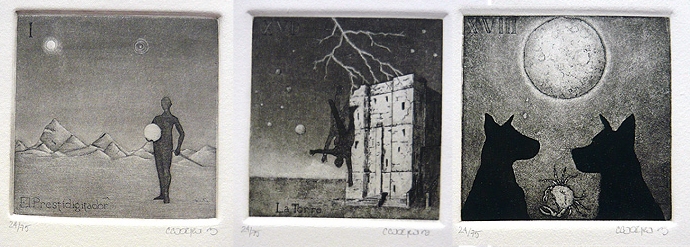
1 February 2011
There is now only one copy left of the Diary of a Broken Soul. First come first served !
27 January 2011
Yesterday I received a very interesting art tarot that I bought from an artist in Italy. There were not his work but those of Najib bin Omar, a Yemeni artist who worked during the 1990's in Italy. As I did not have any tarots that I knew to be created by a Moslem, I was very interesting in buying this. It is in the form of etchings (which were actually created by Alfredo di Prinzio in 1977) which Najib bin Omar hand coloured in 1997. A set of only five copies were made for Art Box 49 and these were sold as individual sheets rather than as complete sets. When I saw these for sale again as individual items, I decided to buy the complete set in order to keep it together as a creation. The colouring is very well executed, and though creative, retains a respect for and does not dominate over the original. These are not cards but a set of 22 engravings coloured by hand. These were expensive, but I felt it right to buy these to preserve the orginal. The arabic at the bottom of each plate merely records Najib bin Omar as colouring the images and gives the year 1418 in the Year of the Prophet that these were made (our 1997).
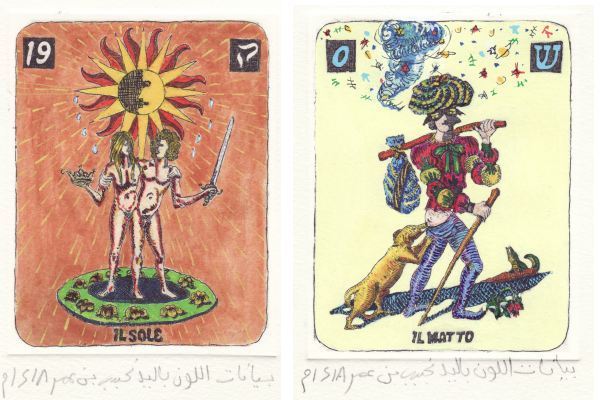
23 January 2011
Another Hungarian Tarot I recently obtained is the Bharat/Nagy Tarot, a majors only deck created by Joshi Bharat and Laszlo Nagy in 1992. They adopt a style based on the Rider Waite, and mimic, using a number of graphic techniques, its line drawn woodcut style and the flat areas of colour tones used in the screen printing. In many places they depart from the standard imagery, for example the Tower and the Moon, while cards such as the Magician adhere closely to the Pamela Colman Smith designs. The cards are covered with a reticulated or textured lamination.
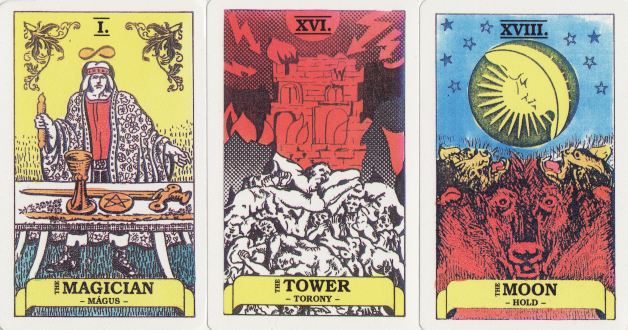
22 January 2011
I have managed to acquire a few more Hungarians tarots. Among these is the Erzsebet Tarot created in 1998 by Dr. Hollo Erzsebet. The designs are in fine different coloured lines, probably using coloured pencil. This is a rather attractive effect suited to the ethereal, almost fairy like forms the artist depicts. Areas of the drawings have been coloured and modelled, probably in coloured pencil, but possibly watercolour - the cards are too small to be definitive. The overall effect is quite delightful. The cards are quite rare outside Hungary. Two versions of this were apparently issued. I have the one without the line border. This gives the cards a clean sharp quality. The imagery clearly follows the tarot archetypes, though some dispense with the obvious elements and are more minimalist. This does not appear to be recorded in Kaplan's volumes.

21 January 2011
I just discovered a wonderful tarot, O Tarot do Amor, issued with a book in Sao Paulo, Brazil, in 1995. The designs by Vinicius Pradella are quite amazing, being both creative and delightfully painted. The book is written by Eduardo Molinero. Pradella is a surrealist artist mostly working in oils with a considerable reputation. The cards are large allowing the details to be seen. You can see some of his other work here.
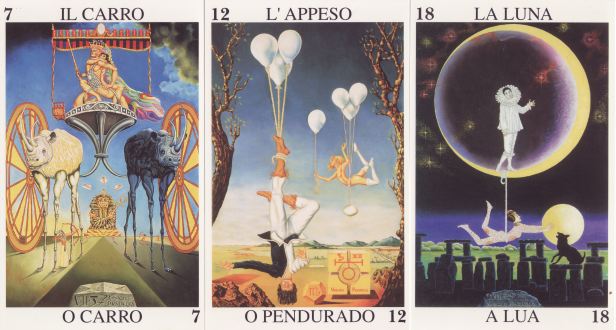
17 January 2011
The Plumoi Tarot is a cut out deck printed on thick card bound into the January, 2011 issue of Koiunreki magazine. The foreground figures in thick black line really pop out from the coloured backgrounds. You can see the deck on the animated page www.plumoi.jp/fc/omiyage/tarot
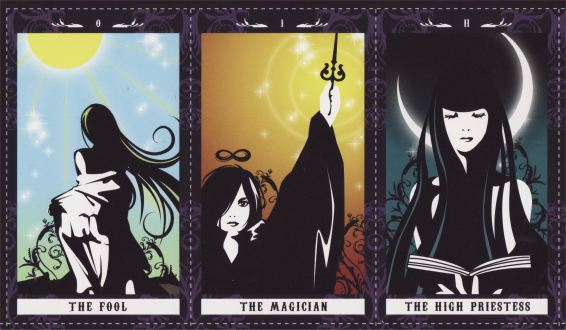
16 January 2011
I missed out on the publication of Emily Carding's Tarot of the Black Mountain which was included as tear out illustrations for a book published in Croatia in 2009 of short stories on a tarot theme by Lena Ruth Stefanovic. Luckily, a dealer in Los Angeles managed to find a set of the cards signed by Emily Carding and I was able to buy these. It is a majors-only deck based on the landscape, people, myths, and history of Montenegro.
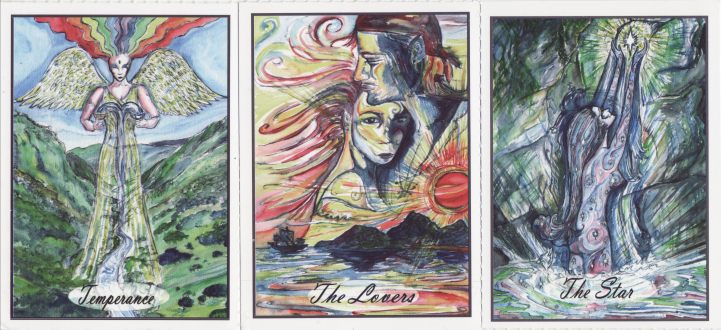
15 January 2011
The Jump Tarot appears to be a self published doujinshi tarot celebrating the artwork of the Japanese Shonen Jump manga magazine. This deck seems to issue from Taiwan. I must try and find out some more information about this deck. Like many other small edition self published tarots there seems to be no information about it readily available on the Internet. It is a rather fine production, well printed and packaged in a flip top box.
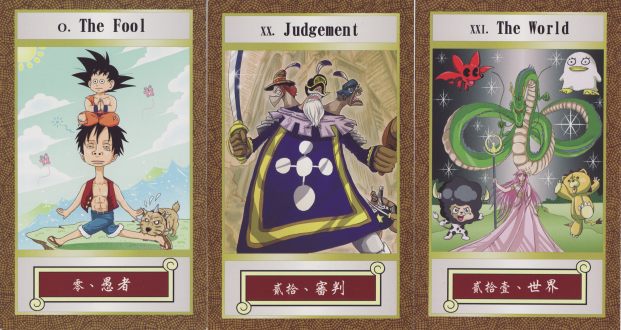
11 January 2011
The Pictarot was issued in Germany in late 2010. The Minors are a conventional playing card deck with an additional court card for each suit. The Majors were artwork created by different graphic artists specialising in cartoon characters, though the style coheres, rather than being merely a muddle of 22 individual contributions. The LWB contains a rather unlikely story about the origins of this deck. It is amusing how people like to mythologise the simple matter of creating or choosing artwork !
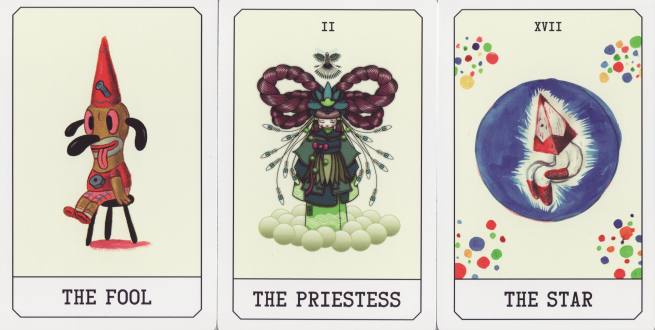
10 January 2011
I recently bought a copy of a French tarot from 1980, the Astrocards of Frederic Maisonblanche. It does not seem to be mentioned in Kaplan. The box contains two sets of cards, a tarot of Marseilles style deck with two extra cards, and a set of 12 astrological cards using images of the zodiac, which are larger than the tarot set. The tarot deck, at first glance appears to be a conventional tarot of Marseilles, but one quickly realises that the expressions of the faces are designed to subtly amuse.
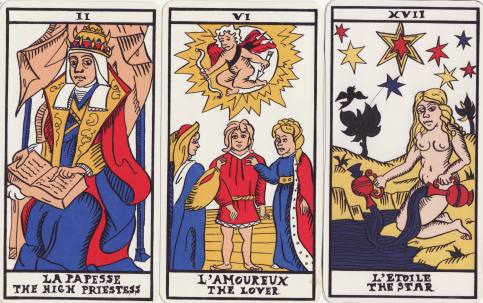
Here are two of the astrological cards which follow the style of the tarot of Marseilles.
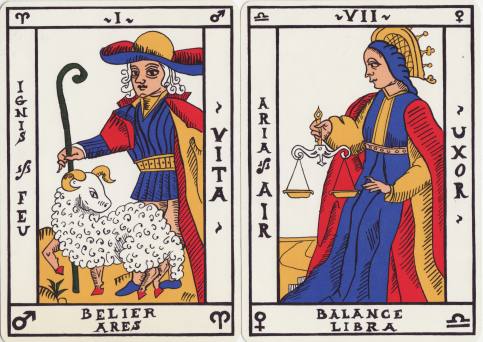
7 January 2011
Another of my Art Tarot series is close to selling out its edition. There are today only five copies left to sell of the Diary of a Broken Soul. Anyone wishing a copy should buy one now. I never reprint decks. Once it is sold out there will be no more copies to sell. Most collectors nowadays hold on to their collection, rather than sell items, so there will be few copies of this deck available on the secondhand market for years to come.
3 January 2011
Square Enix, the Japanese computer games publisher, has now issued a rather delightfully drawn tarot, Tactics Ogre Battle. This is probably a promotional deck for their remake of the 1995 classic Tactics Ogre: Let Us Cling Together in development for the PlayStation Portable.
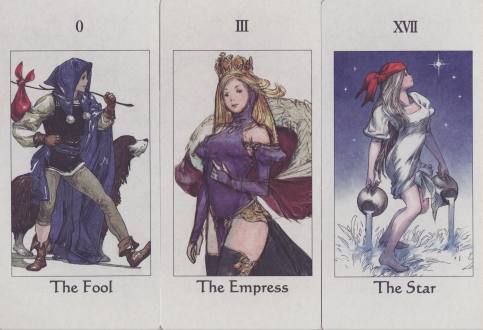
30 December 2010
I have a number of alchemical tarots. Probably close to twenty items. A month or so ago I was delighted to be able to buy a copy of the alchemical tarot designed by my friend Rafal Prinke back in the early 1980's. I have been hoping to get a copy of this rather rare item for some years. A few days ago a box of tarots from Londa Marks arrived from the USA. Among these is her Alchemist Tarot. The artwork is in her unique style. The foreground figures are paintings of figures with her stylised characteristics - elongated bodies, triangular faces, amazing big hair, or entirely bald, gothic style of dress. These are set against a complex background of collaged photographs and images that have been digitally modified. The whole effect integrates together to give strong, powerful and engaging images.
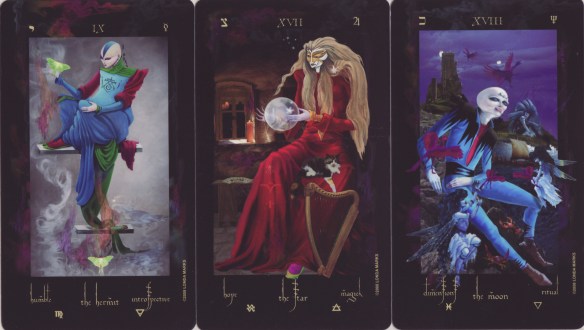
28 December 2010
I recently bought, through the good offices of the Far Eastern tarot dealer Baby Dream, a rather fine promotional tarot issued by a comic books company. This is the KK-Shinema Tarot. The artwork in manga style is a showcase for the various artists who work for the company.
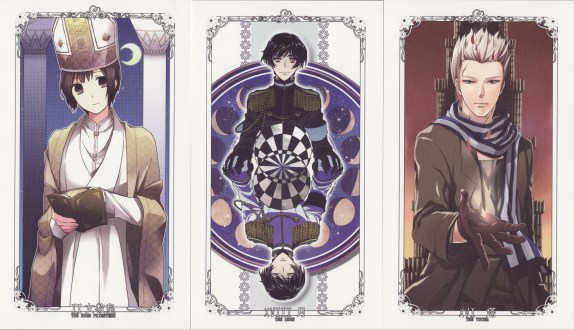
27 December 2010
I found this rather fine image of a fool in a painting The Parable of the Prodigal Son by the strangely named Master of the Female Half-Lengths, active around 1490-1540. This "Master" is the name given by art historians to a yet to be identified artist who specialised in half-length female figures. This painting is thus uncharacteristic of him and I am not sure how it became assigned to him. In any case, we have a rather fine image of a fool.
24 December 2010
The Secret Tarot by Benny published this year in Hong Kong, comes in a rather fine solid box together with a book. The artwork, by Mr. Hung, is entirely in Western art style. Benny Wong is a psychic who owns a shop in Hong Kong where among other things he gives tarot readings.
23 December 2010
When you buy a tarot from the Philippine artist Lynyrd Narciso, you get a little tarot thrown in for free. With his recent Tarot Rikit he excelled himself by enclosing two free tarots. These are in miniature format - one in colour Tarot of PSY Chicks and the other in black and white. These are also in limited editions. It will be best to buy copies quickly as there won't be many left shortly.
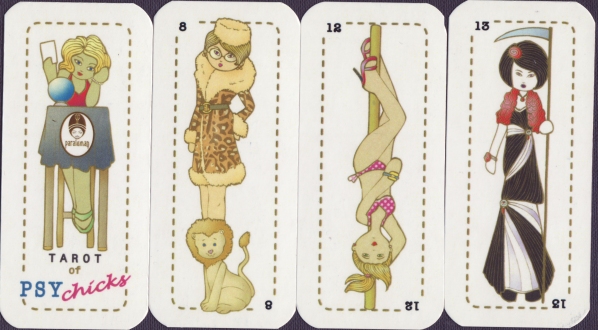
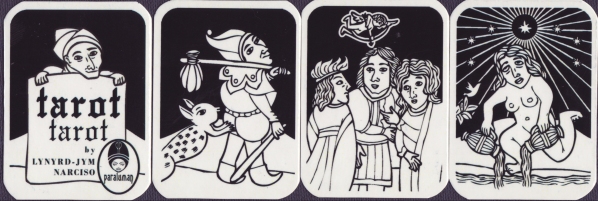
22 December 2010
I have now uploaded the remaining lessons of my Study Course on the Artwork of Modern Tarot to my website. Sadly people did not support my approach to tarot as artwork. I had hoped to get such sufficient response that I could have continued to produce further courses and eventually completely cover the phenomenon of the artwork of tarot in our age, but I sold so few of the first study course that I cannot justify spending the hundreds of hours necessary to develop further lessons. Probably people will catch up with me in a few years time, and eventually come to see the value of my approach, but it will by then be too late. My course just did not engage and enthuse more than a handful of fellow collectors who share my way of looking at tarot as art. Hundreds of web sites sell pointless waffle and regurgitated courses on tarot reading, as that seems to be what people want. If people don't respond to my work then there is nothing I can do. Few people seem to value tarot as art. I am lucky to have been able to contact a few similar minded people. So I now make the entire course freely available on my web site page. Perhaps one day someone will come forward and financially support the further development of the study course. I have done all I can.
22 December 2010
Lynyrd Narciso, the Philippine tarot artist, has just produced his Tarot Rikit. It is in the same luxuriously textured style as he created for the Tarot ng Daigdig sa Balintataw which I published in 2009. The colour pallete is wonderfully harmonised.
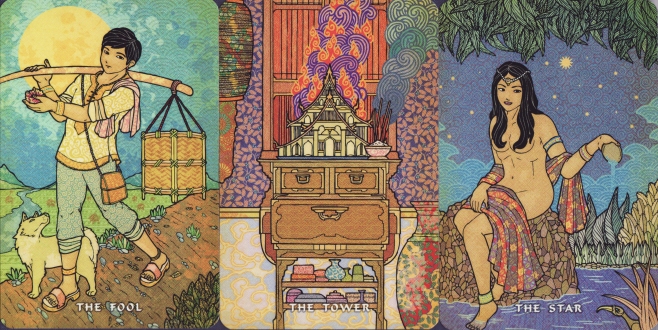
21 December 2010
I just bought a tarot based on an exhibition that opened in May 2009 at the Il Vicolo gallery in Cesena in Italy. This was entitled Il Diavolo & l'Acquasanta Tarocchi Fantastici and seems to have been a grand affair involving various cultural figures in that region of Italy. The artwork is modern and about half of the pieces were sculpture, and half are paintings, photographs and collage.
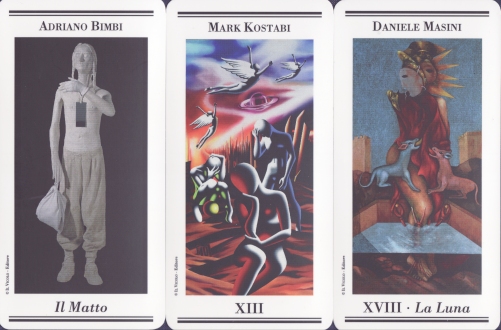
17 December 2010
I now have a rather fine black and white pen and brush drawn tarot created by the prolific Japanese illustrator Ogasa Shin. Entitled Ace of Tarot this is apparently self-published. It is a wonderful art deck and especially as it has been created in conventional media rather than being entirely digitally rendered as is common with Japanese tarot nowadays. Ogasa Shin really knows how to use the dynamic interplay of white space and black areas in these drawings.
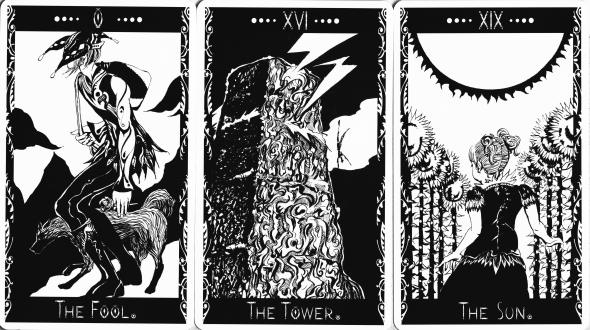
16 December 2010
I have just received a Japanese tarot called the Kojiki Tarot designed by Seiko Kisaki. Kojiki is an ancient Japanese mythological text with poems and songs telling of the creation of the Universe and stories of the Gods and Goddesses that shaped it. This dates from the early 8th century and was composed by Ono Yasumaro by Imperial request. The Kojiki records the mythological origin of the four home islands of Japan, and the Kami or Shinto spirits. The myths contained in the Kojiki are part of the inspiration behind Shinto practices and myths. This tarot comes with a little booklet with some description of how each card corresponds to some god or goddess.
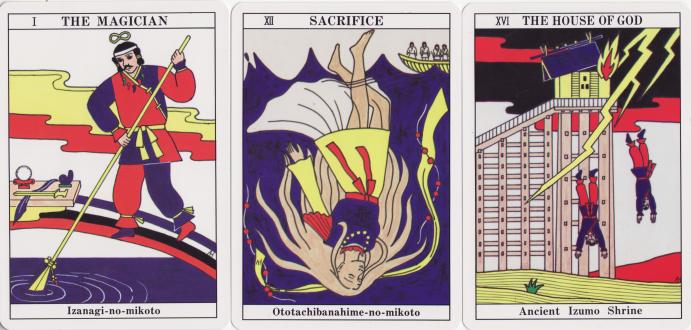
15 December 2010
The Linol Tarot was created by Gerhard Haack in 1988 in Kassel in Germany. It is a full deck with minors and an additional card. It was issued as a signed and numbered edition of 150 copies. The images on the pip cards do not slavishly follow the Colman Smith emblems for the Rider Waite deck, but work within that style. The deck is said to be named after the supposed method of printing - linoleum block prints. I have examined the cards closely and cannot see how these could have been printed or even created as linocuts. It appears more likely that these are printed using serigraphy (commercial screen printing).
15 December 2010
Some years ago I saw some images of this tarot, the Tarocchi di Verona, but I cannot remember where. However, I recently was able to buy a copy, but now cannot find out anything about it. It seems to rely, for some of the card imagery, on various architectural monuments in Verona. The backgrounds are printed in a matt gold ink.
13 December 2010
There is something quite delightful about round tarots. The first appears to be the Nature Tarot issued in Japan in 1980. Many feminist inspired tarots then emerged in the 1980s using the round format, and it is now an established style. I recently obtained, through the good offices of a tarot dealer in Los Angeles, the Sumeremilhun Tarot issued by Emil Kazanlar in 2002 in Hungary. The cards designs take inspiration from Sumerian bas-reliefs and some Byzantine manuscripts. They appear to have been created in gouache. Kazanlar is, of course, best known for the tarot he produced in 1996 published by AGM Müller.
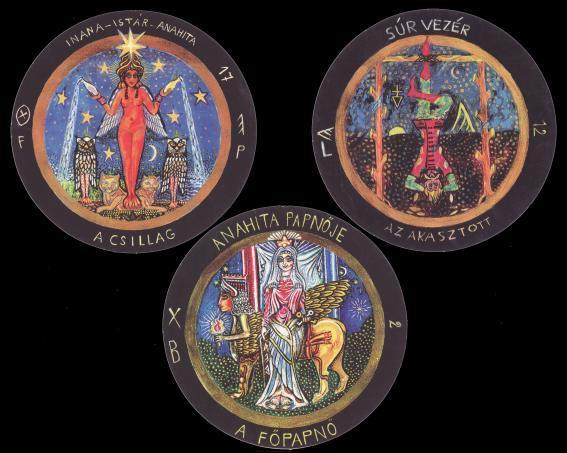
10 December 2010
I just received the Natural Tarot, a set of the conventional Rider Waite images printed onto cherry wood as thin as card. There are a few tarot decks on wood, all being made in different ways. This Natural Tarot is printed directly on the wood, the Pirate Tarot was laser etched line drawings onto thin cherry giving a relief effect, the multitude of Tarots created by Endre Rousseaux were printed papers pasted onto plywood "cards" and heavily varnished, and finally the Wooden Kashmir are hand carved plaques of walnut. Some years ago I missed out on some Japanese wooden tarot, which I believe were made by pyrography.
9 December 2010
I just updated the list of my collection. I had over 50 items to add which I had acquired since August. My collection now amounts to 2124 items with more currently in the post !
9 December 2010
A few days ago I received a rather beautiful tarot from Hungary, A Tarot Titkai (secrets of the tarot) by Katalin Szegedi. It comes with a small booklet in Hungarian written by Zsofia Lazar. The colours are quite delightful. This was originally published in the early 1990's and is difficult to source, so it is rather good that that this has now been reprinted.
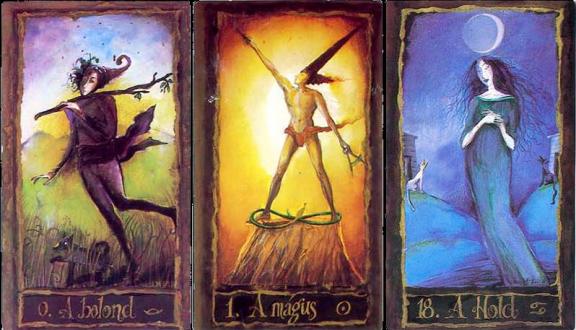
3 December 2010
In February this year I bought a copy of the Tarocchi della Notte by Maria Carmen Franca. This was a signed and numbered edition of 50 copies and I was very lucky to obtain number 1. She has now produced a new tarot Tarocchi I Colori e I Sogni (The tarot of colour and dreams) in an edition of only 25 decks. I immediately bought a copy. She very thoughtfully reserved number 1 of this deck for me. This is a full deck of 78 cards.
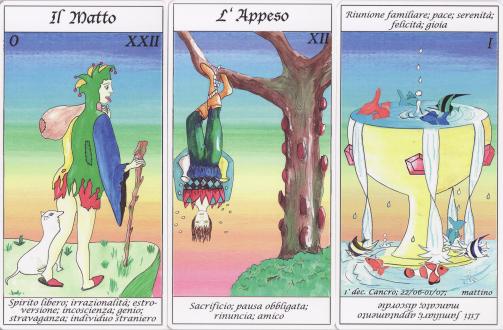
28 November 2010
The last two weeks I have been working flat out on my new Study Course on the Garden of Earthly Delights painting by Hieronymous Bosch and unable to do much on the tarot. I have, however, found this interesting exhibition by Aya Takano the prolific manga artist, illustrator, and science fiction essayist. She has several serialised publications, and is regularly featured in subculture articles. In the art markets of Europe and America, her paintings and drawings are enthusiastically received. Her exhibition at the Frieder Burda Museum in Germany can be seen through this link. The original designs for her tarot cards can be seen in the Exhibition. You can buy the cards at a reasonable price from some dealers.
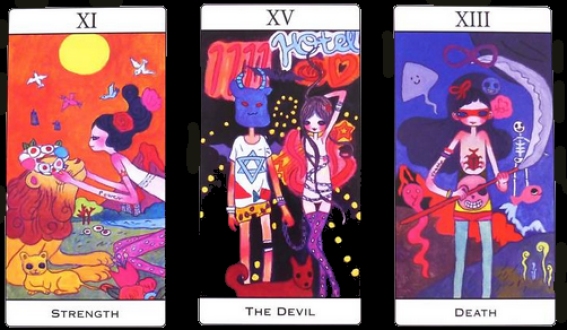
14 November 2010
 I don't usually buy decks that do not have a totally obvious tarot structure, but I could not resist the recently published Deck of Skulls by CJ Miller and Sarah White. There are twenty two cards, but these do not directly relate to the conventional tarot archetypes, though there are some resonances. It is available from SeriousWaffles. The dark Gothic artwork is what attracted me to the deck.
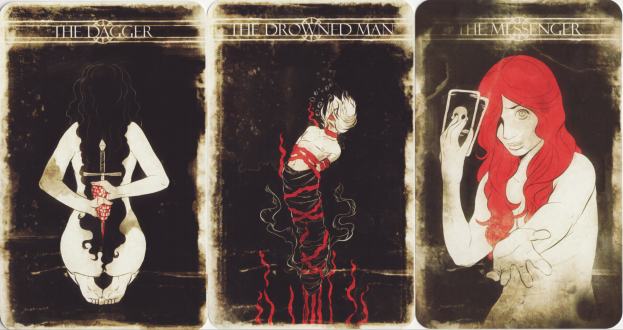
3 November 2010
Amy von Harrington is a New York based artist who works in a variety of media including collage. She has just created a full tarot deck of 78 collaged cards issued as a limited edition of 40 copies. Her style is funny, irreverent, playful, and in places sexually explicit. Her cards were sold at the Capricious gallery in Brooklyn. There is an interview about how she created her tarot to be seen here.
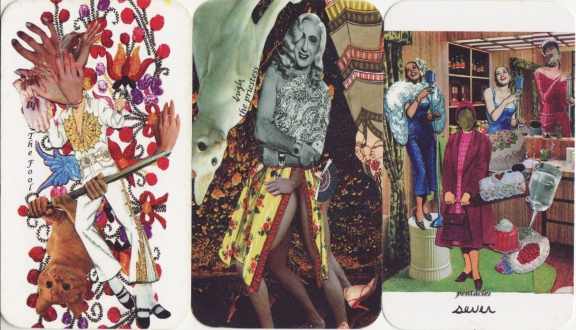
2 November 2010
Today I received the Penguin Tarot produced in Japan by Mamoru and Hisae Hamatsu. It is quite delightful and joins the growing rank of animal themed decks. We used only to have Cat tarots, but now there are rabbit, mouse, snail, fox, mice, ferret and a whole slew of bird tarots. The artwork for the Penguin tarot is extremely good. It comes with a little booklet in Japanese.
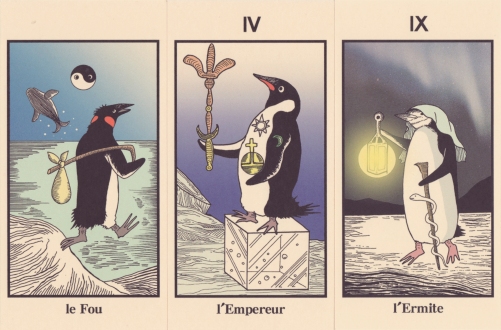
29 October 2010
I have been rather busy this week working on a new project, so was not able to put up an entry here, despite having a pile of decks I would like to draw to your attention. Here is a rather good pencil drawn deck. This was created by M. Thot under the title Il Libro di Thot and published by Aldo Castelli in Milan. It is not clear if "Thot" was a nom de plume of Castelli. From the packaging it looks like it was published some time in the 1980's, but I have not been able to find an actual data. It does not appear to be in Kaplan's Encyclopedia.
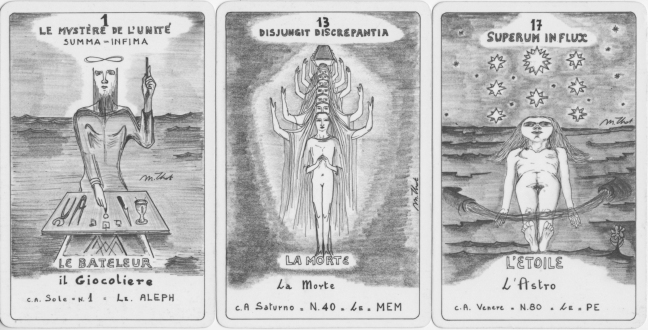
22 October 2010
Collecting tarot cards may seem to be a rather introverted and isolating activity, but in fact tarot art does respond to and reflect many aspects of culture, and as I have noted many times, tarot art documents our cultural history. It works the other way too. Tarot sometimes does influence artists and musicians at the forefront of cultural movements. Last night I was surprised to hear from an influential rapper from Pittsburgh called Kellee Maize. She has a deep interest in tarot and this informs and structures much of her work. Her latest album, Aligned Archetype, is a piece constructed through tarot. It explores "alter egos" or archetypes, and the songs are arranged as the answers to a tarot card reading with the question, "How can I align all the energies affecting my body, mind, and spirit and all the different archetypes with my being to help create real change on the planet?". So she is a rapper with a positive message, seeking answers to cultural change through tarot imagery.
Being 62 years old I do not usually find rap music easy to listen to. Usually the words are so skewed and stretched by the singer that I cannot make out what they are singing. Kellee Maize is not only inventive but can sing at amazing speed without losing diction, so unlike most rappers I could clearly hear what she was singing. Rap is so fast that the first time one listens to a track it really stresses the brain. I suppose it is a kind of verbal jazz, where the invention lies not in the stream of notes but in the stream of words. I suppose after listening to a track many times one loses that first dizzying careering struggle to keep up with the stream of singing. Maize is so sharp and fleet in her vocals. Like Lady Gaga there is a palpably visible intelligence to her writing. I do wish her success.
I sit here in my apartment surrounded by books, tarot cards and paintings, tapping information into a database and working on ways to explore Bosch's Garden of Earthly Delights, introspective and scholarly tasks that will only interest a very few, while others such as Kellee Maize are out there standing in front of large audiences attempting to use this imagery to effect cultural change.
21 October 2010
I must say, being an artist myself, I do like tarots created as oil paintings. There are not that many. A rather fine example arrived this morning. This is a Japanese promotional gift, rather difficult to find, and consequently expensive. It is called the RK Astrology of Love Tarot and came in a little velvet bag.
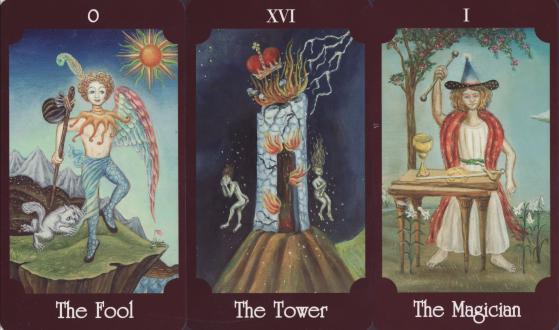
19 October 2010
I recently obtained an Egyptian tarot previously unknown to me. This was produced by Editions Rå in 1985. That is the sum total of my knowledge about this deck. I hope that some of my fellow collectors might be able to provide me with some further information.
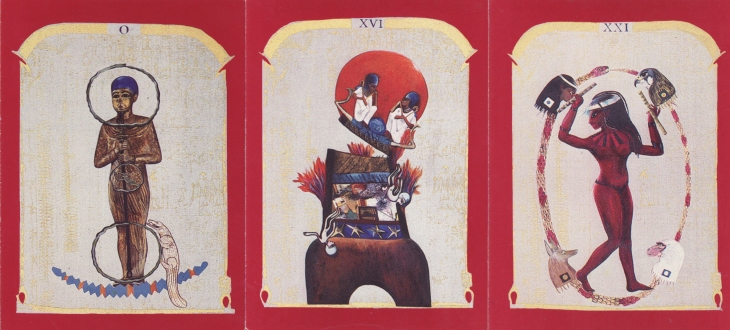
16 October 2010
Yesterday I had a visit from one of the major figures in tarot, Mary Greer. This visit was arranged by another well known promoter of all things tarot, Marcus Katz. It was really interesting to have a discussion about the state of tarot today. I resisted the impulse to overload my visitors by merely pressing them to look at tarot deck after tarot deck - that requires many many hours - and instead we had an exchange of views and information about what is going on in the world of tarot, on the various forums, conferences and events, as well as catching up on news about individual tarot artists and creators. Before they left, I could not resist letting them glance through some of my collection, if only to give a sense of the sheer mass of diverse material that constitutes the artwork of modern tarot. Marcus, who has visited me a few times, never loses his enthusiasm and excitement at seeing a tarot previously unknown to him.
15 October 2010
Over the last week I have been working on my Tarot Art database and so I have not had time to keep up the weblog. I think this database will, in the longer term, be important for the study of the artwork of modern tarot. Other people have occasionally begun similar projects but been unable to complete them. Also many of these attempts have been made by scouring the Internet for information, an unreliable method. The entries in my database are not such second-hand information. Each item is in my collection and my description of each tarot is made with the deck, book and packaging at hand. My methodology is also consistent as it is not drawn from various people's opinions. Also my focus is entirely on the art in the tarot, and not on the divinatory, esoteric or philosophical aspects. The database currently has 500 items in it, and I have focussed on the Far Eastern tarots to begin with, the Japanese, Taiwanese, Chinese and Korean. I will gradually work through it country by country until all the over 2100 items in my collection have been added. It will take some time ! Probably up to a year.
8 October 2010
I have now uploaded the weekly update to the database with another 65 items. I have now added about 90% of my Japanese items and will add the remaining over the next month or so.
www.alchemywebsite.com/tarot/database/tarot0.html
I will eventually make it possible for users to browse just the tarots of individual countries, and will implement this for the Japanese items within the next few weeks.
Initially the database will be based on my own collection, as I have the cards physically at hand. Once I have entered all of my collection, say in a year or so, then I will ask fellow collectors to provide me with details of tarots I do not have, so that the database can become more comprehensive. Hopefully, it will become an important resource on the artwork of modern tarot.
Thanks again to the many fellow enthusiasts who have corrected some of the errors and given me additional information to complete an entry.
There is much more to do, but a substantial beginning has now been made with over 400 items catalogued.
7 October 2010
Much of this week I have devoted to creating entries in my database of tarot. I am, to a great extent focussing this week on the Japanese items im my collection. Each entry requires some research and writing up some descriptive information. My database deals primarily with the artwork. I will be updating the entries online every Friday. This week I should have added over 50 items. It would be great if I could manage to keep to this target every week but I doubt I will be able to allocate the time, as I have to make a living. There are currently 400 items in the database and if I kept to the present rate I could probably complete it within six months. It will be a substantial resource for anyone studying tarot art. I intend to work on individual countries at a time, and after I have completed the Japanese entires I will turn to the Taiwanese and Chinese deecks.
5 October 2010
Modern Tarot does not have a long history. When we use the term an "early tarot" in the context of modern tarot, then we mean one printed in the 1960s. I have now obtained one of these rarities, a copy of the Dimitri Papavasiliu Tarot published in Athens in 1969. This 78 card deck comes in a hardbound book, contained in pockets at the back. It is a variation on the Tarot of Marseilles.
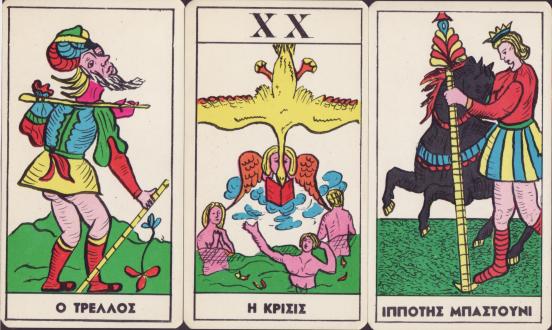
4 October 2010
I recently obtained a Mexican tarot, which adds one to my collection of six. Sadly I know nothing about it. I never heard of this tarot before and can find nothing about it except that it was published by Gomez Gomez Hermanos Editores.
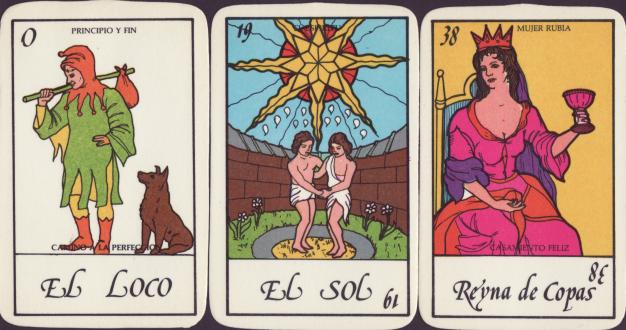
1 October 2010
I often say that there is little point in studying tarot art from fuzzy jpegs from web sites, and that nothing can approach having the actual physical cards in hand. This is especially exemplified by the Tarot de Jean-Luc Bonicel. Published in 1986, this must be among the best of collage tarots. For his source material Bonicel used fine line engraving, probably steel engravings from the 19th and early 20th century. These have extremely fine lines with almost no softness to the edges. He uses hundreds of individual components to make up each card. I expect these were photographed on a litho process camera on a large negative which then was corrected and any edges of the paper layers stopped out. The result is some amazingly complex collaged images. When scanned and jpeged all of the crispness is lost and one only has a fuzzy, muddy mess to look at. This is an expensive tarot but well worth the price. It is at the summit of what can be achieved in black and white collage though only owners of an actual deck will appreciate this.
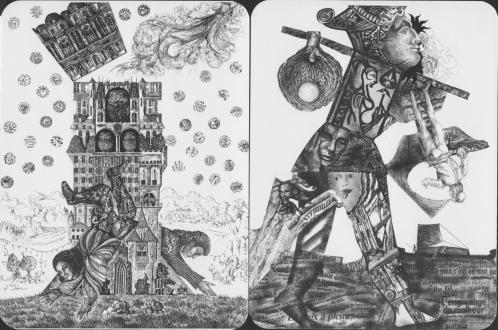
30 September 2010
I have managed to plug another hole in my collection, the Omaho Old Market Tarot from 1988, which had eluded me. A couple of copies had surfaced over the last five or six years on Ebay but I had not managed to win the auctions. The artist Samuel Mercer worked in watercolour without using containing pen or pencil lines. This gives a rather nice effect and style to the artwork. He seems to have used the Oswald Wirth deck as his primary inspiration.
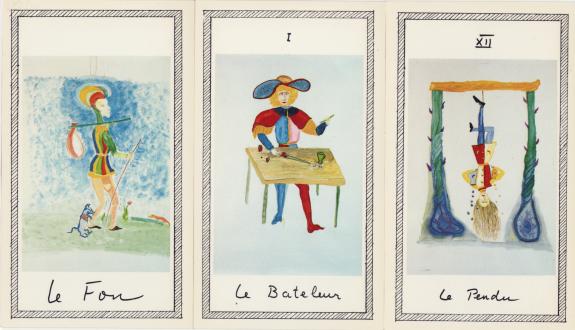
29 September 2010
I am beginning to work on a descriptive database of my collection which I am making available online as a finding aid or reference source for tarot art. There are many items to describe and as I cannot afford to drop everything else and merely work on this, it is likely to take a year or two. I will add items gradually. The first version of this with about 250 items now replaces the Tarot directory link. There will be one page for each tarot and I will try and implement a search engine over the next few weeks.
29 September 2010
Many of my fellow collectors do not like tarots as illustrations in books and prefer to limit themselves to those in card format. They miss out on many art tarots, as many of these are exhibited in a gallery as a series of artworks then issued in a printed catalogue. This applies to the Jak Flash Major Arcana which consists of a series of wonderful posed photographs. This series of photgraphs was the subject of an exhibition in Birmingham earlier this year. You can see details here. The book issued at the same time has very fine printed images. It is not especially expensive. Jak Flash is very inventive and finds some beautiful images for the Majors. The Tower can be a challenging image for artists, but here he has found a rather wonderful way of depicting it. The makeup on many of the models is astounding. He acknowledges special effects and artistic make-up artist Julia Hyland in particular. You will have to buy the book to see the artwork in full detail.
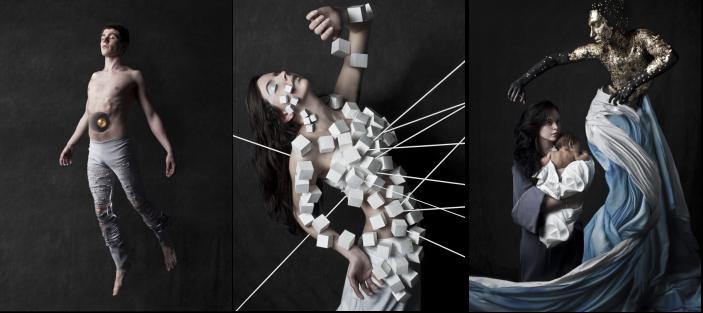
28 September 2010
The Tarot Feminine is a bit of amusement from Australia in the style of pin-up or erotic playing cards. Nothing pornographic, indeed these photographs are the sort of images one sees in established publications. Nothing much erotic, and nothing much of tarot imagery either. One can see small hints in the "Majors" but nothing in the "Minors". Here we are at the outer limits of tarot when its imagery is almost dissolved away. Only those striving for completion and an exhaustive collection would think to buy this deck.
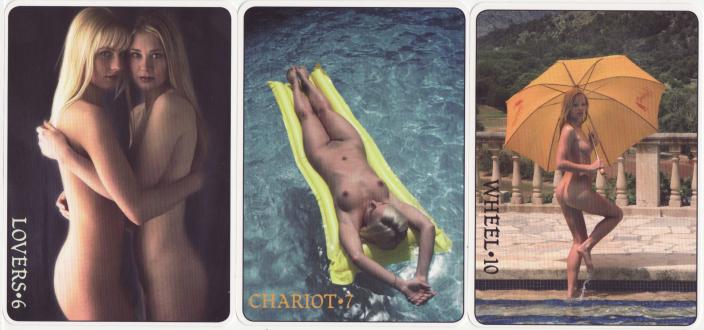
27 September 2010
Apparently the idea for the new deck from Beth Seilonen arose from her being invited to the Bay Area Tarot Symposium (BATS) in August 2010. Thus it was produced in celebration of the BATS. So we have the White Bat Tarot in an edition limited to 25 copies. The imagery of the minors is subtly based on the Pamela Colman Smith minors for the Rider-Waite deck.
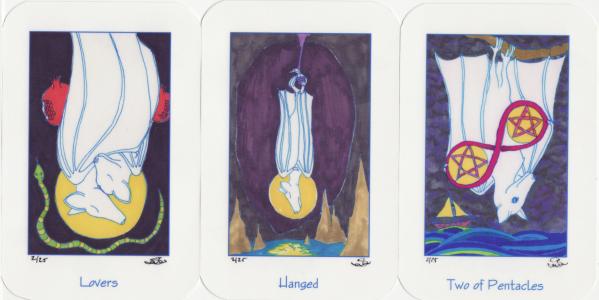
26 September 2010
I have now had to bud off another archive, the fourth, for the weblog, in order to reduce the time required for the browsers to build the page. The archives now amount to over half a megabyte of text and 44 megabytes of images !
26 September 2010
In my entry on this weblog for 3 June 2008 I showed a Buddhist tarot from Thailand. I have now managed to obtain another Thai Buddhist Tarot. This is based on photographs of Buddhist artwork, both paintings and sculpture. Each card has a different coloured background.
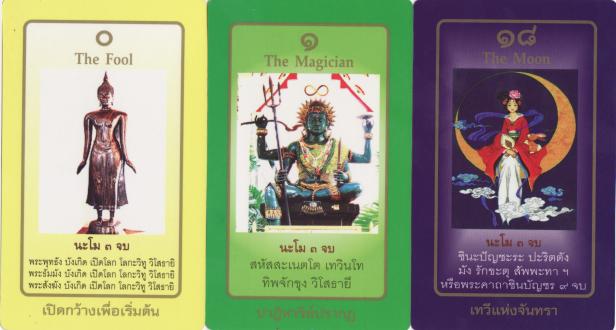
25 September 2010
I have decided to make my course on the Artwork of Modern Tarot freely available on this website. This year I have sold so few copies despite the low price, that I think it best to abandon any further attempt to promote sales. The course is entirely original. It presents ways of looking at tarot as art. All other tarot courses focus entirely on the use of tarot for divination, something I have no interest in nor can engage with. In 2005/6 I wrote this extensive course of 25 lessons exploring ways one can look at tarot as art and as it required considerable research, I am reluctant merely to withdraw it, and instead I will make it freely available for people to study. I will, time permitting, begin to add further lessons to it over the next few years. I do realise that this original piece of research will quickly be pirated. The pirates love original material. My name will be obliterated and someone else (whose sole ability is to be able to cut and paste) assume the credit for writing it, but those who know my style will recognise it. It is a risk but I want to make my approach available to people. I am continually amazed that so few people see any value in looking at tarot as an art format. I am keen to promote tarot as art and will be launching a few projects over the next months to try and encourage people to look at tarot in this way. I have put up the first seven lessons onto the course page and will add the remaining items next week.
24 September 2010
In 1983 I brought together my friend Rafal Prinke with a Scottish artist I knew, Edward O'Donnelly, to produce the designs for an alchemical tarot deck. This was based on existing alchemical emblems from engravings and woodcuts, which were brought together and given a tarot context by Rafal. Edward then redrew the images from the original engravings. I then planned to print these as a set of cards and have Edward hand colour an edition of 150 copies and even annouced a publication date of November 1983. This project did not work out, partly because the printing equipment available to me at that time could not print solid blacks on the two sides of card thick enough to be handcoloured. Some years later, in 1988, I published the designs in my Hermetic Journal magazine, and these were seen by K. Frank Jensen who was so enthused by them that he wanted to publish these and a year later he issued the Alchemical Tarot in an edition of 100 cards. These were hand coloured following Rafal Prinke's suggestions.
I have always regretted not buying one of those decks, and though a couple have appeared on Ebay auctions in the last five years I was not successful in buying one. Now, thankfully, I have been able to obtain a copy of this deck. Yesterday was a good day when this item arrived in the post.
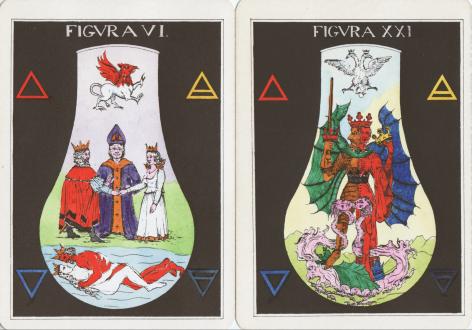
23 September 2010
Every now and again I find myself buying a tarot deck that no one seems to have heard of and it is neither recorded in Kaplan nor referenced on a web site. The one that came into my hands recently is Trocal's originele Tarot, a strange name indeed. This was issued in the Netherlands in 1991. Trocal® is a Dutch supplier of PVC roofing material, so I immediately dismissed this as an explanation, and looked instead for an artist of that name. Zilch! I then decided to look for the publisher Anderson and Lembke, which turned out to be a well known advertising company in 's-Hertogensbosch. It appears that this deck was some promotional item produced by the advertising agency for one of their clients supplying roofing sheets. Now I wonder if anyone else can source a copy ! The deck is made to look as if it were created as woodcuts which were hand coloured. It has a subtle humour.
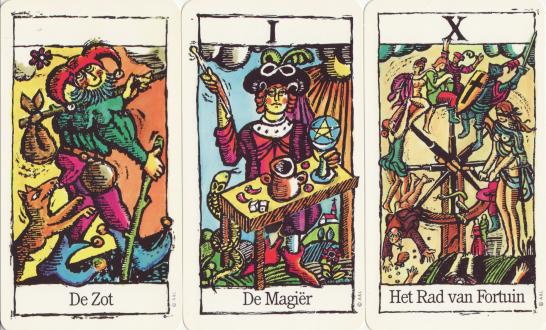
22 September 2010
Last week I received a rather wonderful gift from a friend I have known since the 1980s. Some years ago this friend, a surrealist artist, told me that he had created a tarot deck during the 1980s, as part of his personal exploration of esoterics and kabbalah. He has now decided to donate his original artwork to my collection. I do have a few sets of original artwork, but this one is very special. It is a 78 card deck and full of invention but with a firm structure. I have set up a page for the Robert Ellaby Tarot which shows more of the card designs, and explores some of the symbolism he uses.
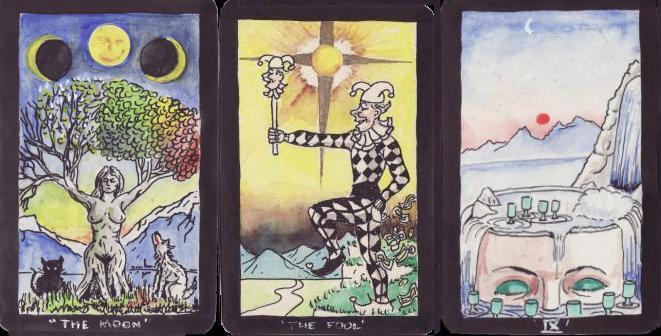
21 September 2010
In the last week or so I have managed to buy some tarots from a collection that was being sold off, that fill some gaps in my own collection. Among these is the JTG tarot by the German artist Johannes Tassilo Gruber in 1987. His original line drawings can be seen in Kaplan's Vol 3 page 269. Gruber must have reworked these into more detailed pencil drawings which model the surfaces, making his geometric forms appear embedded in three dimensions. He has a mastery of perspective and these difficult to visualise surfaces appear convincing and real. At first glance one might see this as mere surrealist abstract forms, but on more considered examination one realises that he uses geometric forms to abstractly model the tarot imagery. He makes many references to kabbalistic ideas, the four elements, the planets and the zodiacal signs, so this can be seen as a magical and esoteric deck expressed through geometric images. In my copy each card has the title, number and artist's signature added in pencil after the printing. One wonders that, after printing the cards, he thought the imagery required him to identify the individual cards. Hand labelling all 22 cards of the full edition must have taken a considerable amount of time. The edition size is 333, a reasonably large edition for an art tarot, but I have never seen a copy on sale. So when one appeared on the list of a collection being sold, I immediately bought it.
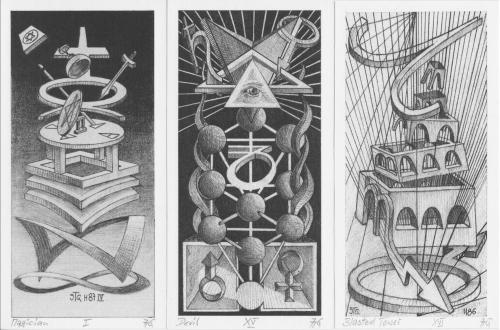
16 September 2010
The Horusov Magicni Tarot, a magical tarot issued by the publisher Horus, must be one of the very few tarot decks issued in Yugoslavia during the communist regime, before its break up that began in 1990. This deck was issued in Belgrade in 1989. It is a 78 card deck with designs by Sendain Tursic and comes with a book by Dragan Simovic and Tomislav Gavric. The designs are conventional with non-emblematic pips. I do not know of any other Yugoslavian tarots, indeed, until a few days ago I did not know of this one.
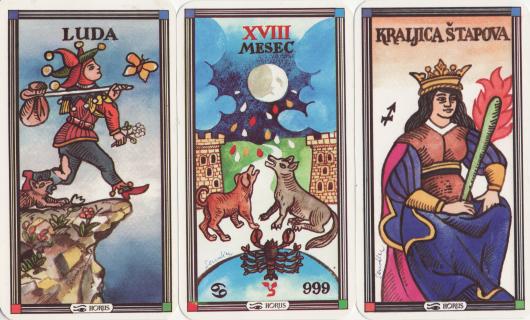
15 September 2010
I have in the last few days been able to buy a copy of the Wooden Kashmir Tarot by the Dutch artist Nicolaas van Beek. This is now the major item in my collection which is currently approaching 2100 decks. I never thought I would be able to own a copy of the Wooden Kashmir, so I have been incredibly lucky to have been able to obtain one. The deck is very beautiful and I have set up a web page about it.
15 September 2010
The other tarot from Moorea/Tahiti is the Tarot of T. Oger. The pen drawings are well executed using heavier outlines and thinner lines for details. They appear to have been coloured by pencils. Like that of its companion deck by J.R. Kahn it does not seem to be mentioned in Kaplan's Encyclopedia.
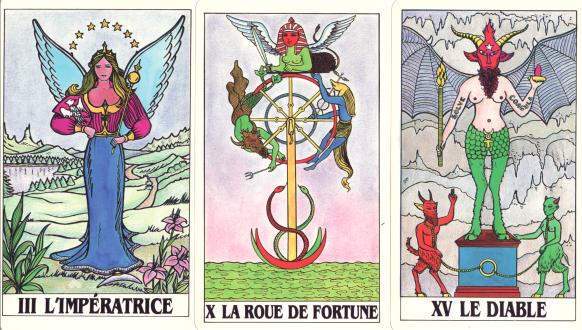
14 September 2010
There are few countries in the world which have not produced a tarot deck. Recently I bought two from Tahiti in French Polynesia, well actually from Moorea a smaller island which has only 16,000 inhabitants. Somehow a publisher Les Éditions du Lézard (the yellow lizard is the emblem of Moorea), issued two decks, probably in the 1980's. The 22 Tarots Divinatoires designed by J.R. Kahn, was created in pen drawings with coloured pencils. The art is amateurish but well realised. It does not seem to be mentioned in Kaplan's Encyclopedia and I had not heard of it until few days ago. It is a rather rare item I suspect.
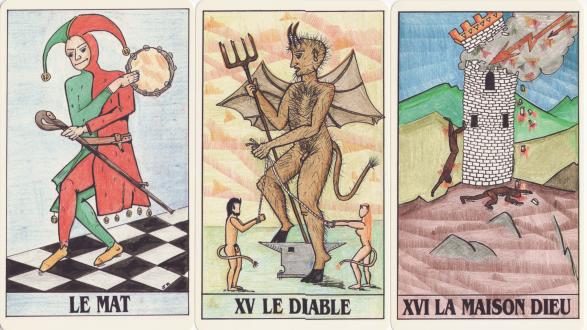
8 September 2010
According to Wikipedia - Katekyo Hitman Reborn! ("Katekyo" being a portmanteau of Katei Kyoshi and translated as Home Tutor), is an ongoing Japanese manga written and illustrated by Akira Amano. The plot revolves around the life of a young boy named Tsunayoshi Sawada, who finds out that he is the next in line to become the boss of the most powerful Mafia organization, the Vongola Family. As such, the Vongola's most powerful hitman, a gun-toting infant named Reborn, is sent to tutor "Tsuna" on how to become a respectable boss. The individual manga chapters are serialized in Japan in the weekly Shonen Jump. It was released as an English language version in the USA under the shortened title of Reborn! I bought a tarot of this name recently. I am not sure if it is an official released tarot or a Doujinshi. The dealer Baby_Dream tells me that it is a Korean self-published tarot and was released this year. The designer is Bian. I am not sure if any more are available. If you want copies of these obscure Far Eastern tarots you should contact Baby_Dream on Ebay.
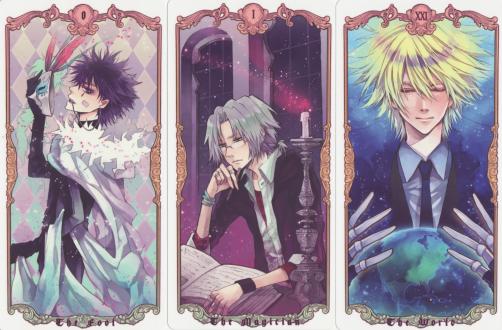
7 September 2010
Mirrorstarot is a rather fine full deck Rider-Waite clone from Taiwan, created in soft graduated tones, in a low-key palette. The imagery is obviously designed to appeal to children. It is printed in a matt finish. The designs are by a graphic artist using the name of Cyberstar and follow quite closely the original Pamela Colman Smith images.
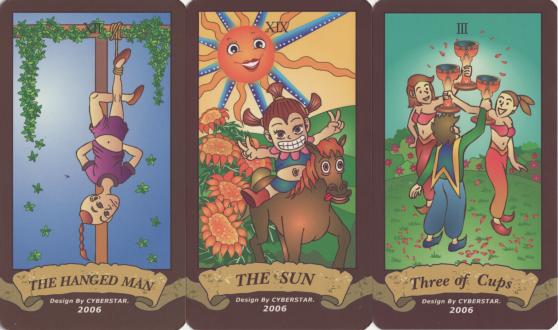
6 September 2010
Along with the Energy Tarot I also bought a set of small cards, the Tarocchi Sigma, which was issued with an Italian book on the history of tarot and tarot reading Leggere i tarocchi by Maurizio Elettrico published by Sigma Libri Gruppo Editoriale Esselibri, which issues much new age material. The imagery uses line drawings which have collaged elements incorporated into the cards design. Some of these drawings are printed in negative and given an intense colour, which is a rather fine effect. Some of these drawings remind me of those in alchemical manuscripts and I expect the artist has been influenced by alchemical material. The artist would appear to be the book's designer Giuseppe Ragno.
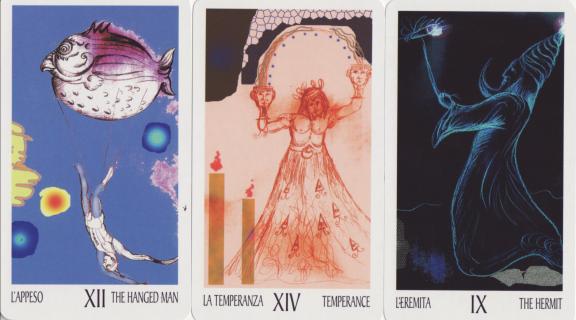
5 September 2010
I have now bought a copy of an Italian version of the German Chakra Tarot. It has the same format, with the seven chakras shown as coloured circles in a panel at the top. Here, it is called the Energy Tarot and, of course, the titles are in Italian.
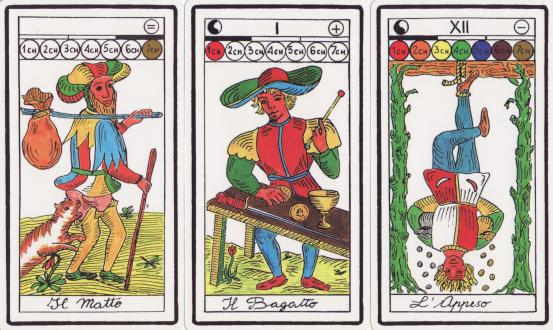
3 September 2010
Emilo Ortu Lieto is an Italian artist who has over the last 5 years or so produced a number of tarot decks in small editions of only 30 copies. I already have his Tarocchi Metafisici, Tarocchi Gay Orsi and Tarocchi Sardi. His latest deck the Tarocchi Surrealisti arrived this morning. Emilo Ortu Lieto is a Set and Costume designer for stage and screen, and has worked on many well known theatrical productions and films. www.perunteatroteatrale.com/index.html
You can buy a copy probably for 100 Euros or so from an Italian dealer who distributes his work. I am sure these will appreciate in value as his art becomes recognised more widely. They will not be around long as the edition is limited to only 30 copies.
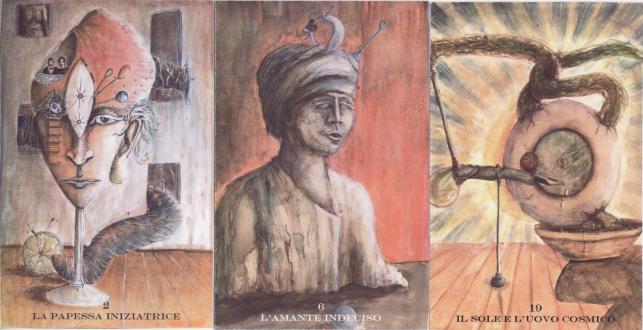
2 September 2010
The Tarot of the Boroughs: An Urban, Contemporary deck set in New York City is exactly what it says on the packet. Nearly all the posed photographs were taken by George Cortney, and he worked with Courtney Weber on the depiction of the ideas. I rather like the self-referential idea where the High Priestess is examining a tarot spread. The full deck of 78 cards can be obtained from www.tarotoftheboroughs.com
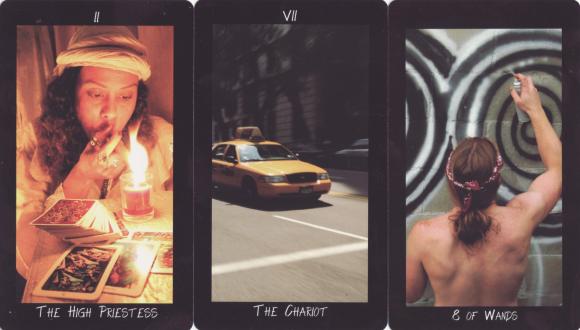
1 September 2010
I recently was able to buy a copy of an influential 1990's Taiwanese tarot, the Fairy Tarot of Yo Su-Lan (1998). What one might call manga in soft focus.
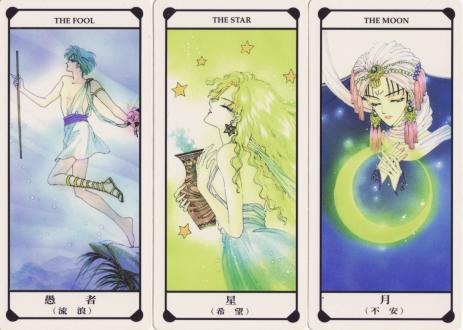
31 August 2010
The Japanese Macalon Tarot named after its creator Kato Macalon is a full 78 card Rider Waite clone designed primarily for children. Its imagery is engaging, cute and positive. You might be lucky to find copies on Ebay auctions.
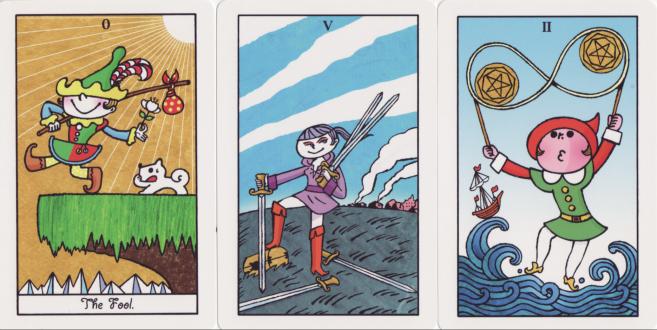
30 August 2010
I recently managed to get a copy of a black and white tarot by the Japanese artist Masahiro Obara, to which a fellow collector had alterted me. They look like woodblock prints, but I suspect they have been created using pen and ink. They appear only to be available from a store in Japan where the designer, who is aslo a tarot reader, goes once a week to read fortunes. The cards are quite expensive, but this is one which, because of the unusual style of the artwork, will greatly appreciate in value once the edition is sold out. I bought two copies.

29 August 2010
In my blog entry for 23 November 2008 I showed a fan art tarot based on the anime 'Bleach'. I have now obtained a self-published tarot by another fan of this Japanese television series.

27 August 2010
The Usatarot has nothing to do with that federal union of fifty states that often seems to dominate the world of tarot publishing. Usa is actually Japanese for Rabbit (Usagi). This is a rabbit tarot self-published in Japan, nicely printed but laminated in those little pouches. It is a delightful deck, not departing far from the conventional images, but with rabbits. There are now a few rabbit tarots and this is a fine addition to this stable. This small deck will be impossible to find in a year or so. You may be lucky and be able to buy a copy from a dealer such as Baby_Dream on Ebay. I really like the use of the indefinite article at the beginning of the title of every card.
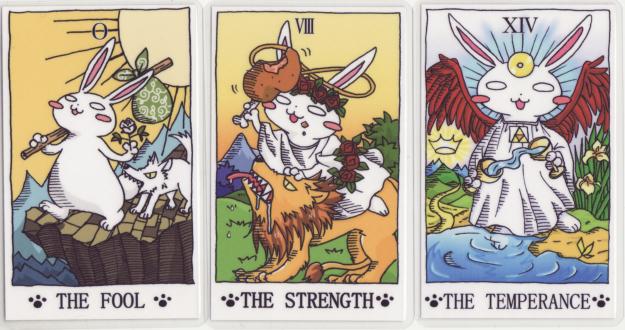
26 August 2010
The strangely named Vitas : Personal Idol Diary Tarot seems even more weird when one realises that though produced in China it has the card titles in Greek! But that is not all for although the alphabet is Greek, these transliterate into either French or English. Is this merely a muddle or is there some subtle message here? We will probbaly never know. The imagery is rather good, being computer created collage, though the densely textured backgrounds fight against the foreground images and often prevent them standing out. There are some fine images here and though quite stylish the cards are immediately recognisable from their content.
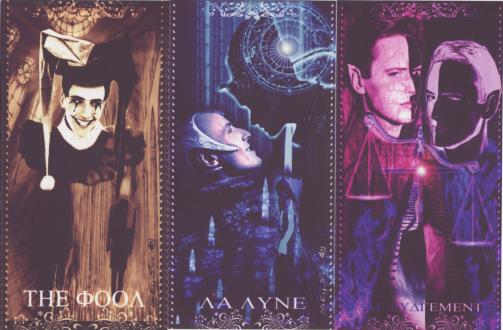
25 August 2010
When a new tarot arrives and one immediately sees from the packaging that the cards are larger than ones hands, then one can be almost certain that one is going to find an art tarot within the wrapping. This indeed happened this morning when I uncovered the Tarot MEM. The cards are 7.5 by 3.7 inches (190 x 93 mm) in size, printed on card and laminated. Some time ago 'MEM' Mark E. Merrill had been in touch with me about the possibility of my publishing his cards. There was a technical problem which made it impossible for me to do this, so it was good to discover a few weeks ago, that he had gone ahead and self-published the deck. Had I been able to publish his tarot images, I expect he would have been disappointed as there is no way I could have printed the cards at the size he has. His designs bring together many disparate visual ideas which are fused together in computer collage. I really liked the use of the image of William Burroughs, the wealthy member of the Burroughs family, who was a friend of Jack Kerouac and Allen Ginsberg and wrote many novels. On his card which is entitled 'L.O.D.' (the Land of the Dead), he is shown with the gun with which he accidentally shot his wife, the crab nebula nova remnant and thus a reference to one of his best known books Nova Express, and a centipede (perhaps a drug-induiced paranoid image which rather obsessed him, being mentioned in a number of his novels, particularly the Soft Machine). Mark Merrill's collages are full of such visual references.
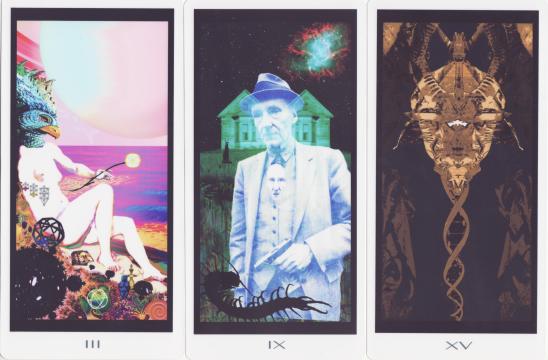
24 August 2010
I have now made up the remainder of the edition of the Sylph Tarot. Sadly, this has not been available for a year or so, but I have now found time to make up the copies for sale again. www.alchemywebsite.com/tarot/art_tarot04.html
23 August 2010
Emilio Ortu Lieto is an Italian artist who has over the last 5 years or so produced a number of art tarots in small editions:- Tarocchi Metafisici, Tarocchi Gay Orsi and Tarocchi Sardi. His latest deck is his Tarocchi Surrealisti.
He is a Set and Costume designer for stage and screen, and has worked on many well known Theatrical productions and films. www.perunteatroteatrale.com/index.html
I just bought a copy from a well known Italian tarot dealer. It is not inexpensive at 100 Euros or so but I am sure these will appreciate in value as his art becomes recognised more widely. They will not be around long as the edition is limited to only 30 copies.
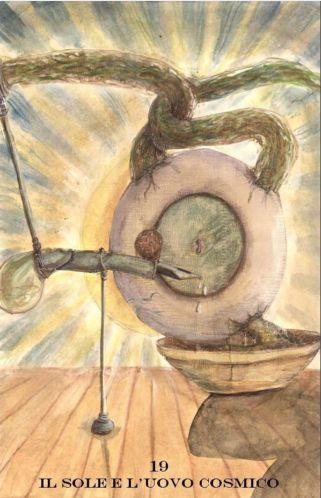
19 August 2010
I have not been very active on this weblog for a month or so. Not that I have a lack of material, there is quite a large pile of recently acquired tarots to work through, but I have diverted much of my time into writing one of my study courses on alchemy. Anyway here is a recent issue from Beth Seilonen (not her most recent that is in the post). Here we have the Blue Dart Frog Arcana: The Life of Balthazar a 22 card deck of watercolour paintings issued as an edition of 50. There are only a few frog tarots and this one is neat.
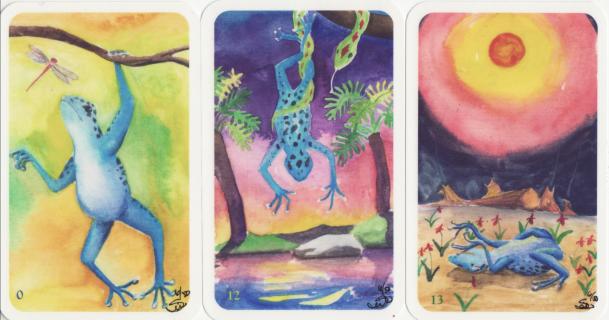
2 August 2010
I have now reworked my study course on the artwork of modern tarot and made it available as a download from the Internet. This means I no longer have to send out the course on a CD-Rom, and it also means that customers can have access to the course realtively quickly. It takes about 20 minutes to half an hour to download. This means I can reduce the price as I no longer have to print out the CD-Rom, make up the case, and pay for the packaging and postage so I have been able to reduce the price considerably. I also now allow payment in Euros, as well as Pounds and Dollars. It is only available for Windows at present - not for Macs!
|
Click to buy my Study Course on the Artwork of Modern Tarot. |
I have begun making up the final batch of copies of the Sylph Tarot. These should be ready for sale next week. This is a beautifully drawn tarot based on the images of butterflies. When I first issued it, to save time, I only made up half of the edition of 100. These sold out a while ago and I could not find time to print out the final 50 as I was working on new tarots. Now the new tarots are abandoned I can catch up on some of the back list.

23 July 2010
Marco Iannaccone is a photographer in Naples. He has recently issued a tarot deck using his photographs. The deck incorporates black and white, coloured and some with areas in colour. These are not collaged, but for the most part are posed photographs. Being an art photographer we expect some intresting takes on tarot imagery. One which struck me was the Wheel of Fortune which shows an execution scene with a revolver the twelve chambers of which are empty except for one with a bullet. He only made a few copies and sold some recently on Ebay.
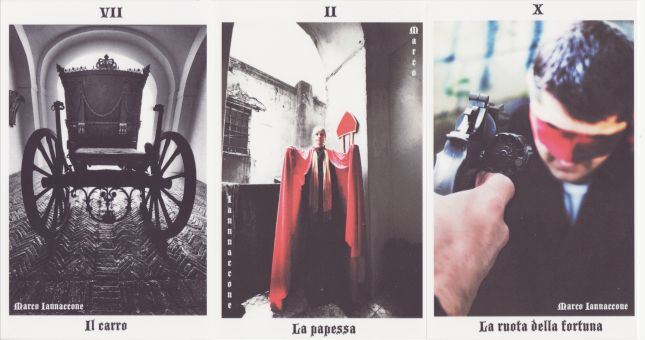
21 July 2010
I recently got a copy of the Orgasm Tarot from Japan. It seems to be produced by an erotic manga artist/publisher called Koh Soramoto. I must say I found this very amusing and not at all erotic. The artist is totally obsessed with large breasts. Every figure in the tarot is depicted with such large breasts as to be ridiculous. It is obviously a parody probably referencing images from well known mangas. This is well worth buying, if you can find it, as a novelty. It was self-published as a doujinshi in 2005 so may now be difficult to source. This is the sort of novelty tarot that will appreciate in value once it is impossible to find. Don't pass up any opportunity to buy this.
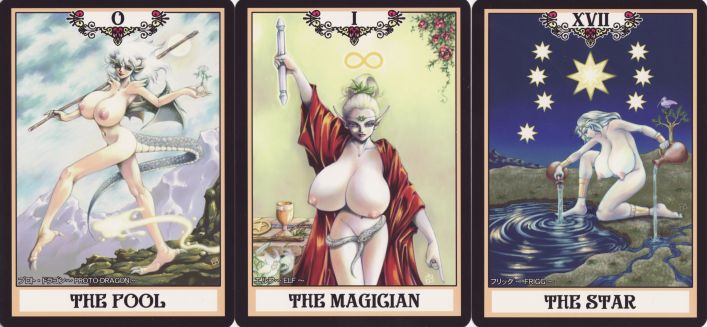
19 July 2010
The other cat tarot that I bought recently is a self-published item from Japan entitled the Black Cat Tarot. I am not sure why it has that title as the cats are not black. Anyway it is a rather sweet childrens deck. It could be rather difficult to find.
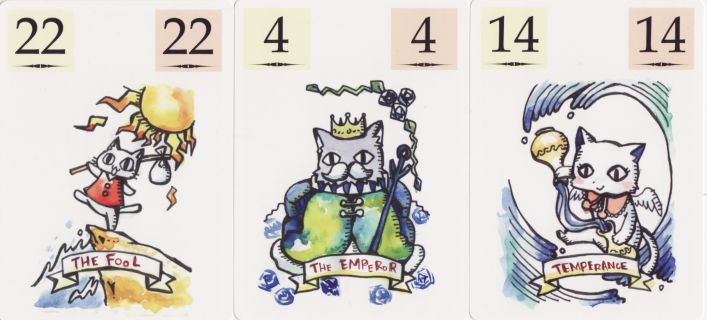
16 July 2010
It is not often that one gets two cat tarots in one days post. The Toro Inoue Tarot are rather well produced cards published by Sony Computer Entertainment Inc. Toro Inoue is also known as the Sony cat, as this cat who wishes to be human, is Sony's mascot in Japan. It first appeared in July 1999 as the main character in the video game Doko Demo Issyo. Now, after over ten years this cat appears in a tarot deck. If I have time I will post up details about the other cat tarot tomorrow.
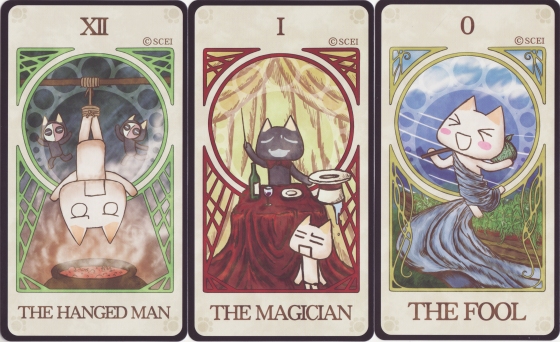
6 July 2010
The Petrak Tarot is wonderfully painted in soft interpenetrating layers of colour by Austrian artist Petra Reiter. It is printed by Paitnik. The imgery is very creative with some ideas I have not seen before. The Hanged Man, for example is shown emerging upside down from a chrysalis structure hanging from a tree, much like a butterfly. It is not easy to source this tarot, but you should be able to find them through Roderick Somerville. Petra Reiter has a website at www.petrak.at where you can see some of her other paintings.