
Rafal T. Prinke - Hunting the Blacke Toade.
Article originally published in The Hermetic Journal, 1991, 78-90.HUNTING THE BLACKE TOADE
Some aspects of alchemical symbolism
The study of alchemical symbolism is in many respects similar to that of Christian symbolism in works of art and literature. The major difference, however, is that the key to the latter is well known while the key to alchemy has been lost [1]. Its re-discovery is not a matter of a single insight but rather of a meticulous and long-lasting comparative study of surviving texts and iconography. It is now fairly obvious that there were several "schools" of symbolism within European alchemy, sometimes overlapping, sometimes borrowing individual symbols from other systems, or even distorting the ideas of earlier writers. These schools should be clearly defined along with the kind of symbols used by them. Even though such "perfect" definitions may not reflect any actual alchemical workss, it would be very useful for reference in any future studies, as well as for the analysis of chronological and geographical spreading of alchemical ideas. Some of such widely defined groups of symbolism and differences between them can be easily seen but have not been properly described yet.
Many scholars stress the fact that most alchemical notions, such as the Philosophers' Stone or the Materia Prima, are denoted by a wide range of names and symbols, and give long lists of examples. But a really helpful kind of "alchemical dictionary" would be to analyze particular clearly defined symbols as used by different alchemical authors and find out their various meanings. A full study of this kind is obviously beyond the possibilities of any individual researcher so I decided to make a small beginning by an attempt to clarify the symbol of the Toad. I chose it because it is not as common as the Lion or the Eagle, and therefore requires less research, but at the same time it is quite distinct and well defined.
Any symbol appearing in an alchemical treatise should be studied from two points of view:
1. Its meaning in other symbolic systems of the period or earlier.
2. Its context in different alchemical treatises.
In the first case care must be taken not to refer to symbolism of the ancient Egyptians or Chinese, as over-enthusiastic occultists tend to do, but rather stick to medieval and renaissance Europe, with possible classical symbols that may have been known there. In the second case the special points to note would be the frequency (and therefore importance) of the symbol in question, whether it appears at the beginning or at the end of the process described, whether it is in a group of three, four, seven, or some other number of symbols, etc.
One of the earliest appearances of the Toad symbol in alchemical literature and iconography seems to be that in the works of George Ripley, in which it plays a very prominent, or even central, part. His short poem The Vision [2] describes an alchemical process veiled in symbols. The Toad first drinks "juice of Grapes" until it is so filled up that "casts it Venom" and "begins to swell" as a result of poisoning. Then the Toad dies in its "Cave" and the usual sequence of colour changes follows: black, various colours, white and red. Thus the Venom is changed into powerful Medicine.
The famous Ripley Scrowle has not been available to me in its entirety but from several published fragments [3] it seems that it presents a similar, though considerably extended, process of the Toad undergoing various chemical changes. It reappears in various points of this symbolic road, clearly suggesting continuity. In some versions the Toad is also the final symbol of the Philosophers' Stone [4].
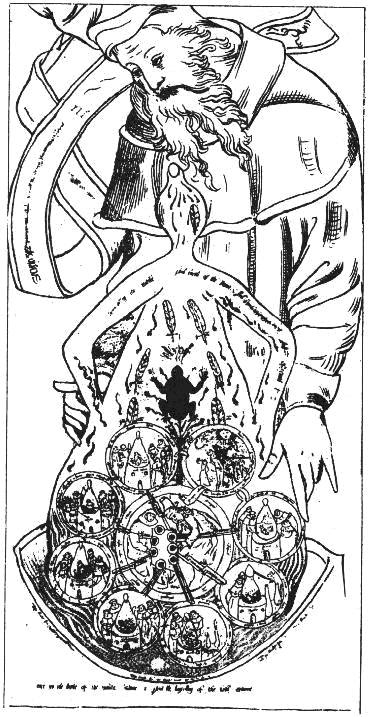
It would, therefore, appear that the Toad is here used as the symbol of the First Matter of the Great Work (as different from the cosmological Prima Materia), which is worked upon until the Stone is obtained. The symbolic sense of choosing this symbol finds confirmation in the fact that toad was believed by Ripley's contemporaries to be a venomous animal, highly repugnant, but containing a stone of great value in its head. That stone has the power of curing bites and is an antidote against poison. This common belief found its way to Shakespeare's As You Like It:
         Sweet are the uses of adversity;
         Which like the toad, ugly and venomous,
         Wears yet a precious jewel in his head.
Another English author wrote in 1569: "There is to be found in the heads of old and great toads a stone they call borax or stelon, which being used in a ring gives a forewarning against venom" [5].
Eirenaeus Philalethes in his comentary to Ripley's Vision says that the Toad symbolizes gold. This view may have been influenced by Michael Sendivogius's statement that the Philosophers' Stone is nothing else but "gold digested to the highest degree" [6], especially as Philalethes was his admirer and adopted his pseudonym of Cosmopolita. As we do not know the First Matter of Ripley, it is difficult to say whether Eirenaeus Philalethes is right. Ripley himself in his most famous work The Twelve Gates, which is less symbolic and uses early chemical terminology, remarks in the first Gate (Calcination):
         The head of the crow that token call we,
         and some men call it the crow's bill.
         Some call it the ashes of Hermes tree,
         Our toad of the earth that eateth his fill,
         and thus they name after their will.
                 Some name it by which it is mortificate,
                 The spirit of the earth with venom intoxicate. [7]
The Toad is therefore clearly identified here as the stage of Nigredo or Raven's Head, but also connected with earth. Interestingly in the nineth Gate (Fermentation, which is the same as Digestion) Ripley says:
         Earth is gold, and so is the soul also,
         Not common gold, but ours thus elementate. [8]
It is, therefore, clear that in Ripley's works the Toad symbolized the First Matter of the Great Work that was obtained in its first stage of Calcination or Nigredo. It may be gold but then the choice of the symbol would appear strange - it should rather be something base and vulgar. It is often said of the First Matter that it can be found everywhere but fools cannot see it, and this opinion would fit the Toad symbol much better. For instance, the anonymous author of the poem Hunting the Greene Lyon says:
         And choose what thou shalt finde of meanest price:
         Leave sophisters, and following my advice,
         Be not deluded; for the truth is one,
         'Tis not in many things, this is Our Stone:
         At first appearing in a garb defiled,
         And, to deal plainly, it is Saturn's childe.
         His price is meane, his venom very great
         His constitution cold, devoid of heat. [9]
This aspect of the toad symbol in medieval imagery is also stressed by the medieval writer Catelanus when he says that unicorns live in caves "amid toads and other noxious, loathy reptiles" [10].
The Toad as a symbol of only one phase in the alchemical process appears also in another poem by Ripley:
         The showers cease, the dews, which fell
            For six weeks, do not rise;
         The ugly toad, that did so swell,
            With swelling, bursts and dies. [11]
This is clearly the same chemical process as in his Vision, where almost exactly the same words are used:
         A Toad full Ruddy I saw, did drink the juice of Grapes so fast,
         Till over-charged with the broth, his Bowels all to brast:
         And after that, from poyson'd Bulk he cast his Venom fell,
         For Grief and Pain whereof his Members all began to swell.
Another of the early English alchemists, Bloomfield, in his Camp of Philosophy lists the Toad as one of the names of the Elixir or Philosophers' Stone itself:
         Our great Elixir most high of price,
         Our Azot, our Basiliske, and our Adrop, our Cocatrice.
         Some call it also a substance exuberate,
         Some call it Mercury of metalline essence,
         Some limus deserti from his body evacuate,
         Some the Eagle flying fro' the north with violence,
         Some call it a Toade for his great vehemence,
         But few or none at all doe name it in its kinde,
         It is a privy quintessence; keep it well in minde. [12]
Mary Anne Atwood interprets all these names as reflecting the Stone on various stages of the Great Work: "being sublimed at first, it is called a serpent, dragon, or green lion, on account of its strength and crude vitality, which putrefying, becomes a stronger poison, and their venomous toad; which afterwards appearing calcined by its proper fire, is called magnesia and lead of the wise". [13]
It can be summed up, therefore, that in the English alchemical tradition the Toad is a symbol of the First Matter of the Work, which is Saturnine in nature (which does not have to mean lead but any substance associated with Saturn). Sometimes it refers only the the phase of Putrefaction or Caput Corvi, on account of its Saturnine symbolism ("Regnum Saturni"), sometimes also to the Philosophers' Stone itself, as the "jewel" hidden in the Toad's head (i.e. in the First Matter). This kind of symbolism seems to have been continued by later alchemists in England, through continuous interest in the works of Ripley displayed by such authors as Elias Ashmole, Eirenaeus Philalates, or Samuel Norton, the grandchild of Ripley's supposed apprentice Thomas Norton.
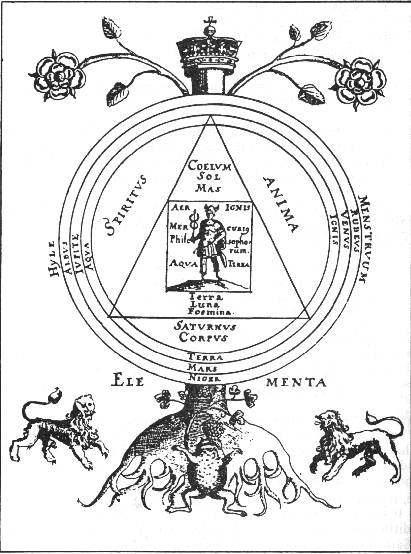
One of the interesting tree diagrams in Norton's Mercurius Redivivus presents the Toad at the roots of the Tree of the Great Work, with two lions at its sides. The Toad reaches for the Grapes above it, thus clearly refering to Ripley's imagery from his Vision.
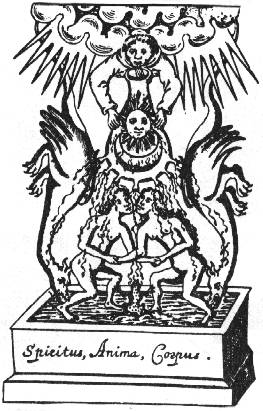
The well known illustration from Ashmole's Theatrum Chemicum Britannicum shows the Toad at the bottom of the symbolic process, probably indicating its beginning. It is interesting that it joins the male and female figures, as if it symbolized the power of attraction with some sexual overtones. The whole figure is entitled "Spiritus, Anima, Corpus", of which the Corpus or Body is the male-female pair. The whole possible sexual aspect of alchemy is still completely unknown and waiting to be explained but it may be interesting to note that Thomas Vaughan, who illustrated Ashmole's collection, made numerous sexual references in his own alchemical works, especially Aula Lucis. In his notebooks Vaughan explained how he had made the "oil of Halcali" with the help of his wife. According to A.E. Waite this oil is the First Matter which connects it with our Toad symbol. [14]
The sexual symbolism of the Toad can also be found outside alchemy, which strengthens our argument. On the great painting of Hieronymus Bosch The Garden of Earthly Delights, on its right wing, there is a figure of a woman with a toad on her breast which symbolizes the sin of debauchery. [15] A sculpture in Strasbourg entitled The Seducer of Unfaithful Virgins depicts snakes and toads climbing up a handsome youth's back while he holds forth an apple. [16] So the toad may be understood to symbolize the power of sexual instinct, the force of attraction of the opposites, which in the official morality was seen as something loathsome and vulgar.
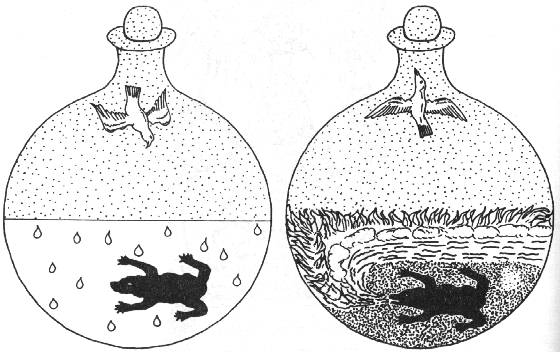
A work that would seem to spring from a totally different tradition, The Crowning of Nature [17], uses the Toad symbol in two of the 67 figures. These are numbers 17 Fermentation and 18 Separation of the Elements. The text accompanying the pictures, however, strongly resembles the Ripleyan ideas: "But by the Toad, here understand the sphere of Saturn swelling with tincture, or his heaven to be great and impregnate therewith, and by and by ready to bring forth, which by the ejection of the four elements appears most plainly in the next Chapter." [18] The Saturnine nature of the First Matter (or Chemical Subject, as it is called here) is confirmed in figure 2 and its text, which agrees with our conclusion reached above. Ripley's "casting of Venom" by the Toad is paralleled here in figure 18. In both cases the White Dove is above the Toad, probably signifying the volatile nature of the "tincture" or Ripley's Juice of Grapes.
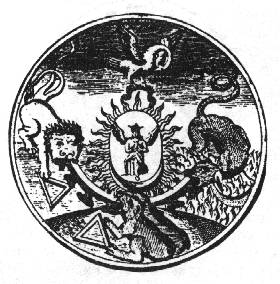
The 18th century published version of the series (without text) produced by Johann Conrad Barchusen [19] has some additional figures, extending the set to 78. Plate 1 also utilizes the Toad symbol in connection with those of the Pelican, the Lion, and the Salamander, surrounding the Mercury of the Philosophers. Adam McLean interprets the whole as representing the four elements [20] but it is not quite obvious, as the bird at the top is clearly the Pelican, usually not a symbol of the Air. It is also difficult to see any obvious connection of the Lion with the Water. It is true that there are the standard triangle symbols of two of the elements beside the Lion and the Toad but in that case the symbolism of this plate would not be uniform with the symbolism of the whole series and would have to be treated as a later addition. On the other hand the creatures can be seen as representing the phases of the Great Work. In the original Crowning of Nature these are found in the following series of plates:
         Green Lion     7-8
         Toad          17-18
         Pelican         37
         Salamander    41-55 and 58
         Angel/Stone   66-67
Seen in this light the first plate from Barchusen is a summary of the whole process of the Great Work and thus an integral part of the series. The only objection may be that the very important symbol of the Dove appearing on plates 10-36 is not included. It seems, however, (and is supported by the accompanying text) that the Dove is only the indication of the direction in which the Spirit (or the volatile principle) goes at any stage.
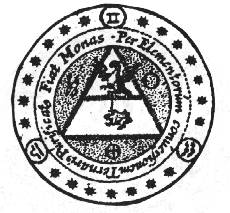
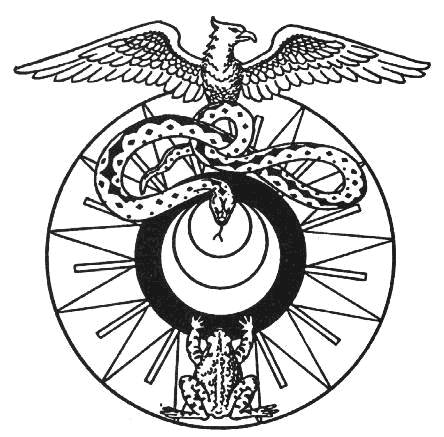
Of the 17th century Rosicrucian heirs to the alchemical tradition I found only two who used the Toad symbol. The less important in this context is Johann Daniel Mylius. In the very numerous engravings found in his works the Toad appears only on the title page of Opus Medico-Chymicum, inside the triangle of Air, chained to the Eagle above it. It probably refers to the volatile (and therefore "aerial") principle of solid bodies or, otherwise, to "fixing of the volatile". It is interesting that the same image of "bird above toad" appeared in The Crowning of Nature but without the chain joining them. In the text of the latter, however, mention is made about fixing the Elements cast forth by the Toad until they are inseparable. Some shift of meaning must have occured between the two uses of this kind of symbolism.
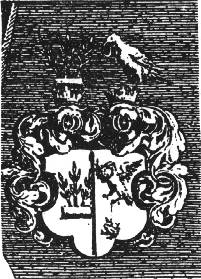
The most striking thing, however, is that Michael Maier has exactly the same symbol in one half of his personal coat-of-arms as displayed on his portrait in Atalanta Fugiens, and that he used it also as the main symbolic emblem of Avicenna in Symbola Aureae Mensae where it is clearly explained as Fixing the Volatile.
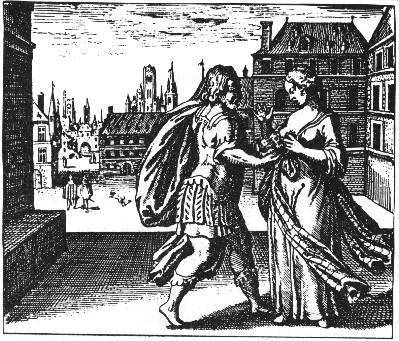
Maier used the Toad symbol in a different context again in Atalanta Fugiens in emblem 5, where it is placed by a man on a woman's breast. The epigram to this emblem is in many ways similar to Ripley's Vision:
         To woman's breast apply the chilly toad,
           So that it drinks her milk, just like a child.
         Then let it swell into a massive growth,
           And let the woman sicken, and then die.
         You make from this a noble medicine,
           Which drives the poison from the human heart. [21]
In this case the Toad drinks Virgin's Milk instead of Juice of Grapes, which may be just different terminology. However, it is the woman who dies, not the Toad. The sexual interpretation can also have been intended as a woman with a toad on her breast is identical with the symbol of debauchery or sexual attraction used by Bosch.
The above cases of Toad symbolism in alchemy are probably very incomplete but even on this basis it can be concluded that there definitely is some continuity in its used from the 15th to the 17th centuries, although occassional shifts in meaning are also noticeable. These may possibly be due to the simultaneous shift from physical alchemy of Ripley and his contemporaries (i.e. probably describing actual chemical processes) to the highly spiritualized (and possibly incorporating the sexual aspect) alchemy of the 17th century Rosicrucian Englightenment.
Notes:
1. Some scholars believe they have discovered that "key" but as the spectrum ranges from highly symbolic explanations of C.G. Jung (that are rather a presentation of his own system of psychoanalysis with the help of alchemical imagery) to strictly chemical ones of chemistry historians, it is difficult to accept such claims.
2. Reprinted with the commentary by Eirenaeus Philalethes from his Ripley Redivivus in The Secret Art of Alchemy by Stanislas Klossowski de Rola, p.23-30.
3. For example in Jung's Psychology and Alchemy, ill. 196, Klossowski de Rola's The Secret Art of Alchemy, pl. 65, Powell's Alchemy, the Ancient Science, p.66.
4. Manly P. Hall, Meditation Symbols in Eastern and Western Mysticism, Los Angeles, 1988, p.203.
5. For general discussion of toad symbolism see the article by E.A. Armstrong in Man, Myth and Magic p.2856.
6. In Tenth Treatise - see Concerning the Secrets of Alchemy, Llanerch Enterprises, 1989, p.116.
7. Quoted after In Pursuit of Gold by Lapidus, Weiser 1976, p.99.
8. Ibid., p.126.
9. Quoted by Mary Ann Atwood in A Suggestive Inquiry into Hermetic Mystery p.317 (apparently from Ashmole's collection Theatrum Chemicum Britannicum but I could not verify it).
10. Quoted after Jung's Psychology and Alchemy, p.437.
11. Quoted by Mary Ann Atwood in A Suggestive Inquiry into Hermetic Mystery p.406, from Ripley Redivivus.
12. Quoted by Mary Ann Atwood in A Suggestive Inquiry into Hermetic Mystery p.94, from Ashmole's Theatrum Chemicum Britannicum.
13. Ibid.
14. See Colin Wilson, Mysteries, Panther 1979, p.433-35. His discussion is based on Kenneth Roxroth's introduction to The Works of Thomas Vaughan, University Books, New York, 1968.
15. Anna Boczkowska, Tryumf Luny i Wenus, Krakow, 1980, p.63.
16. Man, Myth and Magic p.2856.
17. Edited and published by Adam McLean, Edinburgh, 1980.
18. Ibid., p.40.
19. Elementa Chemiae, 1718.
20. The Crowning of Nature, op.cit., p.127.
21. The translation is by Joscelyn Godwin from Adam McLean's edition, Tysoe, 1987, p.85.