
Rafal T. Prinke - The Jagged Sword and Polish Rosicrucians
Article originally published in Journal of Rosicrucian Studies, 1 (1983), 8-13.
The Jagged Sword and Polish Rosicrucians
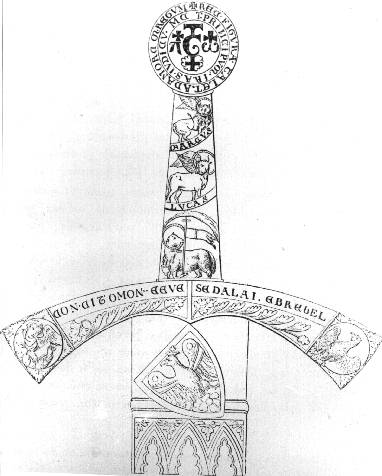
This article treats of various loosely connected facts which may throw some light on historical Rosicrucianism, especially in the context of Poland, though they may as well prove to be just barren speculations. My research along these lines started with the coronation sword of Polish kings known as Szczerbiec (The Jagged Sword) so I will also start with a description of this strange jewel. The legend links it with the first king of Poland, Boleslaus the Brave (ruled 992-1025), who is said to have jagged his sword against the Golden Gate in Kiev on his victorious entry into that city in 1018. However the one which is extant is of later date and does not show any signs of that event, only the name has been transferred to it. The sword is 98 centimetres long and is a piece of ceremonial armoury, most probably made at the end of the 12th century. The most interesting part of it is the hilt which bears some symbols and inscriptions of esoteric character. Starting from the top, the pommel has on one side of it a most curious sigil depicting a big letter T between Greek letters Alpha and Omega each surmounted by a cross. As the authorities have established (on the basis of the shape of the guard) that it is a Templar sword, the letter T may stand for "Templum" or the Order of Knights Templar, who possess the Alpha and Omega of all esoteric knowledge. It may also be noted in passing that the famous sword of Paracelsus had the word AZOTh also on the pommel and it has the same latters with the addition of Z, but this may be a coincidence. What is much more interesting is the small cross below the T, which is usually described a "a cross surrounded by a cloud". However, when I inspected the original on exhibition in Cracow, I found out with considerable surprise that it does not really look like a cloud but rather like a flower, with exactly twelve petals, three in each quarter (Fig. 3). The number is not only that of the signs of the Zodiac but also the number of petals of Robert Fludd's well-known Rose symbol. Therefore the question arises if this symbol may be considered as an early example of the Rosicrucian emblem and an indication of "Passing on the Torch" between Knights Templar and Rosicrucians. It cannot be given a conclusive answer on the basis of this very slight piece of evidence but it has to be remembered that a connection between the two orders has often been put forward, especially by the 18th century Rosicrucian and Freemasonic writers. It has been stated either that the masonic Rose Croix degree was invented by the Crusaders or that after the suppression of the Order of the Temple the surviving members formed a secret fraternity later known as Rosicrucians. These are only legends, of course, but on the other hand it is quite possible. In fact, from the esoteric point of view, such a connection should be accepted, as otherwise the whole notion of "tradition" would become meaningless.
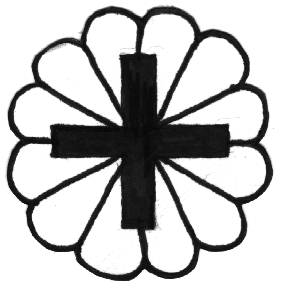
I also believe, and as far as I know nobody has put forward this hypothesis yet, that the very symbol of the Rosy Cross may have originated with the Crusaders in the Holy Land. There was a flower called the Rose of Jericho which the Christian knights in Palestine held in high esteem because of its strange feature, namely its ability to revive after it had been dried, and therefore it was a symbol of resurrection. Curiously enough it is not a rose at all, though it has this name, but belongs to the order called Cruciferae or cruciferous. This latter name is certainly of much later origin but it must have been inspired by some "cross-like" feature common to this order of plants. So it would appear possible that the flower depicted on the pommel of Szczerbiec is the Rose of Jericho, or Cruciferous Rose, or perhaps Rosy Cross, and that it was a symbol adopted by the surviving Templars, who continued the gnostic-hermetic tradition and hoped to 'resurrect' the order in future.
Coming back to the description of the Jagged Sword, around the symbols on the pommel there is an inscription within two rings which says: "Haec figura valet ad amorem regum et principum iras judicam", that is, "This figure serves to love kings and princes who judge contentions". Explanation of this curious phrase is very difficult. It seems to specify the aim which should be pursued by the owners of the sword. The earliest possessors of it are not known and it would be unnecessary to present all the hypotheses here. In short, it was probably made for a member of the royal Piast family, as several of them were involved in the Cruciades at that time and also were connected in one way or another with military orders of knighthood. Most probably it was one of the Silesian princes, as in that region of Poland the Order of the Temple had many possessions. The known history of Szczerbiec starts in 1320, when it was first used for the coronation of the Polish king Ladislaus the Short, who reunited the small appanage divisions after two hundred years. It may be significant that this was shortly after the suppression of Templars. An exciting, though far fetched, hypothesis would be that Polish kings became some sort of hiers to the Order of the Temple. In order to support this conjecture we may be reminded that from that time until the middle of the 17th century Poland (united in a commonwealth with Lithuania) was the greatest European country and one of the most powerful. At the same time she was a country of equality (there were feudal classes, of course, but there was no aristocracy) and tolerance (there have never been religious wars in Poland and it became a shelter for various heretics, Jews and Moslems), which was certainly in the spirit of the Rosicrucian manifestos and later of Freemasonry, and probably also of the Knights Templar. Another significant fact is that when the Jagiellonian dynasty died out and the "period of elected kings" began (the king was chosen by the gentry in a general election), the first one to be elected king of Poland was Henry de Valois, later Henry III, king of France. He was the rightful successor of Philip la Bel, the suppressor of Knights Templar, though from another line of the family. A few months after the election of Henry, he escaped back to France. There were certainly some political reasons for this, but these do not explain why Henry fled from Cracow at night and with only one man accompanying him. Had he perhaps learnt about the Templar oath to revenge Jaques de Molay?
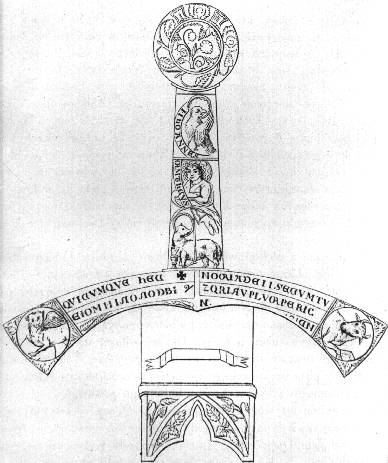
Returning to Szczerbiec again, the reverse side of the pommel bears a floral ornament and the hilt itself, as well as the endings of the guard, show animal symbols of the four Evangelists and the Holy Lamb. These are not of special significance, as they appear very often in the art of the period. The guard, however, has inscriptions on both sides, which seem to be of great interest. On one side it says: "Quicunque haec nomina Dei I secum tulerit, nullum periculum ei omnino nocebit", and on the other: "CON CIT OMON. EEVE SEDALAI EBREBEL". The first inscription is in Latin and means: "Whoever carries these names of God I with him will never suffer from any danger." The "God I" is usually interpreted by historians as the first letter of the Tetragrammaton. The second inscription, however, is very mysterious. In the light of the first one it appears to contain the "names of God I", and, actually, they look like corrupted (or original?) forms of the names of God used in the grimoires of kabbalistic magic. The only attempt at elucidating these words that I could find among scholarly works devoted to the Jagged Sword states that the inscription is in corrupted Hebrew. And so EEVE is interpreted as an abbreviation for the phrase "I am that I am and that is", SEDALAI is "Sadi Eloi", i.e., "God the Omnipotent", and EBREBEL is "Ab Rabi El", i.e., "Father God the Omniscient". This interpretation can be accepted, I think, but the first three words of this inscription are far more difficult to explain. The interpretation I know explains them as abbreviations of either Latin "Cono citare nomina" or Hebrew "Kone Zitu Omon" (meaning "[they] inspire fervent faith"). Both of these are acceptable in this context but also both are rather strained readings. Therefore I thought of trying another, equally strained, interpretation, namely that these are words in the Enochian language. To verify this suggestion is almost impossible due to the fact that too little of Enochian is known, but it has to be remembered that John Dee and Edward Kelley received their specimen of it in Cracow where the Jagged Sword had always been kept. With the help of Dr. Donald C. Laycock's dictionary I found that the word "Om" in Enochian means "understand" or "know", while the suffix "on" signifies (in some cases at least) the Present Perfect tense (e. g. "gohon" = "they have spoken"). The meaning of "CON CIT" in Enochian cannot be established but the whole inscription may refer to those who "have understood" the names of "God I", and therefore define those who are to be the owners of the sword. It may be mentioned that "I" in Enochian is one of the "Filii Lucis" associated with the Sun. This interpretation is far from being convincing but it is useful in that it shows how strained explanations adopted by orthodox scholars can be compared with equally strained and unorthodox ones.
It may also be mentioned here that most of the Polish kings are known to have been interested in one or another of the hermetic sciences. For example, Ladislaus the Varnian (ruled 1434-1444) practiced crystalomancy and his manuscript handbook of it is preserved in the Bodleian Library. The last king of the Jagiellonian dynasty, Sigmund August, was especially noted for his interest in alchemy and magic. He had the second greatest library in Renaissance Europe, a major part of which was connected with the hermetica. In his last will he ordered that some big trunks with books and manuscripts should be burnt after his death, which was done.
On the whole, then, the Jagged Sword used at the coronation of almost all Polish kings seems to have considerable esoteric significance, besides its artistic value. It is a ceremonial sword of the Knights Templar, bearing a proto-Rosicrucian symbol and inscriptions indicative of its magical character.
I wrote about the possible connections of Michael Sendivogius, the great Polish alchemist, with early Rosicrucians in The Hermetic Journal No.15, but there are also some other facts referring to the Polish Rosicrucians. Their activities seem to have been centred in Gdansk (Danzig) where an early Rosicrucian apology was published in 1615. This was Echo der von Gott hocherleuchteten Fraternitet, des loblichen Ordens R.C., by Julius Sperber, and is especially interesting because it presents Rosicrucianism in the occult/hermetic context, which has become connected with it ever since. As this book was published in 1615, i.e., a year after the Fama and in the same year as the Confessio, it may even be considered to be a part of the same plot. In that case we would have to accept the existence of the Rosicrucian Order as an organisation having representatives in various parts of Europe. Though this is by no means certain, it is not completely impossible. Christopher McIntosh mentions a report of a Rosicrucian order working on alchemical lines which existed in 1622 in the Hague and several other cities including Gdansk. Probably the same order was described by Peter Mormius as active as early as 1620 and also preoccupied with alchemy. Significantly it was called the Golden Rosy Cross, the name of the later alchemically orientated organisation connected with Freemasonry in the 18th century. It seems possible that the alchemical organisation with lodges or centres in Gdansk and other cities was an offshoot of the original Fraternity or that it was a group founded during the "Rosicrucian craze" following the publication of the Fama and Confessio, due to the difficulties in contacting the original fraternity. In the latter case the founder (or one of them) may well have been Julius Sperber, mentioned above.
The Rosicrucian group in Gdansk continued to publish books until the late 17th century, among which were, for example, the works of Geber and Chemia Philosophica by Jacob Barner. One of the most interesting items published by them was Ein ausfuhrlicher Bericht von der Ersten Tinctur-Wurtzel... (1681) by Wincenty Kowski or Koffski. It was a German translation of the work previously published in Latin as Tractatus de prima materia veterum lapidis philosophorum in the collection Thesaurinella olympica aurea tripartita, edited and introduced by Benedictus Figulus (Frankfurt, 1608). According to some accounts Figulus in his introduction alludes to a secret association of alchemists, but this is not of main interest here. Much more interesting is his account of the life of Wincenty Kowski, about whom nothing is known from other sources. Figulus states that he was born in Poznan, became a Dominican monk in a monastery in Gdansk and was an alchemist (from other sources it is known that Dominican monasteries were centres of alchemical practices). He wrote his Tractatus de prima materia at the end of his life, having finished it on May 3rd, 1488, and died in the same year. Before his death he had bricked it up in the wall of his cell. It was discovered on August 14th, 1588 and published in 1608. There would be nothing special about the story if a series of coincidences did not appear. First of all, we have Gdansk again mentioned as the place where the tract had been found (though it was first published in Frankfurt-am-Mein); it was then translated by the Rosicrucians of Gdansk into German, and finally the period of time from the death of its author to its publication was exactly 120 years, the same period that elapsed from the death of Christian Rosenkreutz to the opening of his tomb. As the whole story was printed long before the Fama, it may indicate the existence of a certain tradition which surfaced in different guises and in different places. Perhaps it may be connected with the work of Simon Studion, as some authors suggest, or it may point to the existence of an alchemical/hermetic organisation of a Rosicrucian character before the Fama and Confessio were circulated. It should also be mentioned that Kowski's tract is a short work (12 pages) and deals with "mystical" alchemy using allegorical language, and therefore is in line with what is generally termed "Rosicrucianism".
There is little more that can be said about the early phase of the Rosicrucian movement in Poland, as no printed sources are available. It is possible that Cracow was another centre of the order's activity, as it was the capital of the country and a university town. Paracelsian alchemy was intensely studied there and his books were published, and even Paracelsus himself visited the place on various occasions, as he had friends and patients there (especially the Boner family, Wojciech Baza and Dawid Mayer). Interestingly, Paracelsus also visited Gdansk at least once. Anyway, the Rosicrucian issue must have been well known and spoken about shortly after the publication of the manifestos before the order is mentioned in a satirical poem Theatrum diabolorum by Jan Borawski, published in Cracow in 1621. It mentions the Rosicrucian fraternity and its apothecary-alchemist falsifying all remedies and being drowned in hell ("Te solum fratrum rosae crucis...."). It may also be remembered, without going into detail, that Comenius (Jan Amos Komensky), who is frequently believed to have been connected with the Rosicrucians, spent most of his life in Poland, in the town of Leszno.
The next phase of the history of Rosicrucianism, that of the Gold and Rosy Cross, started with the publication of Die wahrhafte und volkommene Bereitung... by Sincerus Renatus or Sigmund Richter in 1710. It is significant that it was based mainly on the works of Julius Sperber of Gdansk and Michael Maier, who connects it with Michael Sendivogius, admired by Maier. However, the name of the Order of the Golden and Rosy Cross had already appeared in the 1620's and was also connected with alchemy. Therefore it may be assumed that the 18th century order was a continuation of the earlier one which had been active in the Hague, Gdansk and other cities. Another interesting lead for the history of Polish Rosicrucianism can be found in Der Rosenkreutzer in seiner Blosse by Magister Pianco or Baron Ecker or Eckhoffen, which contains a strange table purporting to reveal the secrets of the order. The table was partly reprinted in M.P. Hall's edition of D.O.M.A. and it contains, among other things, "Assembly places" for members of each degree. There are some places in Poland named for some degrees, namely "Camra in Poland" (which I could not identify) for the Magistri 2,8 degree; Krolewiec, Szczecin and Gdansk (Konigsberg, Stettin and Danzig) for the Minores 5,5 degree; Cracow, Wroclaw (Breslau) and Warsaw for the Philosophi 6,4 degree. Of course it is not sure that the information given by Magister Pianco is true, but even if it is not, it proves that Rosicrucianism was associated with Poland in the 18th century.
When the Order of the Gold and Rosy Cross was "masonised" and actually became one of the numerous rites of Freemasonry, it also had lodges or "circles" in Poland, especially in Warsaw. This stream of Rosicrucianism was probably introduced in Poland by Jean Luc Louis de Toux de Salvarte, a masonic adventurer who travelled all over Europe before he came to stay in Warsaw in 1749. Before that he had been initiated into the highest degrees of the Gold and Rosy Cross Order in Vienna in 1741. Among the later members were: the last king of Poland, Stanislaw August Poniatowski, his brother Kazimierz Poniatowski, Josef Jerzy Hylzen, who was also the chairman of the Sublime Scottish Council of the Grand Orient of Poland, Samuel Okraszewski, a chemist who made experiments with balloon flights, and Karol Henryk Heyking, one of the most important figures in Polish Freemasonry. Near the end of the 18th century the master of Polish Rosicrucians with the title of "Justitiarius" was Count Karol Adolf Bruhl, known in the Order as Frater Oscarus. An important and influential member was Count August Moszynski, a magnate and alchemist, who had a laboratory in his palace in Warsaw and conducted alchemical experiments financed by King Stanislaw August Poniatowski. He is also known as the person who exposed the frauds of Cagliostro when the latter visited Warsaw in 1780.
There is almost nothing known about the Rosicrucians in Poland during the 19th century. There were a number of people interested in alchemy, as for example Jozef Bohdan Dziekonski, who wrote a novel about Michael Sendivogius and the Rosicrucian Fraternity (published in 1843), in many ways similar to Bulwer Lytton's Zanoni. There were also Polish patrons of Eliphas Levi (Count Branicki and Count Mniszech), a member of Soc. Ros. in Anglia and the Golden Dawn (Dr. Edward Bogdan Jastrzebski), and other later connections, but it is doubtful whether these were within the true "Rosicrucian succession". As far as the problem of "succession" is concerned, it seems to me that there may be three possibilities to be taken into account: (1) that there were two distinct organisations using similar names, one of which was concerned with "universal reformation" in the spirit of various Utopias (this was probably very loosely organised and would include Andreae and his circle, Comenius, etc.), while the other was concerned with alchemy and the hermetic philosophy and included among its members Julius Sperber, Michael Maier, Michael Sendivogius, Robert Fludd, and others; (2) that these were two branches of the same organisation, the alchemical branch being called "Golden" to distinguish itself; (3) that there was only one order devoted to the study of alchemy and the hermetic/gnostic tradition, while the Fama, Confessio and the Chymical Wedding were a joke played by Andreae on the real Rosicrucian fraternity. The third possibility, as far as I am aware, has never been suggested, and it seems to me the most logical explanation of the whole mystery, especially as it is confirmed by Andraea himself who said that he had written the Chymical Wedding as a satire. He may have learnt about the existence of a secret association of people with rather doubtful beliefs and tried to combat it by issuing the manifestos in their name, not expecting that these would be taken seriously by the public.